-
A behavioral design pattern:
Makes it possible to add new operations to pre-existing classes without changing them.
-
separate algorithms from the objects
-
- A behavioral pattern: - Allows you to add new operations to a group of related classes - without modifying their structures.
- It is particularly useful when you have a stable set of classes but need to perform various operations on them,
- making it easy to extend functionality without altering the existing codebase.

Components of Visitor Design Pattern:
- This interface declares a visit method for each type of element in the object structure.
- Each method is designed to handle a specific element type.
- This class implements the Visitor interface.
- provides the specific behavior for each visit method.
- It contains the logic for the operations that need to be performed on the elements.
- This interface defines an accept method that takes a visitor as an argument.
- This method allows the visitor to visit the concrete elements.
- These classes implement the Element interface and
- represent the various types of objects in the structure.
- Each concrete element defines how it accepts a visitor by calling the corresponding method on the visitor.
- This is the collection of elements (the concrete elements) that the visitor will operate on.
- It often includes methods to add, remove, and retrieve elements.

- Declares a set of visiting methods that can take concrete elements of an object structure as arguments.
- These methods may have the same names if the program is written in a language that supports overloading, but the type of their parameters must be different.
- Implements several versions of the same behaviors, tailored for different concrete element classes.
- Declares a method for “accepting” visitors.
- This method should have one parameter declared with the type of the visitor interface.
- Implements the acceptance method.
- The purpose of this method is to redirect the call to the proper visitor’s method corresponding to the current element class.
- Be aware that even if a base element class implements this method, all subclasses must still override this method in their own classes and call the appropriate method on the visitor object.
- Usually represents a collection or some other complex object (for example, a Composite tree).
- Usually, clients aren’t aware of all the concrete element classes because they work with objects from that collection via some abstract interface.
- separate algorithms from the objects
- This pattern keeps operations separate from the objects themselves, making it easier to manage and understand the code.
- You can introduce new operations simply by creating new visitor classes without changing the existing objects. This makes the system flexible.
- All the operations are in one place (the visitor), which helps you see how different tasks interact with your objects.
- If you need to update or fix something, you can do it in the visitor class without touching the object classes, making maintenance simpler.
- Each visitor method is specific to an object type, which helps catch errors early and ensures the right operations are applied.
- Use the Visitor: when you need to perform an operation on all elements of a complex object structure (for example, an object tree).
lets you execute an operation over a set of objects with different classes by having a visitor object implement several variants of the same operation, which correspond to all target classes.
- Use the Visitor: to clean up the business logic of auxiliary behaviors.
lets you make the primary classes of your app more focused on their main jobs by extracting all other behaviors into a set of visitor classes.
- Use the pattern: when a behavior makes sense only in some classes of a class hierarchy, but not in others.
You can extract this behavior into a separate visitor class and implement only those visiting methods that accept objects of relevant classes, leaving the rest empty.
Source: Tutorial Point Dart Code: link
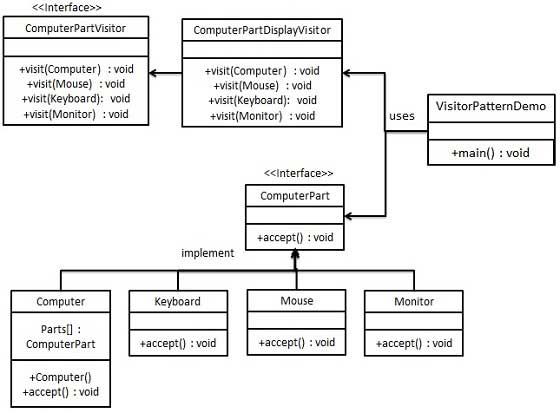
- Source: Geeks for Geeks
- Dart Code: link
- Source: refactoring.guru java example
- Dart Code: link
The Visitor design pattern is a behavioral pattern that allows you to add new operations to a group of related classes without modifying their structures. It is particularly useful when you have a stable set of classes but need to perform various operations on them, making it easy to extend functionality without altering the existing codebase.