-
Write a program to find the node at which the intersection of two singly linked lists begins.
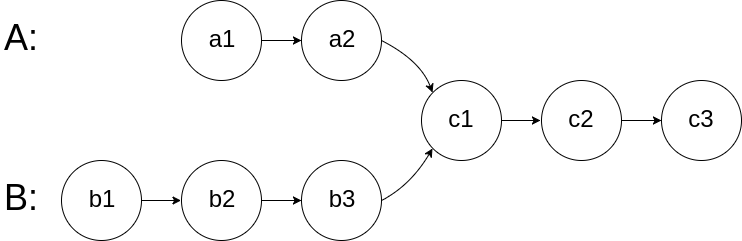
For example, the following two linked lists:
begin to intersect at node c1.
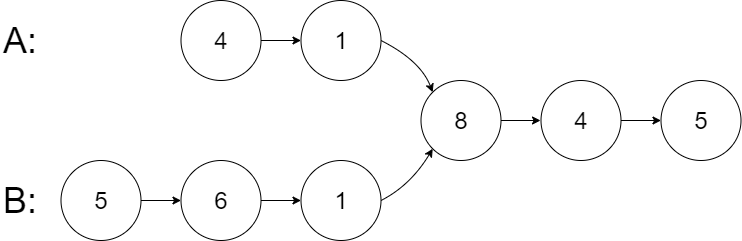
Example 1:
Input: intersectVal = 8, listA = [4,1,8,4,5], listB = [5,6,1,8,4,5], skipA = 2, skipB = 3
Output: Reference of the node with value = 8
Input Explanation: The intersected node's value is 8 (note that this must not be 0 if the two lists intersect). From the head of A, it reads as [4,1,8,4,5]. From the head of B, it reads as [5,6,1,8,4,5]. There are 2 nodes before the intersected node in A; There are 3 nodes before the intersected node in B.
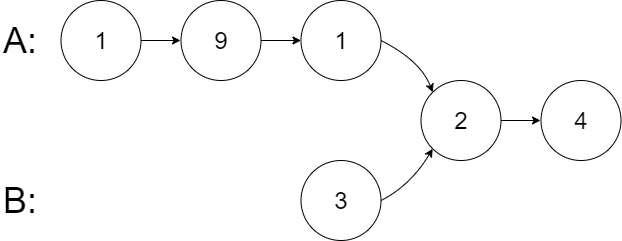
Example 2:
Input: intersectVal = 2, listA = [1,9,1,2,4], listB = [3,2,4], skipA = 3, skipB = 1
Output: Reference of the node with value = 2
Input Explanation: The intersected node's value is 2 (note that this must not be 0 if the two lists intersect). From the head of A, it reads as [1,9,1,2,4]. From the head of B, it reads as [3,2,4]. There are 3 nodes before the intersected node in A; There are 1 node before the intersected node in B.
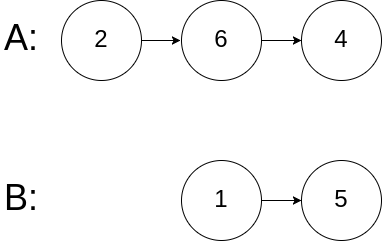
Example 3:
Input: intersectVal = 0, listA = [2,6,4], listB = [1,5], skipA = 3, skipB = 2
Output: null
Input Explanation: From the head of A, it reads as [2,6,4]. From the head of B, it reads as [1,5]. Since the two lists do not intersect, intersectVal must be 0, while skipA and skipB can be arbitrary values.
Explanation: The two lists do not intersect, so return null.
Notes:
- If the two linked lists have no intersection at all, return
null. - The linked lists must retain their original structure after the function returns.
- You may assume there are no cycles anywhere in the entire linked structure.
- Each value on each linked list is in the range
[1, 10^9]. - Your code should preferably run in O(n) time and use only O(1) memory.
- If the two linked lists have no intersection at all, return
/**
 * Definition for singly-linked list.
 * public class ListNode {
 *     int val;
 *     ListNode next;
 *     ListNode(int x) {
 *         val = x;
 *         next = null;
 *     }
 * }
 */
public class Solution {
    public ListNode getIntersectionNode(ListNode headA, ListNode headB) {
        //create a set collection
        Set<ListNode> set = new HashSet<>();
        while(headA != null){
            set.add(headA);
            headA = headA.next;
        }
        while(headB != null){
            if(set.contains(headB))
                return headB;
            headB = headB.next;
        }
        return null;
    }
}public class Solution {
public ListNode getIntersectionNode(ListNode headA, ListNode headB) {
if(headA == null || headB == null)
return null;
Stack<ListNode> stack1 = new Stack<ListNode>();
Stack<ListNode> stack2 = new Stack<ListNode>();
ListNode peek = null;
while(headA != null){
stack1.push(headA);
headA = headA.next;
}
while(headB != null){
stack2.push(headB);
headB = headB.next;
}
while(!stack1.empty() && !stack2.empty() && stack1.peek() == stack2.peek()){
peek = stack1.peek();
stack1.pop();
stack2.pop();
}
return peek;
}
}public class Solution {
public ListNode getIntersectionNode(ListNode headA, ListNode headB) {
if(headA == null || headB == null)
return null;
int lengthA = ListLength(headA);
int lengthB = ListLength(headB);
while(lengthA != lengthB){
if(lengthA > lengthB){
headA = headA.next;
lengthA--;
}else{
headB = headB.next;
lengthB--;
}
}
while(headA != headB){
headA = headA.next;
headB = headB.next;
}
return headA;
}
private int ListLength(ListNode list){
int length = 0;
while(list != null){
length++;
list = list.next;
}
return length;
}
}public class Solution {
public ListNode getIntersectionNode(ListNode headA, ListNode headB) {
if(headA == null || headB == null)
return null;
ListNode A = headA;
ListNode B = headB;
while(A != B){
A = A == null ? headB : A.next;
B = B == null ? headA : B.next;
}
return A;
}
}