LINK:189. 轮转数组
给定一个整数数组 nums,将数组中的元素向右轮转 k 个位置,其中 k 是非负数。
示例 1:
输入: nums = [1,2,3,4,5,6,7], k = 3
输出: [5,6,7,1,2,3,4]
解释:
向右轮转 1 步: [7,1,2,3,4,5,6]
向右轮转 2 步: [6,7,1,2,3,4,5]
向右轮转 3 步: [5,6,7,1,2,3,4]
示例 2:
输入:nums = [-1,-100,3,99], k = 2
输出:[3,99,-1,-100]
解释:
向右轮转 1 步: [99,-1,-100,3]
向右轮转 2 步: [3,99,-1,-100]
提示:
1 <= nums.length <= 105-231 <= nums[i] <= 231 - 10 <= k <= 105
进阶:
- 尽可能想出更多的解决方案,至少有 三种 不同的方法可以解决这个问题。
- 你可以使用空间复杂度为
O(1)的 原地 算法解决这个问题吗?
Given an integer array nums, rotate the array to the right by k steps, where k is non-negative.
Example 1:
Input: nums = [1,2,3,4,5,6,7], k = 3
Output: [5,6,7,1,2,3,4]
Explanation:
rotate 1 steps to the right: [7,1,2,3,4,5,6]
rotate 2 steps to the right: [6,7,1,2,3,4,5]
rotate 3 steps to the right: [5,6,7,1,2,3,4]
Example 2:
Input: nums = [-1,-100,3,99], k = 2
Output: [3,99,-1,-100]
Explanation:
rotate 1 steps to the right: [99,-1,-100,3]
rotate 2 steps to the right: [3,99,-1,-100]
Constraints:
1 <= nums.length <= 105-231 <= nums[i] <= 231 - 10 <= k <= 105
Follow up:
- Try to come up with as many solutions as you can. There are at least three different ways to solve this problem.
- Could you do it in-place with
O(1)extra space?
这一题做的时候思路比较清晰,用了Python的切片来旋转数组,自己的代码如下,可惜只想到这一种解法,题解中的其他方法还有待学习
from typing import List

class Solution:
    def rotate(self, nums: List[int], k: int) -> None:
        n = len(nums)
        k = k % n
nums[:] = nums[n-k:] + nums[:n-k]使用额外的数组来将每个元素放至正确的位置。
class Solution {
public:
    void rotate(vector<int>& nums, int k) {
        int n = nums.size();
        vector<int> newArr(n);
        for (int i = 0; i < n; ++i) {
            newArr[(i + k) % n] = nums[i];
        }
        nums.assign(newArr.begin(), newArr.end());
    }
};var rotate = function(nums, k) {
const n = nums.length;
const newArr = new Array(n);
for (let i = 0; i < n; ++i) {
newArr[(i + k) % n] = nums[i];
}
for (let i = 0; i < n; ++i) {
nums[i] = newArr[i];
}
};根据题解仿写如下Python代码
from typing import List

class Solution:
    def rotate(self, nums: List[int], k: int) -> None:
        n = len(nums)
        newArr = [0] * n  # 创建一个与 nums 相同大小的新列表,并初始化为 0
        for i in range(n):
            newArr[(i + k) % n] = nums[i]  # 将每个元素移动到正确的位置
nums[:] = newArr # 将新列表的内容复制回原列表,实现原地修改nums = [1, 2, 3, 4, 5, 6]
k = 2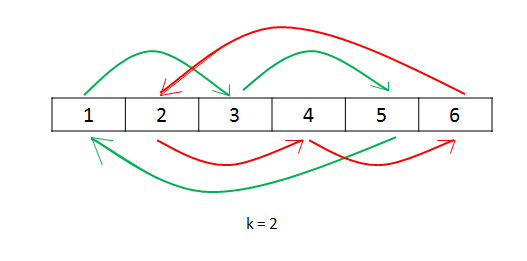
class Solution {
public:
    void rotate(vector<int>& nums, int k) {
        int n = nums.size();
        k = k % n;
        int count = gcd(k, n);
        for (int start = 0; start < count; ++start) {
            int current = start;
            int prev = nums[start];
            do {
                int next = (current + k) % n;
                swap(nums[next], prev);
                current = next;
            } while (start != current);
        }
    }
};const gcd = (x, y) => y ? gcd(y, x % y) : x;
var rotate = function(nums, k) {
const n = nums.length;
k = k % n;
let count = gcd(k, n);
for (let start = 0; start < count; ++start) {
let current = start;
let prev = nums[start];
do {
const next = (current + k) % n;
const temp = nums[next];
nums[next] = prev;
prev = temp;
current = next;
} while (start !== current);
}
};仿照写的Python如下
from typing import List
from math import gcd  # 引入gcd函数计算最大公约数

class Solution:
    def rotate(self, nums: List[int], k: int) -> None:
        n = len(nums)
        k = k % n  # 确保k不大于n
        count = gcd(k, n)  # 计算k和n的最大公约数,以确定需要遍历的环数

        for start in range(count):
            current = start
            prev = nums[start]
            while True:
                next_idx = (current + k) % n  # 计算下一个要替换的位置
                nums[next_idx], prev = prev, nums[next_idx]  # 交换元素
                current = next_idx  # 更新当前位置
                if start == current:  # 如果环回到起点,则结束当前环的替换
break**LINK:**https://leetcode.com/problems/rotate-array/discuss/54250/Easy-to-read-Java-solution
这个方法太巧妙了,下面这个解释写的很清晰
nums = "----->-->"; k =3
result = "-->----->";

reverse "----->-->" we can get "<--<-----"
reverse "<--" we can get "--><-----"
reverse "<-----" we can get "-->----->"
this visualization help me figure it out :)class Solution {
public:
void reverse(vector<int>& nums, int start, int end) {
while (start < end) {
swap(nums[start], nums[end]);
start += 1;
end -= 1;
}
}
void rotate(vector<int>& nums, int k) {
k %= nums.size();
reverse(nums, 0, nums.size() - 1);
reverse(nums, 0, k - 1);
reverse(nums, k, nums.size() - 1);
}
};const reverse = (nums, start, end) => {
while (start < end) {
const temp = nums[start];
nums[start] = nums[end];
nums[end] = temp;
start += 1;
end -= 1;
}
}
var rotate = function(nums, k) {
k %= nums.length;
reverse(nums, 0, nums.length - 1);
reverse(nums, 0, k - 1);
reverse(nums, k, nums.length - 1);
};仿照写的Python如下
from typing import List

class Solution:
    def reverse(self, nums: List[int], start: int, end: int) -> None:
        while start < end:
            nums[start], nums[end] = nums[end], nums[start]  # 交换元素
            start, end = start + 1, end - 1  # 更新索引

    def rotate(self, nums: List[int], k: int) -> None:
        n = len(nums)
        k %= n  # 确保k不大于数组长度

        # 翻转整个数组
        self.reverse(nums, 0, n - 1)
        # 翻转前k个元素
        self.reverse(nums, 0, k - 1)
        # 翻转剩余的元素
        self.reverse(nums, k, n - 1)