Circular Linked List append and prepend method
Append - Add the Node from end of list
Prepend - Add the Node from front of the list
Circular Linked Lists -- Remove Node
It will remove the Node from the list
Circular Linked Lists -- Split List
It will split the Circular Linked List into two Circular Linked List
Circular Linked Lists -- Josephus Problem
Josephus problem will remove every node from the given Circular Linked List of the given step until only one Node left in the list

Example:

Circular Linked List :
                        1
                        2
                        3
                        4
                        5
                        6

step = 2

so the step start from head of the list

2 is Node where step meet
remove : 2

4 is Node where step meet
remove : 4

6 is Node where step meet
remove : 6

since, it is cicular linked list it will circular again and remove the step Node until only one Node left

3 is Node where step meet
remove : 3

Only one Node left : which is 5
Circular Linked Lists -- Is Circular Linked List

It will check the list which is given is circular or not

we can check this by giving Singly and Doubly linked list to verify Circular Linked List
Given head, the head of a linked list, determine if the linked list has a cycle in it.
There is a cycle in a linked list if there is some node in the list that can be reached again by continuously following the next pointer. Internally, pos is used to denote the index of the node that tail's next pointer is connected to. Note that pos is not passed as a parameter.
Return true if there is a cycle in the linked list. Otherwise, return false.
Example 1:
Input: head = [3,2,0,-4], pos = 1
Output: true
Explanation: There is a cycle in the linked list, where the tail connects to the 1st node (0-indexed).
Example 2:
Input: head = [1,2], pos = 0
Output: true
Explanation: There is a cycle in the linked list, where the tail connects to the 0th node.Example 3:
Input: head = [1], pos = -1
Output: false
Explanation: There is no cycle in the linked list.This problem requires detecting whether a linked list has a cycle. A cycle occurs when a node's next pointer points back to a previous node, creating a loop.
-
Why This Approach?
We detect the cycle using Floyd’s Tortoise and Hare Algorithm (a two-pointer technique). This method is both efficient and elegant — it doesn't require extra space like hash sets and detects cycles in
O(n)time withO(1)space. -
Problem-Solving Pattern
- Two Pointer (Fast and Slow Pointers) — a classic approach used for cycle detection in linked lists.
- Hashing (Method 2) — an alternative approach that uses extra space but is easier to understand for beginners.
-
We will walk through Floyd's Cycle Detection Algorithm using the input:
Input: [3, 2, 0, -4], pos = 1
-
This means the list looks like:
3 → 2 → 0 → -4and-4.next = 2(cycle starts at node 2). -
Iteration Table
Step Slow Pointer Fast Pointer Notes 0 3 (head) 3 (head) Both pointers start at head 1 2 0 slow = slow.next, fast = fast.next.next 2 0 2 moving further 3 -4 -4 Both meet → Cycle detected -
When
slow == fast, a cycle is confirmed.
| Method | Time Complexity | Space Complexity | Explanation |
|---|---|---|---|
| Two Pointer (Floyd) | Fast and slow pointer traversal | ||
| Hashing | Store each node in a set |
- Best Practice: Use Floyd’s algorithm for efficient constant space solution.
- Alternative: Hashing can be useful when clarity is more important than optimal space.
Given the head of a linked list, return the node where the cycle begins. If there is no cycle, return null.
There is a cycle in a linked list if there is some node in the list that can be reached again by continuously following the next pointer. Internally, pos is used to denote the index of the node that tail's next pointer is connected to (0-indexed). It is -1 if there is no cycle. Note that pos is not passed as a parameter.
Do not modify the linked list.
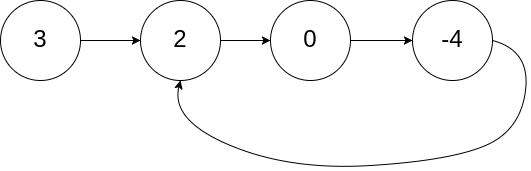
Example 1:

Input: head = [3,2,0,-4], pos = 1
Output: tail connects to node index 1
Explanation: There is a cycle in the linked list, where tail connects to the second node.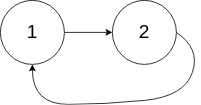
Example 2:

Input: head = [1,2], pos = 0
Output: tail connects to node index 0
Explanation: There is a cycle in the linked list, where tail connects to the first node.
Example 3:

Input: head = [1], pos = -1
Output: no cycle
Explanation: There is no cycle in the linked list.This problem requires us to detect the starting node of a cycle in a linked list, if it exists. The solution must efficiently identify the cycle without modifying the list or using extra space.
-
Why This Approach
Iv'e used Floyd’s Cycle Detection Algorithm (also called the Tortoise and Hare algorithm). It efficiently detects the presence of a cycle and determines its starting node with:
- O(n) time complexity
- O(1) space complexity
- No modifications to the linked list structure
-
Pattern Used
- Fast and Slow Pointer Technique (Two-Pointer Technique)
This is a classic technique for detecting cycles in linked structures.
-
How This Approach Works
Floyd’s Cycle Detection Algorithm works in two phases:
- Phase 1: Detect whether a cycle exists using two pointers:
slow(moves 1 step) andfast(moves 2 steps). If a cycle exists, they will meet inside the cycle. - Phase 2: Once a cycle is detected, place one pointer (
p) at the head and move bothpandslowone step at a time. They will meet at the starting point of the cycle.
After they meet in the loop, starting one pointer from head and one from the meeting point — both moving 1 step at a time — will always meet at the start of the cycle.
- Phase 1: Detect whether a cycle exists using two pointers:
-
Let's use the input:
head = [3, 2, 0, -4], withpos = 1. That means the tail connects back to the node with value2. -
Linked List Structure (Cycle Exists)
3 -> 2 -> 0 -> -4 ↑ ↓ ← ← ← ← ← -
Step-by-Step Execution Table
Step slowvaluefastvaluePhase 1 3 3 Init 2 2 0 Moving 3 0 2 Moving 4 -4 -4 Meeting Point (Cycle Detected) -
We now place
p = head = 3, and move bothpandslowone step at a time.Step pvalueslowvalueComment 1 3 -4 2 2 2 Cycle begins here
| Complexity Type | Value | Explanation |
|---|---|---|
| Time Complexity | Each pointer traverses the list at most twice. | |
| Space Complexity | No extra space is used except pointers. |