


Citation / Interaction Types / Data Definitions / Included Resources / Data Issues / Summary
vampire-moth-dwca is a repository for specimen occurrence data about vampire moths and their fruit-piercing relatives (Lepidoptera: Erebidae: Calyptra spp.). The feeding observations are from the specimens.
Workflow
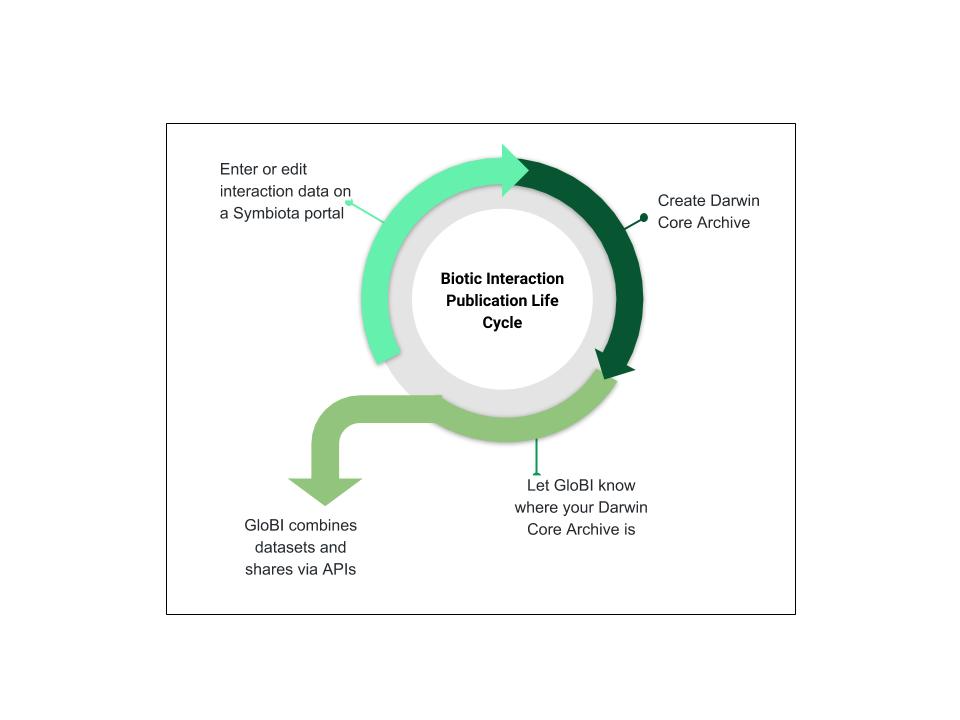
Edit on Symbiota -> create Darwin Core Archive -> let GloBI know where the Darwin Core Archive lives
All of the fields in the occurrences.csv dataset was produced by entering data in presently available fields in Symbiota (September 28, 2018). The records were entered or edited by a person using the occurrence editor pages in the portal, which has both DWC:associatedTaxa and DWC:dynamicProperties available to edit as free text. Once the records were entered, a Darwin Core Archive was created using the Symbiota Darwin Core Archive publishing tool and the files from that publication are directly uploaded to the GitHub repository. The contents of a Symbiota Darwin Core Archive file were uploaded to GitHub. To propagate any additions or changes to GloBI a new DWC Archive is published and the new version of the files are uploaded to GitHub.
Entering Data in Symbiota
Biotic interaction data can be entered through the DWC:dynamicProperties and DWC:associatedTaxa fields.
DWC:associatedTaxa is "A list (concatenated and separated) of identifiers or names of taxa and their associations with the Occurrence." The TDWG recommended best practice is to "separate the values with a vertical bar (' | '), and to separate the relationship from the taxon with a colon (':'). Examples: "host: Quercus alba", "parasitoid of:Cyclocephala signaticollis | predator of Apis mellifera".
The interactions are not explicitly defined, meaning that the word "host" or "eats" could have different meanings in different datasets because a definition of the word is not included. This is where the DWC:dynamicProperties becomes useful.
DWC:dynamicProperties is a "list of additional measurements, facts, characteristics, or assertions about the record. Meant to provide a mechanism for structured content", and that structured content for biotic interactions could include the explict identifiers for the details of the interaction.
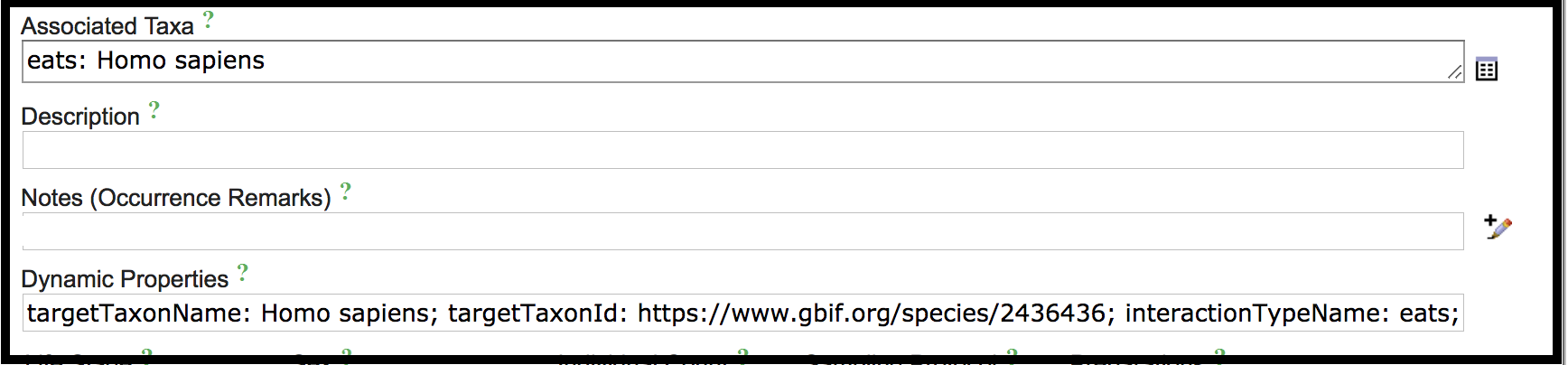
Key:value formatted data entered into DWC:dynamicProperties in the above examples are:
targetTaxonName: Homo sapiens;
targetTaxonId: https://www.gbif.org/species/2436436;
interactionTypeName: eats;
interactionTypeId: http://purl.obolibrary.org/obo/RO_0002470;
targetBodyPartName: blood;
targetBodyPartId: http://purl.obolibrary.org/obo/NCIT_C12434
Key:value formatted data entered into DWC:associatedTaxa in the above examples are:
eats: Homo sapiens
Publish Darwin Core Archive
Symbiota comes with the tools to publish your data into a Darwin Core Archive. Publish your data and make it live.
Let GloBI Know Where Your Dataset Is
You can let GloBI know where your Darwin Core Archive RSS feed is online by opening up an issue or choose one of the other methods of sharing your data on the GloBI contribute page. Symbiota creates the RSS feed when the archive is created (ex. UCSB RSS Feed: https://symbiota.ccber.ucsb.edu:443/webservices/dwc/rss.xml)
Jennifer Zaspel. 2018. Biotic species interactions manually extracted from occurrence records.
The kinds of biotic species interactions in this dataset are mapped to terms in the Relations Ontology (RO). Classes to describe interactions in the RO (and other ontologies) can be searched through the Ontobee.
| interactionTypeName | interactionTypeId |
|---|---|
| eats | http://purl.obolibrary.org/obo/RO_0002470 |
The definitions of the keys from the key:value pairs that are used in DWC:dynamicProperties field in the occurrences.csv dataset are described in this document. This is not an exaustive list of classes to describe the interactions, only the ones that were used in this dataset.
- A sourceTaxonId DWC:scientificNameID : An identifier for the nomenclatural (not taxonomic) details of a scientific name.
- A sourceTaxonName DWC:scientificName : The lowest level taxonomic rank that can be determined.
- A interactionTypeId : Identifier for the interaction type.
- A interactionTypeName : A interaction type (ex. eats, piercing). The name of the interaction type should be the name as it is listed in the original text, which is not always the name of the term it is mapped to. As long as the definition to the mapping is compatible with the
interactionTypeName, it is usable as ainteractionTypeId. - A targetBodyPartName : The specific name of the target body part. The name of the body part should be the name as it is listed in the original text, which is not always the name of the term it is mapped to. As long as the definition to the mapping is compatible with the
targetBodyPartName, it is usable as atargetBodyPartId. - A targetBodyPartId : Identifer for the body part name.
- A targetTaxonId DWC:scientificNameID : An identifier for the nomenclatural (not taxonomic) details of a scientific name.
- A targetTaxonName DWC:scientificName : The lowest level taxonomic rank that can be determined.
Darwin Core Archive created by the UC Santa Barbara Symbiota Portal
Several issues and decisions arose while translating the observations from the literature into a series of single observations. These issues are detailed in the GitHub issues for this project and also described here.
- Invalid date strings according to TDWG and GloBI. The date strings like
2008-00-20are entered in DWC:eventDate. TDWG suggests that dates without months or days are entered without the zeros (ex. 1906-06). In this specific case, where the month is not known, the DWC:eventDate could include only the year (ex. 2008) and DWC:startDayOFYear be entered for the day of year. - Dynamic properties not in JSON format. It is recommended best practice for DWC:dynamicProperties to be in JSON format. The decision was made to include as key:value pairs only because the information was entered by a human into the field, rather than coming from an application. This creates a strong likelihood that errors in the JSON formatting are introduced. Validation checks in Symbiota could help with formatting this field.
- Only records with
DWC:associatedTaxaorDWC:dynamicPropertiesare indexed by GloBI. GloBI does not store all of the records in occurrence dataset. - GloBI is using the EML to obtain attribution information. It is important to have this information filled out, so that attribuiton can be correctly linked to the data records when they are indexed in GloBI, and it will act as the reference for the interactions. Ideally, individual occurrence records would have a resolving link back to the reference, which would also serve as a way of linking the interactions on GloBI with the rest of the information about the occurrence.
- Interaction data coming from multiple record providers could create duplicate interaction records in GloBI with different citations.
- There is no validation of the information entered in these fields, which increases the change of human error. Improved validation around data format, controlled vocabularies and taxon name verification would improve the data quality.
This dataset can serve as a example of how species interaction data can be formatted directly in a Symbiota portal and shared through GloBI. Only presently available Symbiota data entry fields and other resources are used in this example, and it is the first example of a Darwin Core Archive made directly available through GloBI without further manipulation of the data format. This is not the only way to format interaction data for sharing, but if this format is reused, GloBI can understand the structure of the data.
This example is valuable because it demonstrates that biotic interaction data contained within Darwin Core Archives can be presently shared and integrated into other interaction data through GloBI as long as some effort is put into formatting those data. The data can be entered according to TDWG standards in the DWC:associatedTaxa field, and as key:value pairs in DWC:dynamicProperties by anyone transcribing data into a Symbitota portal and it does not require additional special services or modifications to the software to perform this task successfully.