


Write one .native.dart spec file. Get type-safe Kotlin, Swift, or C++ — all generated.
No method channels. No manual FFI. No boilerplate.
📖 Full docs, live examples, and API reference: nitro.shreeman.dev
| Method Channel | Manual FFI | Nitrogen | |
|---|---|---|---|
| Call overhead | ~107 µs | ~0 µs (floor) | ~0.26 µs (macOS) – ~2.1 µs (Android) |
| Type safety | stringly-typed | hand-written, error-prone | generated from one Dart spec, strict |
| Async | ✅ | manual isolates | ✅ generated (@nitroAsync / @nitroNativeAsync) |
| Streams + backpressure | ✅ slow | manual SendPort plumbing |
✅ zero-copy, 4 backpressure strategies |
| Zero-copy buffers | ❌ | manual Pointer<T> |
✅ @HybridStruct(zeroCopy: [...]), @zeroCopy |
| Desktop (Windows/Linux) | method channel only | manual FFI | ✅ same spec, direct C++ |
| Code you write | a lot, on every platform | enormous, unsafe | 3 files: spec + Kotlin impl + Swift impl (or 1 C++ impl) |
| Package | Role | pubspec.yaml section |
|---|---|---|
nitro |
Runtime — base classes, FFI helpers, codec | dependencies |
nitro_annotations |
All annotations (zero deps, works without Flutter) | dependencies |
nitro_generator |
build_runner code generator | dev_dependencies |
nitrogen_cli |
CLI — init, generate, link, doctor |
dart pub global activate |
# pubspec.yaml
dependencies:
  nitro: ^0.5.7

dev_dependencies:
  nitro_generator: ^0.5.7
  build_runner: ^2.4.0
dart pub global activate nitrogen_cli # one-time| Tool | Minimum version |
|---|---|
| Flutter SDK | 3.22.0+ |
| Dart SDK | 3.3.0+ |
| Android NDK | 26.1+ (r26b) |
| Kotlin | 1.9.0+ |
| iOS Deployment Target | 13.0+ |
| Swift | 5.9+ (Xcode 15+) |
| Xcode | 15.0+ |
| Windows (desktop C++) | Visual Studio 2022 + CMake 3.14+ |
| Linux (desktop C++) | GCC/Clang + CMake 3.10+ |
nitrogen init my_plugin
# Creates a fully-wired Flutter plugin with a starter spec, Kotlin impl, and Swift impl.// lib/src/math.native.dart
import 'package:nitro/nitro.dart';
part 'math.g.dart';
@NitroModule(
lib: 'math',
ios: AppleNativeImpl.swift,
android: AndroidNativeImpl.kotlin,
)
abstract class Math extends HybridObject {
static final Math instance = _MathImpl();
double add(double a, double b);
String greet(String name);
int get precision;
set precision(int value);
}nitrogen generate
# Runs build_runner, then syncs generated files to ios/Classes/ and android/src/Kotlin (android/.../MathImpl.kt):
class MathImpl : HybridMathSpec {
    override fun add(a: Double, b: Double): Double = a + b
    override fun greet(name: String): String = "Hello, $name"
    override var precision: Long = 6
}
Swift (ios/Classes/MathImpl.swift):
class MathImpl: NSObject, HybridMathProtocol {
    func add(a: Double, b: Double) -> Double { a + b }
    func greet(name: String) -> String { "Hello, \(name)" }
    var precision: Int64 = 6
}nitrogen link # wires CMake, Podspec, .clangd
nitrogen doctor # health-check every layerfinal sum = Math.instance.add(3.14, 2.71);
print(Math.instance.greet('World')); // "Hello, World"Running nitrogen with no arguments launches a TUI dashboard covering every command above (init, generate, watch, link, doctor, migrate, clean, update) with live progress, plus one-click Open in VS Code / Open in Antigravity buttons:
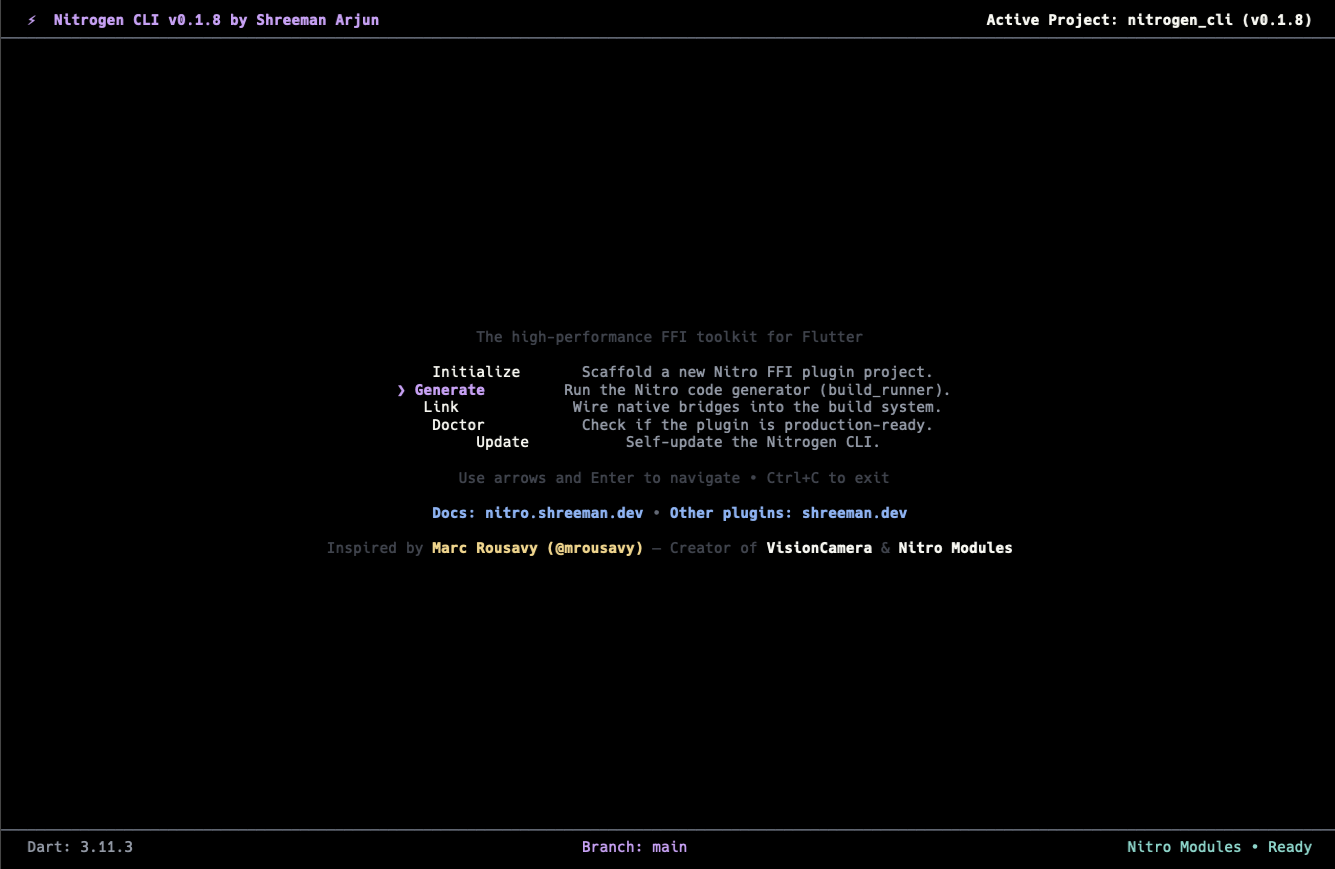

Every command also works headlessly for CI — pass --no-ui, or just pipe the output (non-TTY auto-detects and switches to plain-text [nitro]/[nitro:warn]/[nitro:error] logging):
nitrogen generate --no-ui --fail-on-warn   # exit 2 on spec warnings
nitrogen doctor --no-ui # exit 1 on any health-check error| Platform field | Constant | Bridge | When to use |
|---|---|---|---|
ios: / macos: |
AppleNativeImpl.swift |
Swift @_cdecl |
iOS/macOS platform APIs |
ios: / macos: |
AppleNativeImpl.cpp |
Direct C++ | Shared C++ logic |
android: |
AndroidNativeImpl.kotlin |
Kotlin JNI | Android platform APIs |
android: |
AndroidNativeImpl.cpp |
Direct C++ | Shared C++ logic |
windows: |
WindowsNativeImpl.cpp |
Direct C++ | Windows desktop |
linux: |
LinuxNativeImpl.cpp |
Direct C++ | Linux desktop |
web: |
WebNativeImpl.wasm |
WASM/JS interop | Web |
NativeImpl.swift, .kotlin, .cpp, .wasm are backward-compatible shorthands. The explicit per-platform constants catch invalid combinations (e.g. Kotlin on macOS) at compile time.
When both ios: and android: use *NativeImpl.cpp, a single C++ class serves all platforms with no JNI or Swift shim:
@NitroModule(
  lib: 'math',
  ios: AppleNativeImpl.cpp,
  android: AndroidNativeImpl.cpp,
  macos: AppleNativeImpl.cpp,
  windows: WindowsNativeImpl.cpp,
  linux: LinuxNativeImpl.cpp,
)
abstract class Math extends HybridObject {
  static final Math instance = _MathImpl();
  double add(double a, double b);
}
After nitrogen generate, subclass the abstract C++ interface:
// src/HybridMathImpl.cpp  (you write this)
#include "math.native.g.h"

class HybridMathImpl : public HybridMath {
public:
    double add(double a, double b) override { return a + b; }
};

static HybridMathImpl g_math;
__attribute__((constructor))
static void math_auto_register() { math_register_impl(&g_math); }@NitroModule(
lib: 'camera', // shared library name
ios: AppleNativeImpl.swift,
android: AndroidNativeImpl.kotlin,
macos: AppleNativeImpl.cpp,
)
abstract class Camera extends HybridObject {
static final Camera instance = _CameraImpl();
bool isAvailable();
}Maps a Dart enum to int64_t. Values are contiguous from startValue by default; use nativeValues for non-contiguous OS enums.
@HybridEnum(startValue: 0)
enum DeviceStatus { idle, busy, error }

// Non-contiguous (e.g. mirror an OS SDK enum with gaps):
@HybridEnum(nativeValues: [0, 50, 100])
enum Quality { low, medium, high }Passes all fields as a packed C struct across the FFI boundary in a single call. Best for hot-path numeric data (frames, sensor readings). Fields may be int, double, bool, or another @HybridStruct.
@HybridStruct(packed: true)
class SensorReading {
  final double temperature;
  final double humidity;
  final int timestampMs;
  const SensorReading({required this.temperature, required this.humidity, required this.timestampMs});
}
Note:
Stringfields in a@HybridStructcost ~100–500 ns each (heap copy viastrdup). If your struct carries string fields used frequently, prefer@HybridRecord.
For infrequent, complex transfers (device lists, configs, API responses). Supports strings, nested records, lists, and nullable fields — encoded as a compact little-endian binary protocol (no JSON).
@HybridRecord()
class UserProfile {
  final String name;
  final int age;
  final List<String> tags;
  const UserProfile({required this.name, required this.age, required this.tags});
}

// Wire format (little-endian):
// [4B payload_len][4B utf8_len][utf8_bytes][8B int64][4B count][...]Marks a sealed class as a tagged union. Each concrete subclass is one variant case. Cases with fields encode them using the @HybridRecord binary codec.
@NitroVariant()
sealed class FilterResult { const FilterResult(); }

class FilterAccepted extends FilterResult {
  final String id;
  const FilterAccepted({required this.id});
}
class FilterRejected extends FilterResult { const FilterRejected(); }

// Usage:
final result = await filter.apply(input);
switch (result) {
  case FilterAccepted(:final id): print('accepted: $id');
  case FilterRejected(): print('rejected');
}
Limit:
@NitroVariantsupports up to 255 cases. Exceeding this is rejected at generation time.
Annotate a Dart 3 positional record typedef. Fields are accessed via $1, $2, etc. in Dart; Kotlin gets a data class and Swift a struct.
@NitroTuple()
typedef Point2D = (double, double);

@NitroTuple()
typedef NamedPair = (String, int);

@NitroModule(lib: 'geometry', ios: AppleNativeImpl.cpp, android: AndroidNativeImpl.cpp)
abstract class Geometry extends HybridObject {
  static final Geometry instance = _GeometryImpl();
  Point2D midpoint(Point2D a, Point2D b);
}

// Usage:
final mid = Geometry.instance.midpoint((1.0, 2.0), (3.0, 4.0));
print('${mid.$1}, ${mid.$2}'); // "2.0, 3.0"Offloads a synchronous native call to Nitrogen's pre-warmed isolate pool and returns a Future. Overhead: ~28 µs on macOS (persistent-worker isolate dispatch — roughly at parity with a method channel round-trip; see Performance).
@nitroAsync
Future<String> processImage(String path);

// With timeout:
@NitroAsync(timeout: 5000)
Future<Uint8List> fetchData(String url);The native side runs its own async work (Swift async/await, Kotlin coroutine, C++ thread pool) and calls Dart_PostCObject_DL to post the result directly. Dart opens a ReceivePort and awaits it — no Dart isolate is spawned. Overhead: ~27 µs on macOS — no isolate hop, so no dispatch overhead beyond the native call itself.
@nitroNativeAsync
Future<String> fetchDataNative(String url);

@nitroNativeAsync
Future<int> heavyComputation(int n);
Swift implementation (uses native async):
// Generated protocol method:
func fetchDataNative(url: String, port: Int64) {
    Task {
        let result = await URLSession.shared.dataTask(url: URL(string: url)!)
        Nitro.postString(to: port, value: String(data: result.0, encoding: .utf8)!)
    }
}
Kotlin implementation (uses coroutines):
override fun fetchDataNative(url: String, port: Long) {
    scope.launch {
        val result = httpClient.get(url).bodyAsText()
        NitroBridge.postString(port, result)
    }
}
Use
@nitroNativeAsyncwhen: the native side already has async infrastructure (coroutines, Swift async, thread pool) — it skips the isolate hop entirely.@nitroAsyncexists for the opposite case: a blocking native call with no async infrastructure of its own, dispatched off the main isolate via a persistent worker pool.
Configures a native-to-Dart event stream with built-in backpressure. The native side emits items from any thread; Dart receives them as a typed Stream<T>.
@NitroStream(backpressure: Backpressure.dropLatest)
Stream<SensorReading> get sensorStream;

@NitroStream(backpressure: Backpressure.batch, batchMaxSize: 64)
Stream<double> get audioSamples;
Backpressure strategies:
| Strategy | Behaviour | When to use |
|---|---|---|
Backpressure.dropLatest |
Drop the newest item if Dart is behind | Camera frames, sensors — stale data is useless |
Backpressure.bufferDrop |
Ring buffer; oldest item dropped when full | Logging, monitoring — prefer recent, tolerate loss |
Backpressure.block |
Block the emitter until Dart consumes | Reliable delivery, emitter is interruptible |
Backpressure.batch |
Accumulate up to batchMaxSize before one bridge crossing |
High-frequency primitives (IMU, audio samples) |
When a @NitroStream item type is a @HybridStruct, the generator emits a proxy class that extends the value type and reads every field lazily from native heap memory — no fields are copied until accessed, and a NativeFinalizer frees the native struct automatically on GC:
// Declared type is unchanged — Stream<SensorReading>, not some proxy type.
sensorModule.sensorStream.listen((reading) {
  // reading is SensorReadingProxy at runtime (IS-A SensorReading).
  // Reading a field is a single native-heap load — zero allocation.
  print(reading.temperature); // → native heap load, no copy, no malloc

  // Need an immutable copy that outlives this callback?
  final snapshot = (reading as SensorReadingProxy).toDartAndRelease();
});| Approach | Field read | Allocation per item | Memory management |
|---|---|---|---|
Eager .toDart() on arrival |
All fields copied upfront | 1 Dart object | Manual malloc.free in unpack |
| Zero-copy proxy (default) | Lazy — only accessed fields | 0 extra allocations | NativeFinalizer on GC |
The native implementation signals failure by returning an error tag + message instead of throwing. Dart receives NitroResultValue<T> (either NitroOk<T> or NitroErr) — exception-free error handling.
@NitroResult()
@nitroNativeAsync
Future<NitroResultValue<String>> login(String user, String password);

// Dart usage — no try/catch needed:
final result = await auth.login('alice', 'secret');
switch (result) {
  case NitroOk(:final value): print('token: $value');
  case NitroErr(:final message): print('failed: $message');
}Marks a Uint8List parameter as a raw native pointer. The callee must not retain the pointer past the function call — it points to pinned Dart memory.
void processPixels(@zeroCopy Uint8List pixels);
// C: void processPixels(const uint8_t* pixels, int64_t pixels_length)
// Kotlin: fun processPixels(pixels: ByteBuffer)
// Swift: func processPixels(pixels: UnsafeMutablePointer<UInt8>?, pixelsLength: Int64)The native side heap-allocates a resource and Dart takes ownership. A NativeFinalizer calls the generated _release C symbol when the NativeHandle is GC'd.
@NitroOwned
NativeHandle<Void> acquireFrame();

// Usage:
final frame = camera.acquireFrame();
// frame is automatically released when GC'd.
// Or release eagerly:
frame.release();Registers a Dart class as a custom bridge type with a user-provided NitroFfiCodec. The generator emits codec.encode() / codec.decode() calls wherever the type appears in a spec. Native implementations receive raw bytes.
class ColorCodec extends NitroFfiCodec<Color> {
  const ColorCodec();
  @override int get encodedSize => 5; // 1B hasValue + 4B RGBA
  @override Pointer<Uint8> encode(Color? v, Arena alloc) {
    final p = alloc<Uint8>(5);
    p[0] = v != null ? 1 : 0;
    if (v != null) { p[1] = v.r; p[2] = v.g; p[3] = v.b; p[4] = v.a; }
    return p;
  }
  @override Color? decode(Pointer<Uint8> ptr) {
    if (ptr[0] == 0) return null;
    return Color(ptr[1], ptr[2], ptr[3], ptr[4]);
  }
}

@NitroCustomType(codec: ColorCodec, encodedSize: 5)
class Color {
  final int r, g, b, a;
  const Color(this.r, this.g, this.b, this.a);
}| Dart | C | Kotlin | Swift |
|---|---|---|---|
int |
int64_t |
Long |
Int64 |
double |
double |
Double |
Double |
bool |
int8_t |
Boolean |
Bool |
String |
const char* / std::string |
String |
String |
void |
void |
Unit |
Void |
Nullable primitives are bridged using @Packed(1) structs — the same in-memory layout as C++ std::optional<T>. No sentinels, no heap allocation on sync paths.
| Dart | C struct | Wire size |
|---|---|---|
int? |
NitroOptInt64 { uint8_t hasValue; int64_t value; } |
9 bytes |
double? |
NitroOptFloat64 { uint8_t hasValue; double value; } |
9 bytes |
bool? |
NitroOptBool { uint8_t hasValue; uint8_t value; } |
2 bytes |
String? |
const char* (null pointer = absent) |
pointer |
Note:
int?,double?, andbool?inside callback parameters use sentinel values (notNitroOptXxxstructs) becauseNativeCallablefunction pointers have noArenaavailable. Full-range nullable prim callbacks should wrap params in a@HybridRecord.
All variants are supported: Uint8List, Int8List, Int16List, Uint16List, Int32List, Uint32List, Int64List, Uint64List, Float32List, Float64List.
Each TypedData param expands to (pointer + length) at the C boundary:
// Dart spec:
void processAudio(Float32List samples);
// C bridge: void processAudio(const float* samples, int64_t samples_length)
// Kotlin:   fun processAudio(samples: FloatArray)
// Swift: func processAudio(samples: UnsafeMutablePointer<Float>?, samplesLength: Int64)| Dart | Encoding |
|---|---|
List<int> / List<double> / List<bool> / List<String> |
@HybridRecord binary codec |
List<@HybridRecord> |
Indexed binary blob (LazyRecordList<T> — O(1) random access) |
List<@HybridEnum> |
@HybridRecord binary codec |
List<@NitroVariant> |
@HybridRecord binary codec |
Map<String, T> |
JSON via dart:convert (String key only) |
Map<String, @HybridRecord> |
Binary tag-5 blob |
Map<String, @NitroVariant> |
Binary tag-5 blob |
| Annotation | C type | Use case |
|---|---|---|
@HybridEnum |
int64_t |
Enum constants |
@HybridStruct |
void* (packed struct) |
Hot-path numeric structs |
@HybridRecord |
uint8_t* (binary blob) |
Complex / infrequent data |
@NitroVariant |
uint8_t* (tag + payload) |
Discriminated unions |
@NitroTuple |
uint8_t* (binary blob) |
Named positional record |
@NitroCustomType |
uint8_t* (codec bytes) |
Any user-defined type |
NativeHandle<Void> |
void* |
Opaque pointer with auto-release |
| Type | Description |
|---|---|
AnyNativeObject |
Opaque native object handle (pointer stored as int64) |
NitroAnyValue |
Dynamic variant: null / bool / int / double / String / List / Map |
NitroAnyMap |
Map<String, NitroAnyValue> — equivalent to a JSON object |
NitroPromise<T> |
Dart-side future that a native side can resolve/reject; wraps a ReceivePort |
Named parameters with default values are preserved in generated Dart FFI bindings — callers get the default, no wrapper needed:
@HybridEnum()
enum PrintQuality { draft, normal, high }

abstract class Printer extends HybridObject {
  void print(String text, {PrintQuality quality = PrintQuality.normal, int copies = 1});
}
Generated Dart FFI (callers see the defaults):
void print(String text, {PrintQuality quality = PrintQuality.normal, int copies = 1}) { ... }Supported default literal types: int, double, bool, String, @HybridEnum.
Types defined in one .native.dart can be imported and used in another. The generator tracks ownership and emits correct #include directives:
// types.native.dart  ← type-only file (no @NitroModule)
import 'package:nitro/nitro.dart';
part 'types.g.dart';

@HybridEnum()
enum DeviceStatus { idle, busy, error }

@HybridRecord()
class DeviceInfo {
  final String name;
  final DeviceStatus status;
  const DeviceInfo({required this.name, required this.status});
}
// scanner.native.dart
import 'package:nitro/nitro.dart';
import 'types.native.dart'; // import shared types
part 'scanner.g.dart';
@NitroModule(lib: 'scanner', ios: AppleNativeImpl.swift, android: AndroidNativeImpl.kotlin)
abstract class Scanner extends HybridObject {
static final Scanner instance = _ScannerImpl();
List<DeviceInfo> scanDevices();
}All bridge paths catch native errors and rethrow as HybridException:
try {
  await myModule.doWork();
} on HybridException catch (e) {
  print('Native error: ${e.message}');
}- Kotlin/JNI path: Java
Exception→HybridException - Swift path: Swift
Error+NSException→HybridException - C++ direct path:
std::exception→nitro_report_error()→HybridException
For fallible operations that should not throw, @NitroResult() gives you a typed result:
@NitroResult()
Future<NitroResultValue<UserProfile>> fetchUser(String id);

// Dart switch is exhaustive — no uncaught exceptions:
final r = await api.fetchUser('123');
switch (r) {
  case NitroOk(:final value): useProfile(value);
  case NitroErr(:final message): showError(message);
}
NitroAnyValue is a dynamic variant type. It bridges arbitrary JSON-like data without a schema:
// Spec:
AnyNativeObject? getMetadata(String key);

// Dart usage:
final meta = module.getMetadata('config');
if (meta is Map<String, NitroAnyValue>) {
  final name = meta['name']?.asString;
  final count = meta['count']?.asInt;
}
Use NitroAnyMap (a typedef for Map<String, NitroAnyValue>) when the native side returns a dictionary with mixed value types. Prefer @HybridRecord when the schema is known — it is significantly faster.
| Bridge | Latency | vs Method Channel |
|---|---|---|
| Method Channel | 107.7 µs | 1× |
| Nitrogen (Swift/Kotlin) | 2.1 µs | 51× |
| Nitrogen (Direct C++) | 1.7 µs | 64× |
Measured against a raw dart:ffi leaf call as the theoretical floor — the entire delta is codegen safety (instance registry, error slot, typed marshalling), not JIT/AOT noise:
| Bridge | Latency | vs raw FFI | vs Method Channel |
|---|---|---|---|
| Raw FFI (leaf) | 0.011 µs | 1.0× (floor) | 2318× faster |
| Nitrogen (Direct C++) | 0.272 µs | 23.6× | 98× faster |
| Nitrogen (Swift) | 0.261 µs | 22.7× | 102× faster |
| Method Channel | 26.7 µs | 2318× | 1× |
At 60 fps, that's ~63,000 Nitrogen calls per frame budget vs ~625 for a method channel — 101× more headroom for per-frame native work (sensors, codecs, game state).
| Annotation | Latency | vs Method Channel | Mechanism |
|---|---|---|---|
| Method Channel | 26.8 µs | 1× | — |
@nitroAsync |
~28 µs | ~1.05× (slightly slower) | Persistent-worker isolate pool dispatch |
@nitroNativeAsync |
~27 µs | ~1.0× (parity) | Native Dart_PostCObject_DL, no isolate hop |
@nitroAsync's isolate pool was rewritten to use a persistent reply port and least-busy worker scheduling (no per-call ReceivePort allocation) — current overhead is dominated by the inherent cost of an isolate message round-trip, not by pool bookkeeping. @nitroNativeAsync skips that hop entirely because native already owns the async work; use it whenever the native side has its own async infrastructure (coroutines, Swift async, a thread pool). Use @nitroAsync for the opposite case — a blocking native call that just needs to run off the main isolate.
| Bridge | Time | Throughput |
|---|---|---|
| Method Channel | ~117 ms | ~854 MB/s |
| Nitrogen (Swift/Kotlin) | ~59 ms | ~1,676 MB/s |
| Nitrogen (Direct C++) | ~8 ms | ~11,792 MB/s |
| Bridge | Bandwidth | vs Method Channel |
|---|---|---|
| Method Channel (copies every byte) | 4,623 MB/s | 1× |
| Nitrogen pinned buffer (zero-copy) | 31,876 MB/s | 6.9× bandwidth |
The gap is the copy itself: Method Channel always serializes the buffer; Nitrogen pins the Dart-managed memory and hands native code a direct pointer — no copy, regardless of payload size.
The generator validates your spec before emitting any code:
| Code | Severity | Condition |
|---|---|---|
| E001 | Error | Map<K, V> where K is not String |
| E002 | Error | @nitroAsync on a non-Future return type |
| E014 | Error | @NitroVariant with more than 255 cases |
| W001 | Warning | Non-nullable int/double/bool named param with no default |
| W002 | Warning | Non-nullable @HybridEnum named param with no default |
| W003 | Warning | Non-nullable @HybridStruct named param with no default |
| W004 | Warning | Stream<T> getter without @NitroStream annotation |
Errors stop generation. Pass --fail-on-warn to also stop on warnings (recommended in CI).
Specs that use callbacks (methods with function parameters) previously required import 'dart:isolate' in the spec file because generated .g.dart part files use ReceivePort for the callback-release port.
As of 0.5.0, package:nitro/nitro.dart re-exports ReceivePort and SendPort conditionally (with a web stub). You no longer need this import:
// ❌ Before 0.5.0 — required for callback specs:
import 'dart:isolate';

// ✅ 0.5.0+ — not needed; covered by package:nitro/nitro.dart
import 'package:nitro/nitro.dart';
part 'my_spec.g.dart';[4B payload length][fields in declaration order]
int → 8 bytes, little-endian int64
double → 8 bytes, IEEE 754 float64
bool → 1 byte (0 = false, 1 = true)
String → [4B UTF-8 length][UTF-8 bytes]
nullable → [1B null tag][value bytes if present]
list → [4B count][elements]
int?, double?, and bool? use @Packed(1) Dart FFI structs that are binary-compatible with C++ std::optional<T>. No heap allocation on sync paths:
// Generated in C bridge header:
typedef struct __attribute__((packed)) { uint8_t hasValue; int64_t  value; } NitroOptInt64;
typedef struct __attribute__((packed)) { uint8_t hasValue; double   value; } NitroOptFloat64;
typedef struct __attribute__((packed)) { uint8_t hasValue; uint8_t value; } NitroOptBool;| ID | Limitation | Workaround |
|---|---|---|
| L6 | @HybridStruct and @HybridRecord cannot be returned from a callback (function parameter). Callbacks that need to return complex data should return void and call back via a method. |
Use a method channel or reverse callback pattern |
| L7 | TypedData? (nullable Uint8List, etc.) is not supported in sync/async params or returns. The two-param C ABI (pointer + length) makes optional transport ambiguous. |
Use a @HybridRecord wrapper: @HybridRecord() class MaybeBuffer { final Uint8List? data; } |
| L8 | Web (WebNativeImpl.wasm) does not support dart:ffi. ReceivePort and SendPort are replaced by stubs that throw UnsupportedError. Streams and callbacks are unavailable on web. |
Use package:nitro/nitro.dart's conditional re-exports; guard platform-specific code |
| L10 | Map<String, @HybridStruct> is not supported. |
Use Map<String, @HybridRecord> instead |
| L12 | @NitroVariant callbacks (function parameters returning a variant) are not supported. |
Return void from callback; use a reverse method call |
nitrogen              # no args → interactive TUI dashboard
nitrogen init    [--name <name>] [--org <id>] [--platforms <list>]
nitrogen generate [--no-ui] [--fail-on-warn] [--check] [--dry-run] [--targets <list>]
nitrogen link    [--yes] [--no-ui]
nitrogen doctor  [--no-ui]
nitrogen watch   [--no-ui]
nitrogen clean
nitrogen migrate [--dry-run] [--no-backup]
nitrogen update
nitrogen open    [--editor code|antigravity]
Every command accepts --no-ui for CI (auto-enabled when stdout isn't a TTY). See packages/nitrogen_cli/README.md for full flag documentation and CI examples.
MIT