
Replies: 2 comments 1 reply

-
|
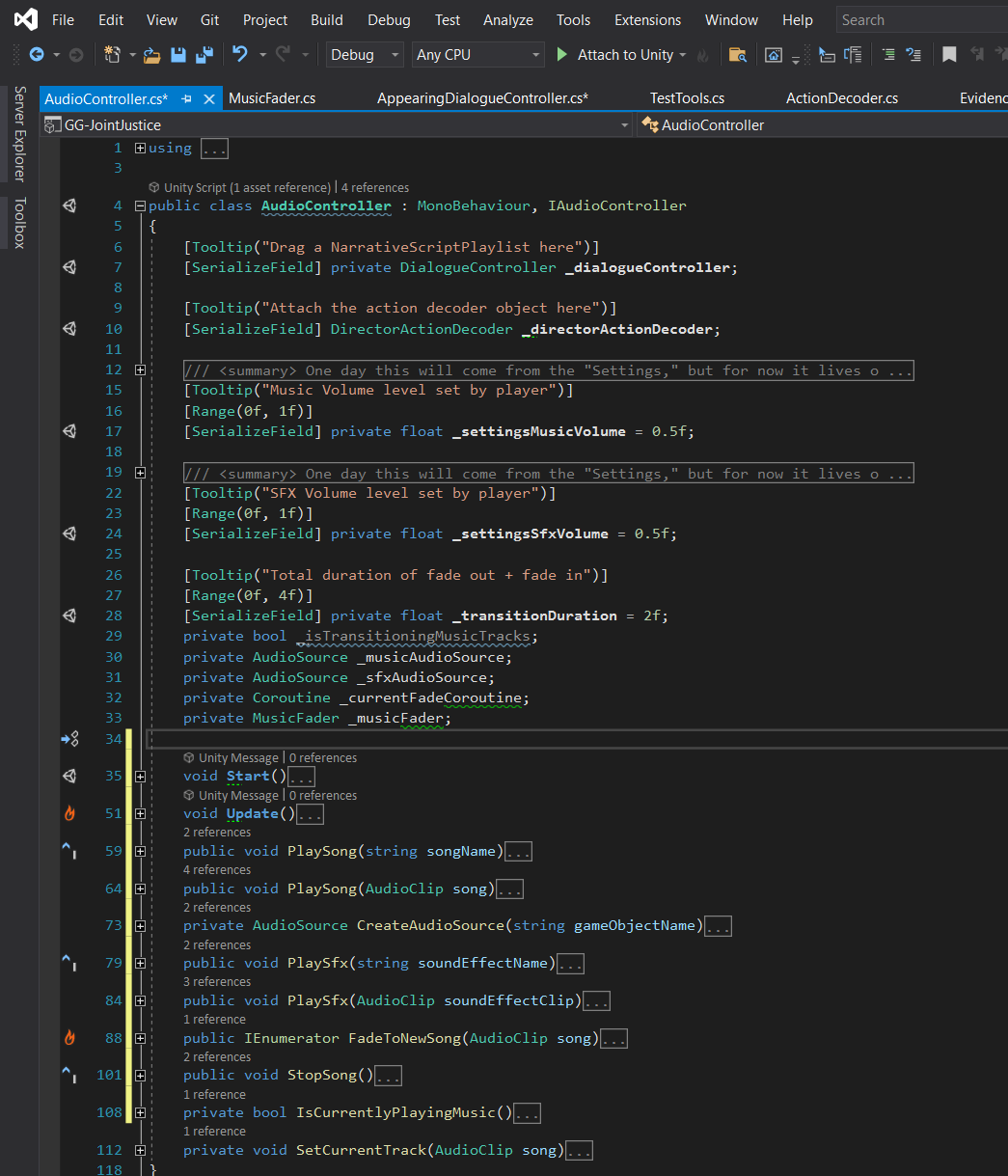
Mildly torn on this one. I agree a lot of our summaries are kinda pointless, then again, I think having a green section above each method looks nice and orderly and makes the start of methods easy to find 😅. |
Beta Was this translation helpful? Give feedback.

-
|
Admittedly, I think I'm too used to ReSharper's Fuzzy Search navigation and "goto usages/declaration", that I don't actually look at full files anymore. 🙈 If it helps you keep an overview, I think that's a good reason to keep it; still trying to think of alternatives that might achieve the same goal. |
Beta Was this translation helpful? Give feedback.

-
|
I think I'm on @PhoebeMitchell 's side for this one. In a wall of text, the summary blocks definitely help with scanning for specific methods (especially for less-experienced folk like myself 😅). And on that "less-experienced" note, the summaries help me know what the method is doing without picking apart the code and Googling the stuff I don't understand. The title of method could definitely describe what the method is doing, but I won't always know for sure what it's doing in the context of its application, you know? I like the summaries so I know for sure what it's doing without having to assume. I don't like the idea of collapsing all methods as a resolution because that would make it harder for me to scan the code as a whole. I would def be open to another option if there is one brought up, but for now, summaries seem like the best deal for me. |
Beta Was this translation helpful? Give feedback.


Uh oh!
There was an error while loading. Please reload this page.
-
So... I'm not really a fan of comments for methods. Shocking, coming from the guy who build a documentation generator. : D
Enforcing comments on methods in my experience ends up in comments that are only "englishifying" information already obtainable from a method's signature or body. With the added risk of not being updated when making changes to it, introducing conflicting information.
Comments for classes or inside method bodies technically also suffer from the problem of being outdated when underlying code changes, but being either in a higher (class-level) or lower (per-instruction) context, usually means they supply information on why they exist, not what they do.
For example: A
DisplayNameHelperclass was added, each method taking data and generates human-readable strings. That itself is deductible from the names of methods in classes. So no need for comments.However, let's say that this class was created, as previously 20 UI elements had to individually generate locale and culture information about a user only to immediately discard it, once whatever they want to display was generated and then be re-generated every time the underlying data changed, resulting in duplicate code and processing overhead.
This kind of information isn't inferable from a method or parameter names and should be present at the same place as the underlying code. A quick excerpt on top of the class (similarly to what gets written into a related GitHub Issue or Pull Request) would serve whoever discovers this code later on well.
The same applies comments inside method bodies for methods that do a lot and aren't worth encapsulating, as that logic is only present once for this specific method. (For example
ActionDecoder.OnNewActionLine()or test cases.)And to address the elephant in the room: I'm totally okay with the comments for
ActionDecoderaction methods, as they serve another audience (namely our writers). That fact alone, forces whoever is writing comments for a new action to think about who they are writing for and which information is actually critical and non-deductible from method or parameter names.Beta Was this translation helpful? Give feedback.
All reactions