Newton's square root method (also known as the Newton–Raphson method), named after Isaac Newton and Joseph Raphson, is one example of a root-finding algorithm. It is a method for finding successively better approximations to the roots of a real-valued function.
The method starts with a function f defined over the real numbers x, the function's derivative f', and an initial guess x0 for a root of the function f. If the function satisfies the assumptions made in the derivation of the formula and the initial guess is close, then a better approximation x1 is:
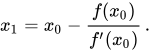
Geometrically, (x1, 0) is the intersection of the x-axis and the tangent of the graph of f at (x0, f (x0)).
The process is repeated as:
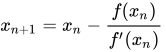
Until the result reaches a sufficiently accurate value. The method can also be extended to complex functions and to systems of equations.
