Examples
This example presents a single-wavelength simulation for monodisperse spheres possessing a complex refractive index. The results from the Mie Simulator GUI demonstrate excellent agreement with Scott Prahl's Mie Scattering Calculator; minor discrepancies primarily attributed to rounding.
Sphere Diameter: 1.0microns
Refractive Index of Medium: 1.33
Real Refractive Index of Sphere: 1.5
Imaginary Refractive Index of Sphere: -0.5
Wavelength: 632.8nm
Number Density: 1e8spheres/mm3
Number of Angles: 360 (dtheta = π/360 = 0.5˚)

Comparison:

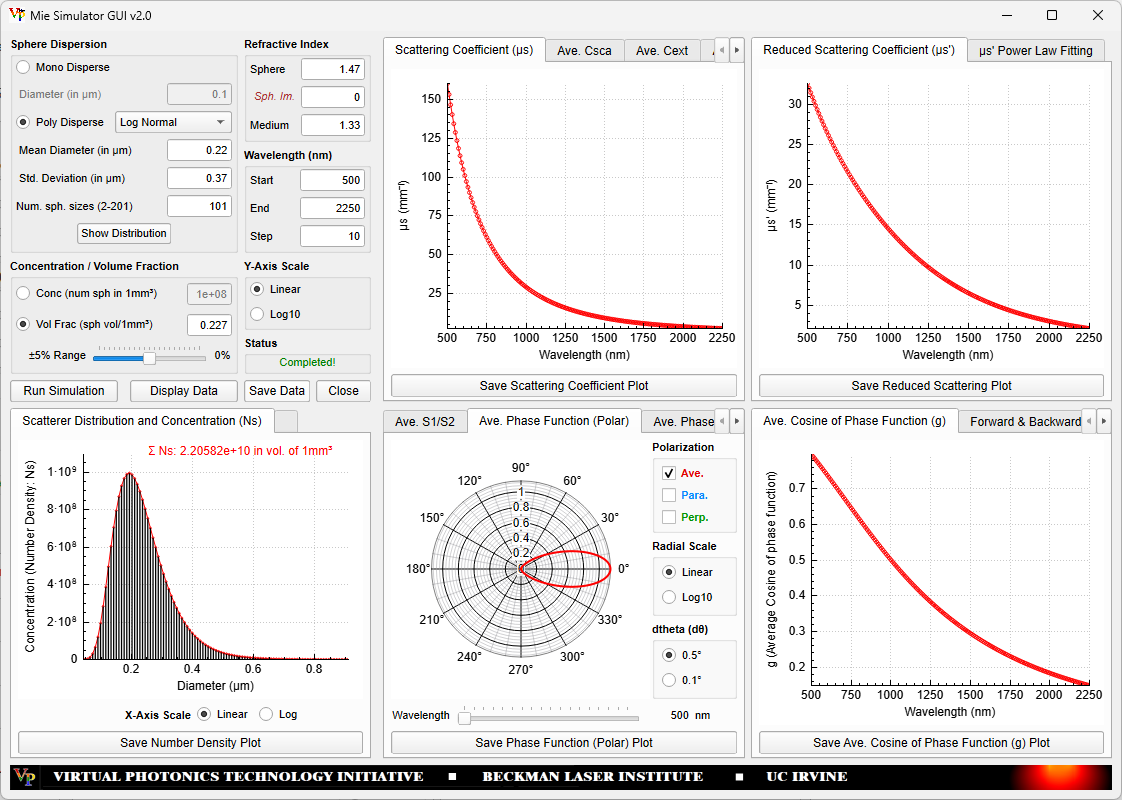
To demonstrate the tool's scientific utility, we considered the characterization of Intralipid, a standard tissue phantom in biomedical optics (DiNinni2011). Based on Intralipid particle distribution profiles in the literature Raju2017, we assumed a polydisperse Log Normal particle distribution with a mean diameter of 0.22 Num. sph. sizes field.
To analyze different concentrations ranging from 0.2% to 20% (Aernouts2013, vanStaveren1991), volume fractions were scaled using a baseline value of 0.227 for a 20% (w/w) Intralipid concentration (Aernouts2013). Upon executing the simulation across the 400–2250 MieSimulatorGUI calculates
Simulation parameters used to compare the equations in the plots with Eq. (1) in Aernouts2013:
Poly Disperse Distribution: Log Normal
Mean Diameter: 0.22 microns
Std. Deviation: 0.37 microns
Number of Sph. Sizes: 101
Refractive Index of Medium: 1.33
Real Refractive Index of Sphere: 1.47
Imaginary Refractive Index of Sphere: 0
Wavelength: 500 nm to 2250 nm in 10 nm steps
Volume Fraction: 0.227 (20% IL)
Number of Angles: 360 (dtheta = π/360 = 0.5˚)

Simulation parameters for comparing Eqs. (12) and (13) in van Staveren (1991):
Poly Disperse Distribution: Log Normal
Mean Diameter: 0.22 microns
Std. Deviation: 0.37 microns
Number of Sph. Sizes: 101
Refractive Index of Medium: 1.33
Real Refractive Index of Sphere: 1.47
Imaginary Refractive Index of Sphere: 0
Wavelength: 400 nm to 1100 nm in 10 nm steps
Volume Fraction: 0.1135 (10% IL)
Number of Angles: 360 (dtheta = π/360 = 0.5˚)


While the selected volume fractions may exceed independent scattering limits established in the literature (Tien1987, Galy2020, Yalcin2022), the results show strong agreement with established bulk scattering properties (Aernouts2013, vanStaveren1991).