We can efficiently implement sorted map using a search tree structure.
Binary trees are an excellent data structure for storing items of a map, assuming we have an order relation defined on the keys. A binary search tree is a binary tree T with each position p storing a key-value pair (k, v) such that:
- Keys stored in the left subtree of p are less than k.
- Keys stored in the right subtree of p are greater than k.
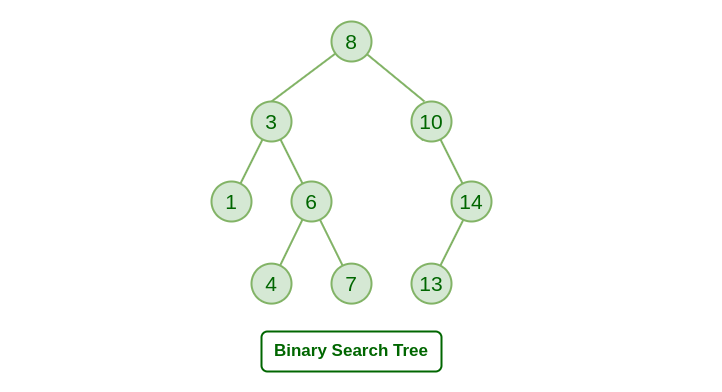
An inorder traversal of a BST visits positions in the increasing order of their keys.
An inorder traversal is typically expressed using a top-down recursion.
With a BST, we can provide additional navigation based on natural order of the keys stored in the tree. In particular, we can support the following methods, akin to those provided by a PositionalList:
first(): Return the position containing the least key (or None, if the tree is empty).last(): Return the position containing the greatest key (or None, if the tree is empty).before(p): Return the position containing the greatest key that is less than that of position p (i.e. the position that would be visited immediately before p in an inorder traversal), or None if p is the first position.after(p): Return the position containing the least key that is greater than that of position p (i.e. the position that would be visited immediately after p in an inorder traversal), or None if p is the last position.
The first() and last() methods are trivial to implement, as they simply follow the left or right child pointers
from the root until reaching an external node.
The successor of a position, after(p), is determined by the following algorithm:
Algorithm after(p):
    if right(p) is not None:    {successor is leftmost position in p’s right subtree}
        walk =  right(p)
        while left(walk) is not None do
            walk = left(walk)
        return walk
    else:   {successor is nearest ancestor having p in its left subtree}
        walk = p
        ancestor = parent(walk)
        while ancestor is not None and walk == right(ancestor) do
            walk = ancestor
            ancestor = parent(walk)
        return ancestor
The most important consequence of the structural property of a BST is its namesake: the ability to efficiently search for an entry with a given key. We can attempt to locate a particular key in a BST by viewing it as a decision tree. In this case the question asked at each position is: "Is the search key less than, equal to, or greater than the key stored at the position?"
- Pseudocode for the search algorithm:
Algorithm TreeSearch(T, p, k):
    if k == p.key() then
        return p
    else if k < p.key() then
        if left(p) is not None then
            return TreeSearch(T, left(p), k)
    else
        if right(p) is not None then
            return TreeSearch(T, right(p), k)
    return p
- The worst-case running time of the search algorithm is O(h), where h is the height of the tree.

Insertion
The map command M[k] = v begins by calling T.search(k) to determine whether the key k is already in the tree.
If so, the value associated with k is replaced by v. Otherwise, the new entry is inserted into the tree as a leaf.
- Pseudocode for the insertion algorithm:
Algorithm TreeInsert(T, k, v):
    p = TreeSearch(T, root(T), k)
    if k == p.key() then
        set p's value to v
    else if k < p.key() then
        add node storing (k, v) as left child of p
    else
        add node storing (k, v) as right child of p
Deletion
The map command del M[k] begins by calling T.search(k) to determine whether the key k is already in the tree.
If so, we distinguish between two cases:
- If p has at most one child, we remove p by splicing out its position.
- If position p has two children, we cannot simply remove the node from T since this would create a “hole” and two orphaned children. Instead, we proceed as follows:
- We locate position r=above(p) that follows p in an inorder traversal of T.
- We use r's item as a replacement for the item at p (that is to be deleted).
- Having used r's as a replacement for p, we instead delete the node at position r, which is guaranteed to have at most one child.
The primary drawback of a BST is that its performance degrades to O(n) when the tree becomes unbalanced. A balanced search tree is a search tree that maintains O(log n) height.
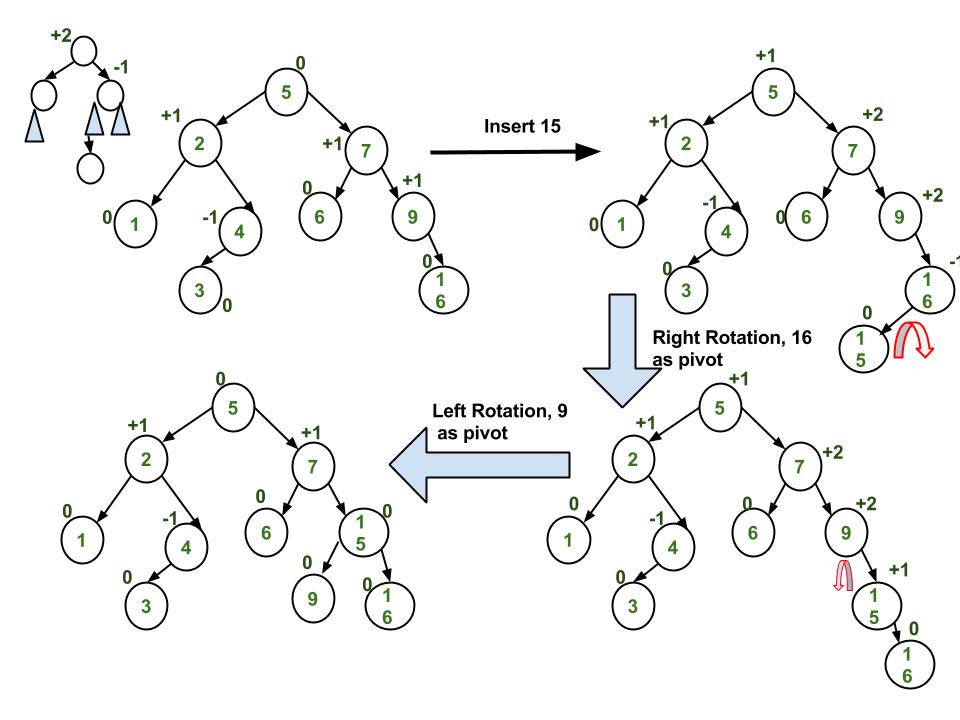
The primary operation to rebalance a binary tree is called a rotation. A rotation is a local operation that preserves the BST property. During a rotation, we rotate a child to be above its parent.
- Pseudocode for a rotation:
Algorithm restructuring(x):
    input: a Position x of a BST that has both a parent y and a grandparent z
    output: Tree T after a trinode restructuring (which corresponds to a single or double rotation) involving positions x, y, and z

    1. Let (a, b, c) be a left-to-right (inorder) listing of the positions x, y, and z, and let ($T_1$, $T_2$, $T_3$, $T_4$)
    be a left-to-right (inorder) listing of the subtrees of x, y, and z not rooted at x, y, or z.
    2. Replace the subtree rooted at z with a new subtree rooted at b.
    3. let a be the left child of b and let $T_1$ and $T_2$ be its left and right subtrees, respectively.
    4. let c be the right child of b and let $T_3$ and $T_4$ be its left and right subtrees, respectively.

An AVL tree is a binary search tree that maintains O(log n) height by making use of an auxiliary balance factor attribute on each node.
- The balance factor of a node v is defined as the difference between the height of v's left subtree and the height of v's right subtree.
- A node v is said to be balanced if the balance factor of v is -1, 0, or 1.