fastapi-opa adds authentication and authorization middleware to FastAPI. It handles
the login flow with an identity provider, validates the returned token, and forwards
the user's claims to Open Policy Agent for
policy-based access control.
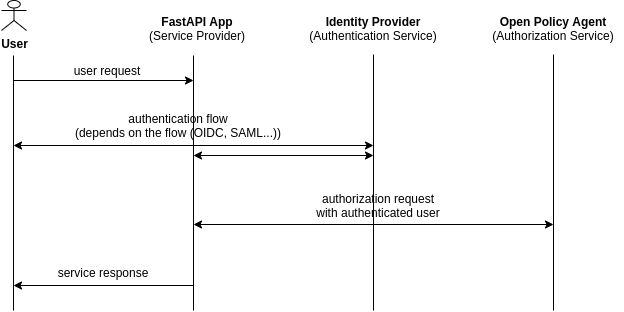
Every request passes through the middleware. Unauthenticated requests redirect to the identity provider. Once OPA validates the token, it evaluates the request against your policy and either allows or rejects it with a 403.
uv add fastapi-opaOptional extras:
| Extra | Adds |
|---|---|
graphql |
GraphQLInjectable for GraphQL payload enrichment |
saml |
SAML 2.0 authentication support |
authlib |
Authlib-backed PKCE token generation (stdlib fallback used otherwise) |
uv add "fastapi-opa[graphql,saml]"For SAML, you may need to install the binary dependencies without wheels:
PIP_NO_BINARY="lxml,xmlsec" uv run pip install --force-reinstall --no-binary=lxml --no-binary=xmlsec lxml xmlsec💡 see docs/getting-started.md for a complete local setup with Keycloak and OPA, including Docker Compose configuration and a working policy.
Add the middleware to your FastAPI app:
from fastapi import FastAPI

from fastapi_opa import OPAConfig
from fastapi_opa.auth import OIDCAuthentication
from fastapi_opa.auth import OIDCConfig
from fastapi_opa.models import TokenCookieConfig
from fastapi_opa.opa.cookie_middleware import CookieAuthMiddleware

oidc_config = OIDCConfig(
    well_known_endpoint="https://idp.example.com/realms/myrealm/.well-known/openid-configuration",
    app_uri="https://app.example.com",
    client_id="my-client",
    client_secret="my-secret",
    preserve_tokens=True,  # required for CookieAuthMiddleware
)
oidc_auth = OIDCAuthentication(oidc_config)
opa_config = OPAConfig(authentication=oidc_auth, opa_host="http://localhost:8181")

app = FastAPI()
app.add_middleware(
    CookieAuthMiddleware,
    config=opa_config,
    cookie_config=TokenCookieConfig(cookie_secure=True),
)


@app.get("/finance/salary/{name}")
async def salary(name: str) -> dict[str, str]:
return {"msg": "success", "name": name}| Doc | Description |
|---|---|
| docs/getting-started.md | Full local setup with Keycloak and OPA: Docker Compose, Rego policy, Keycloak configuration |
| Doc | Description |
|---|---|
| docs/opa.md | OPA input format, policy examples, OPAConfig reference, skipping endpoints, body buffering |
| docs/token-enrichment.md | Custom injectables and GraphQL enrichment to add extra fields to the OPA input |
| Doc | Description |
|---|---|
| docs/authentication.md | All authentication methods: API key, OIDC (full configuration reference), SAML, custom handlers |
| docs/cookie-auth.md | Cookie-based sessions with CookieAuthMiddleware: flow, TokenCookieConfig options, security checklist |
| docs/pkce.md | Public clients and PKCE: setup, PKCEStoreProtocol, example Redis store for multi-process deployments |
See CONTRIBUTING.md for the full contributor guide. In brief:
# Install all dev dependencies
uv sync

# Full QA pipeline: lint, type check, tests, security scan
make qa

# Tests only
uv run pytest

# Tests against the lowest allowed dependency versions
make qa-lowestThanks to all the contributors below. Furthermore thanks for raising issues.


