Experiement_Verify
Two common behavioral tasks on mice were used as verifications for the ArControl. All experimental data was acquired via the ArControl at Level 3, without any assistance from other DAQ devices. The experiment results of these two distinctive behavioral tasks were consistent with previous research. The data collected from experiments were adequate for offline analyses.
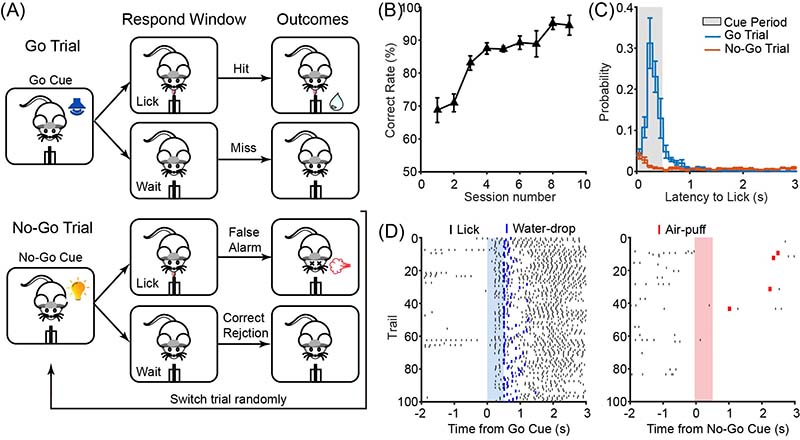
In this task, mice’s bodies were restricted with a head bar and a body tube (Guo et al., 2014). They were required to discriminate a go cue (tone) and a no-go cue (light). They would consequently get a reward (water-drop) or a punishment (air-puff) once they responded (lick) to the go cue (tone) or the no-go cue (light) during a timed response window.
This result was similar to previous research (Liu et al., 2014).
The recorded licking events were verified with gold standard (NI DAQ, sample rate = 1000 Hz), which showed that the ArControl has no type I/Ⅱ errors and possessed -0.6±0.6 ms reliability (± sd; 4 sessions, 1838 lickings).
You can find this task in demos.
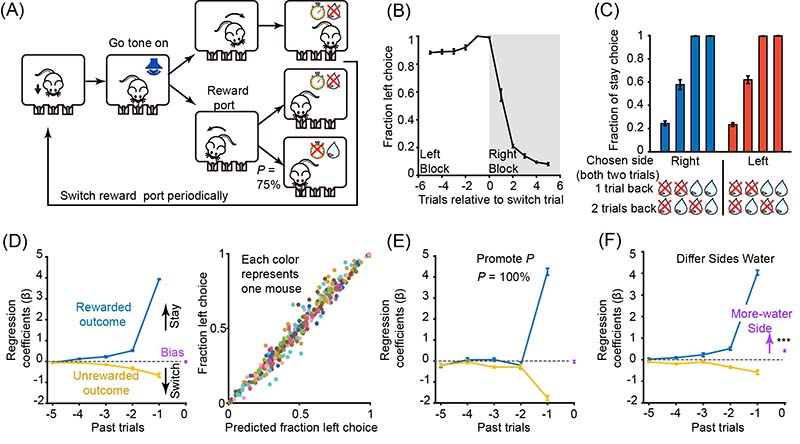
The spatial two-alternative forced-choice probabilistic switching task (2AFPC), a variant of the two-choice procedure task, requires participants to make a selection decision that relied on recent trial history. The animals were required to initiate a trial by licking the central port, and sequentially move to a left or a right port in order to obtain a reward. Only one port was rewarded by 75% at a time. In 25% of trials, neither port was rewarded. If no reward was delivered, animals would be punished by a time out. The rewarded port was periodically switched from time to time. The length of each block was randomized between 7-14 rewarded trials, and the switch only took place after a rewarded trial. Additionally, in order to prevent the mice from becoming demotivated when rewards were successively missing, the max consecution of reward-missing were limited to 2 trials consecutive.
This result was similar to previous research (Tai et al., 2012).
You can find this task in demos.