
Jump right in and vibe together — if you can talk, you can build apps.
直接上手,一起 vibe!会说话就会做应用。
🚀 Start Exploring · ✨ Interactive Tutorial · 🦞 Learn OpenClaw
🚀 开始体验 · ✨ 交互式教程 · 🦞 学习 OpenClaw
Read Online ·
Learning Map ·
Community
开始阅读 ·
学习地图 ·
社区





A beginner-friendly learning map Clear guidance from zero, so you can stop "learning and forgetting" |

Step-by-step visual tutorials Detailed walkthroughs that feel like learning with a private tutor |

Immersive simulated coding Virtual mouse guidance helps you quickly learn the core IDE workflow |

Visible AI principles Animated explanations make it easy to see how AI generates images |

Learn RAG like a game Interactive components let you click through the full RAG data flow |

Visual terminal concepts Command-line behavior becomes intuitive when the underlying logic is visualized |
⭐ Star the repo here to help accelerate updates ❤️
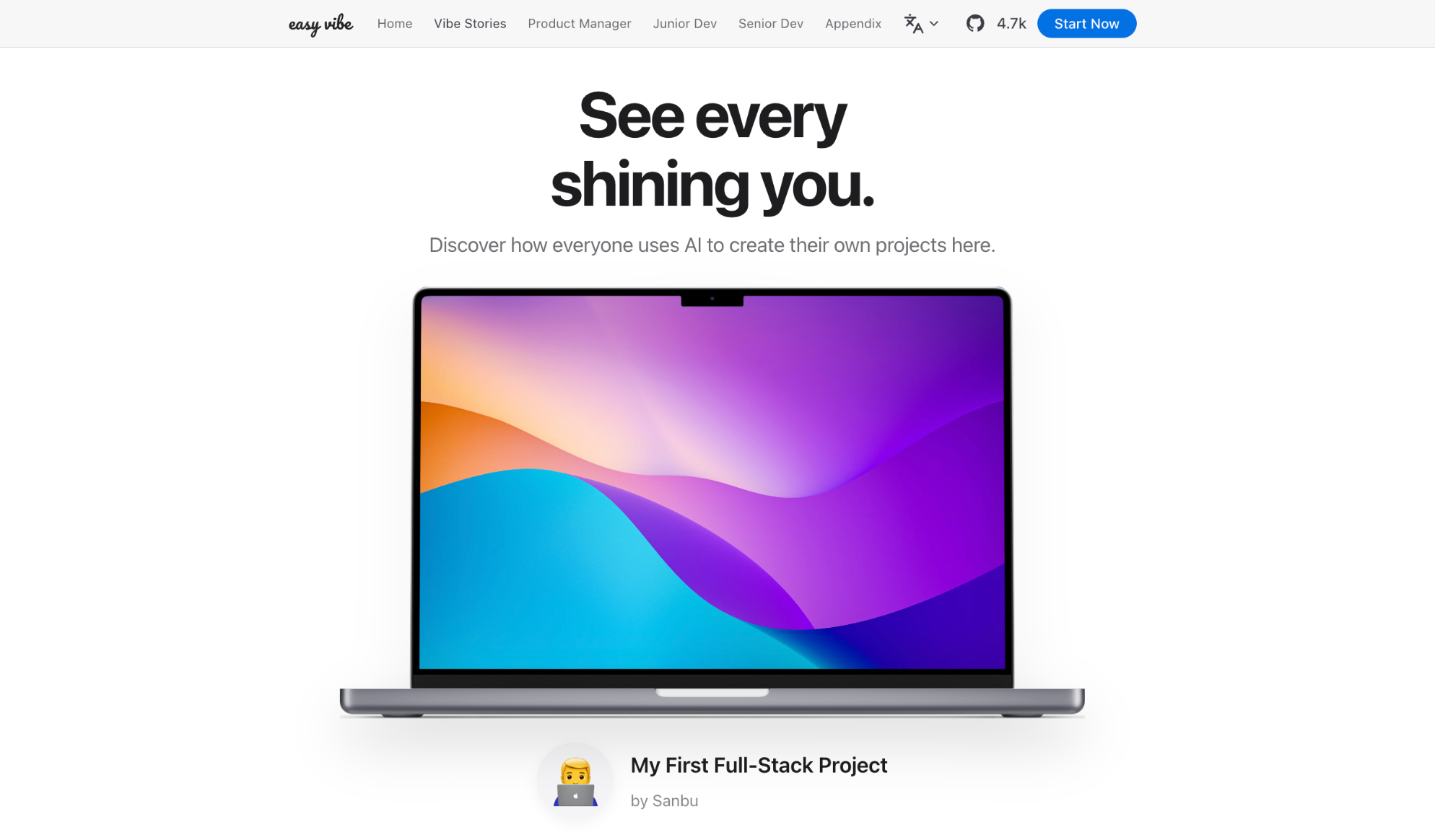
📝 Have your own vibe coding story? Submit it here and inspire others!
Want an expense tracker? Say it.
Need a booking system with WeChat login? Say it.
Want a blog with comments? Say it.
In the AI era, programming starts by describing what you want.
Easy-Vibe teaches you how to turn that into a real product.
- [2026-03-29] ✨ Vibe Stories launched and upgraded with real user journeys: Added a new homepage Vibe Stories section with an interactive carousel and dedicated story pages, then replaced placeholder content with four real user stories featuring a rural primary school teacher, a college student, a high school IT teacher, and a truck driver who built real products with AI. 👉 View the stories
- [2026-03-26] 🚀 Major Stage 2 practice update: Completed the SaaS capstone project "Your First SaaS Full-Stack App: Copywriting Generator Website" and substantially expanded the "How to integrate Stripe and payment systems" section, plus key content around multi-product UI and WeChat Mini Program backend workflows.
- [2026-03-25] 📚 New appendix: User Research and Requirement Validation: Added four new articles covering idea sourcing, the Double Diamond model, Jobs to Be Done, and The Mom Test to help beginners discover and validate product ideas. 👉 Read the appendix
- [2026-03-25] 📚 English documentation fully updated: Stage 2 (Full-stack Development) and Stage 3 (Advanced Development) are now fully available in English. 👉 Start learning
Past News
- [2026-03-02] 🦞 OpenClaw and AI Agent friendly support: Added
llms.txtso OpenClaw, Claude, Cursor, Trae, and other AI agents can quickly understand the repository structure and find the right tutorial content. - [2026-03-01] The Advanced Development section has been comprehensively upgraded with deep guides for Claude Code, including MCP, Skills, Agent Teams, and more, along with eight cross-platform project tutorials.
- [2026-02-25] Updated the Appendix Knowledge Base, now covering 9 knowledge areas and 80+ interactive topics.
- [2026-01-27] Added Android and iOS app development tutorials.
- [2026-01-19] Released interactive demos for Prompt Engineering, AI history, authentication design, Git principles, and more.
- [2026-01-16] Reorganized the project structure and formally established a beginner entry path.
- [2026-01-14] Completed a large update to the Stage 1 product prototyping docs.
- [2026-01-13] Refactored the documentation architecture and fully enabled multi-language support.
- [2026-01-01] Released the core learning map for the project.
- Complete beginners: Build your first project first, then understand how it works
- Product managers / founders: Validate ideas fast and build MVPs at low cost
- Students: Develop practical skills for the AI era
- Junior developers: Learn the full path from idea to launch
- Mid-level and senior developers: Upgrade your AI collaboration workflow for complex projects
Best for: Everyone What you will learn: Your first AI coding experience with a Snake mini-game What you will get: Your first AI-built app in 5 minutes
Best for: Beginners / product managers / founders What you will learn: AI IDE tools, requirement breakdown, page design, feature planning, prompting, prototype iteration What you will get: A demoable product prototype
Best for: Developers / advanced learners What you will learn: Frontend, backend, databases, AI integration, deployment, Claude Code workflow What you will get: The ability to ship a full-stack AI app independently
Best for: Developers interested in AI agents What you will learn: OpenClaw assistant workflows, the Skills system, and automation What you will get: Your own command-line AI assistant
Best for: Everyone What you will learn: Computer fundamentals, AI principles, and 9 major knowledge areas What you will get: 80+ interactive reference topics
- If you are a beginner, product manager, or founder, start with Stage 0 / Stage 1
- If you already have development experience, start with Stage 2
- If you want to jump directly into complex projects, go to Stage 3
- If you want to learn AI agents, check out Hello Claw

| Section | Key Content |
|---|---|
| Learning Map | A guided overview of the full learning journey |
| In the AI era, if you can talk, you can code | Get your first feel for AI coding through examples like Snake |
| Finding great ideas | Learn how to discover and validate product ideas worth building |
| Introduction to AI IDE tools | Learn to use an IDE and build simple local projects |
| Build your prototype | Move from requirements to single-page and multi-page product prototypes |
| Add AI capabilities to your prototype | Integrate text, image, and video AI features |
| Complete project practice | Simulate real scenarios, collect user feedback, and iterate on a full project |
| Section | Key Content |
|---|---|
| Product thinking and solution design | Core frameworks for going from zero to one with a product |
| AI industry application scenarios (B2B) | Understand how AI is applied across industries |
| AI consumer product inspiration (B2C) | Explore product opportunities in consumer AI |
| Section | Key Content |
|---|---|
| What to do when coding errors happen | Common vibe coding issues and how to troubleshoot them |
| Comparison of seven AI coding tools | Compare major AI coding platforms through hands-on testing |
| Design a website with design and coding agents | Learn multi-agent collaboration in practice |
| Section | Key Content |
|---|---|
| Build your own asset-generation agent starting from Lovart | Use Nanobanana and Lovart to generate high-quality visual assets and build a drawing agent that understands intent |
| Getting started with Figma and MasterGo | Organize information architecture and page structure with design tools |
| Build your first modern application: UI design | Turn design drafts into component-based interfaces |
| UI guidelines and multi-product UI design | Extend a unified visual system across multiple products |
| Make interfaces beautiful with LLMs and Skills | Use prompting and Skills plugins to generate distinctive, polished interfaces |
| Build Hogwarts portraits together | Create a frontend app from scratch that integrates AI capabilities |
| From design prototype to project code | Three practical paths to convert design prototypes into frontend code |
| Refresh your UI with modern component libraries | Build more professional interfaces faster with modern component systems |
| Section | Key Content |
|---|---|
| From databases to Supabase | Implement databases and APIs with Supabase and connect them to your frontend |
| Use LLMs to write API code and API docs | Generate backend code and documentation that is easier to read and test |
| Git and GitHub workflow | Manage versions and collaborate effectively with Git workflows |
| How to deploy web applications | Deploy apps with platforms like CloudBase, Vercel, and Zeabur |
| CLI AI coding tools | Build a personal engineering workflow with terminal-based AI tools |
| How to integrate Stripe and payment systems | Add payment flows and basic billing capabilities |
| Capstone: build your first modern full-stack application | Combine frontend, backend, and payments into a launch-ready web product |
| Section | Key Content |
|---|---|
| Getting started with Dify and knowledge base integration | Build utility products with Dify workflows and basic RAG |
| Section | Key Content |
|---|---|
| Getting started with Claude Code | Installation, setup, fundamentals, and useful commands |
| Claude Code MCP guide | Connect Claude Code to GitHub, databases, APIs, and other services through MCP |
| Claude Code Skills guide | Package expertise into reusable skills you can use again and again |
| Claude Code workflow best practices | Best practices for refactoring, code review, and daily development |
| Claude Agent Teams guide | Coordinate multiple AI instances like a real development team |
| Claude Code Superpowers for engineering-grade development | Help AI produce engineering-grade code with TDD and best practices |
| How to keep Claude Code working for long-running tasks | Design long-running tasks so coding tools can keep working until the job is done |
| Section | Key Content |
|---|---|
| Build a WeChat Mini Program | Understand the ecosystem and ship a frontend mini program from template to launch |
| Build a WeChat Mini Program with backend | Add backend logic and databases to complete the full business loop |
| Build an Android app | Use Expo and related tools to build Android apps across web and native |
| Build an iOS app | Use Expo and related tools to build iOS apps across web and native |
| Build a personal website and academic blog | Create an online home for projects, personal branding, and academic work |
| Build a local PWA app | Turn a website into a real app with offline support, push, and installation |
| Build a browser AI assistant extension | Create a Chrome extension that summarizes any page with either cloud APIs or built-in AI |
| Build an Electron desktop app | Build a voice-to-text desktop app with Electron for three platforms |
| Rapidly build and mint an NFT | Write a smart contract from scratch, deploy it, and mint your own NFT |
| Build a VS Code extension | Build an AI project assistant with templates, code chat, and multi-file Q&A |
| Build an industrial-grade Qt desktop app | Create a real-time Qt HMI system with trends, alerts, and monitoring |
| Section | Key Content |
|---|---|
| What is RAG and how does it work | Build a systematic understanding of RAG principles and common architectures |
| Intermediate and advanced RAG workflows with LangGraph | Design multi-step workflows and more advanced RAG systems |
Covering 9 major knowledge areas and 80+ interactive topics, this appendix uses animation and visual components to help you intuitively understand core concepts from computer fundamentals to the AI frontier.
- Read and practice the sections that match your current level. If you get stuck, feel free to open an issue.
In an AI IDE chat window such as VS Code, Cursor, or Trae, you can simply say:
Please help me run this project locally.
npm installnpm run dev- Open
http://localhost:3000in your browser.
- If you find an issue or see something that can be improved, feel free to open an issue. If nobody replies, you can also contact the Datawhale support team.
- If you want to contribute, open a pull request. If nobody replies, you can also contact the Datawhale support team.
- If you want to start a new Datawhale open-source project, please follow the Datawhale Open Source Project Guide.
- Sanbu - Project Lead (Datawhale member)
- Fang Ke - Mentor (Datawhale member, Tsinghua University)
- Yerim Kang (Practice projects, Tsinghua University)
- Zhilin Zhao (Practice projects, Tsinghua University)
- Yixuan Li (Visual design, Tsinghua University)
- Siyi Liu (Practice projects, Tsinghua University)
- Lixin Liu (Practice projects, Tsinghua University)
- Everyone in the AI Vibe Coding 101 internal testing group who shared suggestions and feedback
- Thanks to @Sm1les for the help and support on this project
- Thanks to every contributor and everyone who supported the project with feedback and stars ❤️
If you have feedback, questions, or want to connect with the community, scan the QR code below.

Scan the QR code below to follow the Datawhale public account.


This work is licensed under the Creative Commons Attribution-NonCommercial-ShareAlike 4.0 International License .