You signed in with another tab or window. Reload to refresh your session.You signed out in another tab or window. Reload to refresh your session.You switched accounts on another tab or window. Reload to refresh your session.Dismiss alert
Let's learn about Infrastructure via these 159 free blog posts. They are ordered by HackerNoon reader engagement data. Visit the /Learn or LearnRepo.com to find the most read blog posts about any technology.
Infrastructure refers to the fundamental facilities and systems, including hardware, software, network resources, and data centers, that support IT operations and services. Robust infrastructure is critical for the reliable performance and scalability of modern digital systems.
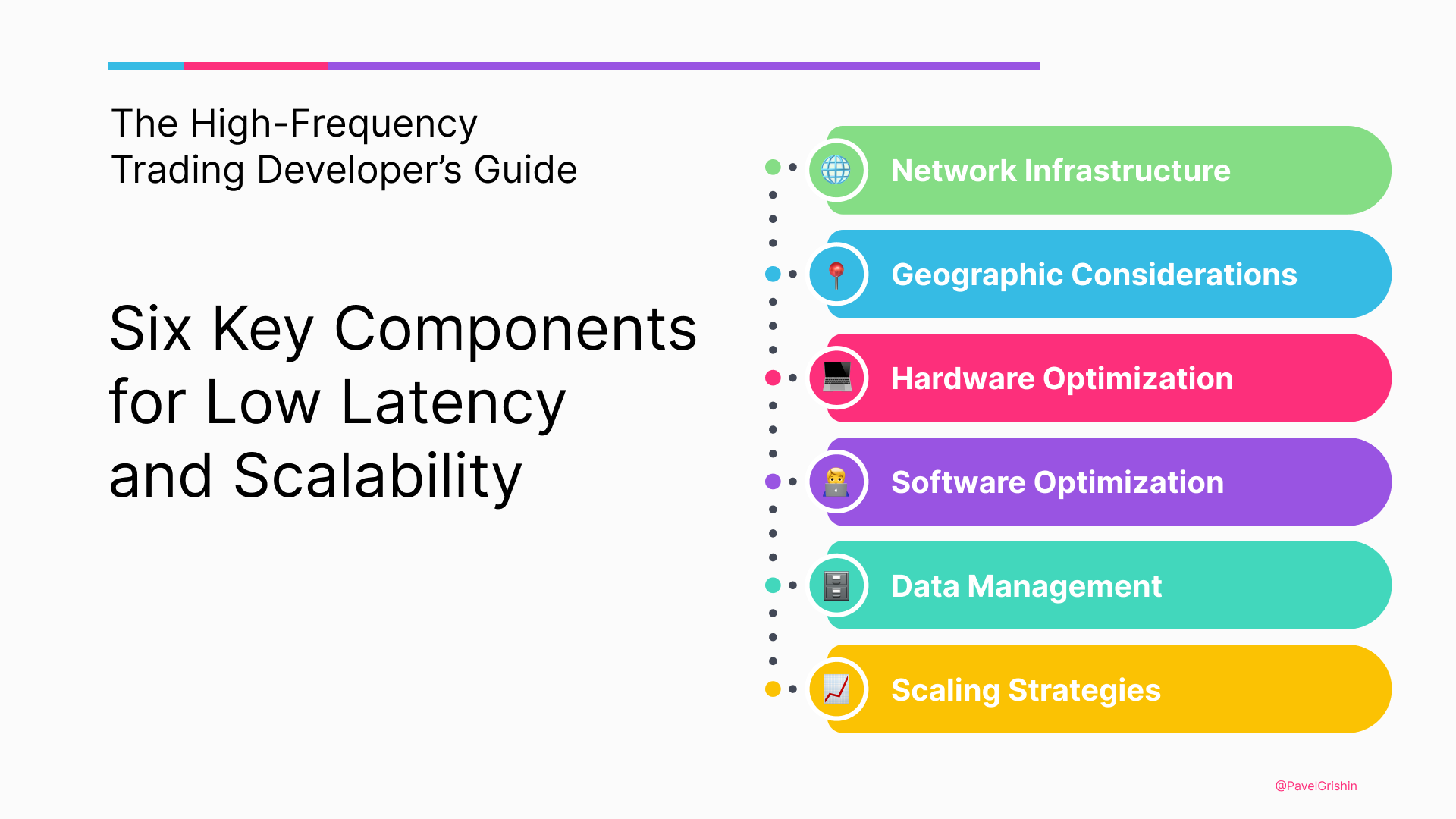
High-frequency trading (HFT) relies on complex algorithms to profit from small price discrepancies, requiring ultra-low latency and high-speed order execution.
This manual describes the process of setting up continuous backups for PostgreSQL databases to safeguard your data from accidental loss in an efficient way.
FTL usually refers to "faster than light". A theoretical particle known as a tachyon that powers certain spaceships in the Star Trek universe keeps the plot going for decades through multiple series and and movie franchises.
This article will cover how I got the viral Dubai Chocolate Pistachio Shake using basic network calls and built a scalable cloud infrastructure for ML services.
As the cloud-native ecosystem evolves, it is beginning to appear as if a challenger to containerization has emerged. In this blog post, I'm going to dive into what unikernels are, and why I think they will be the most likely candidate to replace container-based infrastructure.
Understand how reverse proxies powers almost every service that we use today from monolith to microservices. It is a vital piece of 21st century infrastructure!
While running a self managed elasticsearch cluster like any other database, it's important to make provisions for data backups. Data backups on Elasticsearch can't be done by simply copying elasticsearch data files from one disk to another, this tutorial guides you through making the best use of the Elasticsearch snapshot module for creating cluster snapshots and leverages the Azure blob storage for securely storing your backed up data. Also besides backing up data, the snapshot api also comes in handy for migrating data from one cluster to another.
A successful cyberattack targeting solar infrastructure could adversely impact convenience, safety and national security. Here's how to defend solar equipment.
The internet, by design, has enabled many forms of capture from data mining to market manipulation. So how do we build infrastructures which avoid capture?
To understand why embracing Open RAN should be an easy decision and get a better understanding of what is Open RAN and what are the benefits of Open RAN.
Meta: KubeMQ, makers of the eponymous Kubernetes-native message queue, has a new web-based tool that promises to make setup a breeze. Let's try it out!
In this multi-part series, I'll transform a new application into a multi-tenant experience running in the Heroku ecosystem. This article focuses on the object model, design, architecture, and security.
Spawning an AWS EKS cluster has never been easier and options are many: CloudFormation, Terraform or CDK. For the lazy, you can even use the great CLI utility eksctl from Weavework.
How changing the development mindset to a product-led-growth one can improve the user experience by focusing the thought process for the team's members.
The corona virus has challenged all aspects of our lives. Healthcare not with standing, one of the biggest challenges has been in trying to keep as much of our lives as possible running as normal. Technology might already have altered the way we work, rest and play for good– but it’s been even more crucial during a period where people are working from home and avoiding large gatherings in the US and the rest of the world. In this post, we’ll look at how tech industry is rising to the corona virus challenge to keep the world moving.
Hi all! I'm Dmytro Dziubenko, Co-founder & CTO of Corefy, a white label SaaS platform that empowers clients to launch their own payment systems in a few clicks. Our platform helps numerous payment providers and companies successfully cover all their payment acceptance needs. The key value of our platform for clients is that it eliminates the difficulties of payment provider integrations. After a single integration with us, clients get access to hundreds of ready-made integrations with PSPs and acquirers worldwide, allowing them to connect any payment method easily.
OSS and BSS are entities that represent the operational and business sides of the telecom respectively. They enhance the engagement with their customers.
Goplicate - An epic tale about a developer trying to maintain dozens of project config files and finding the one config to bind them and rule them all.
Google is make its Jules coding agent more "proactive," allowing it to surface tasks and respond to events without being explicitly invoked by developers.
Software-defined networking, otherwise known as SDN, is a new approach to networking that has come to be favored by experienced technology professionals.
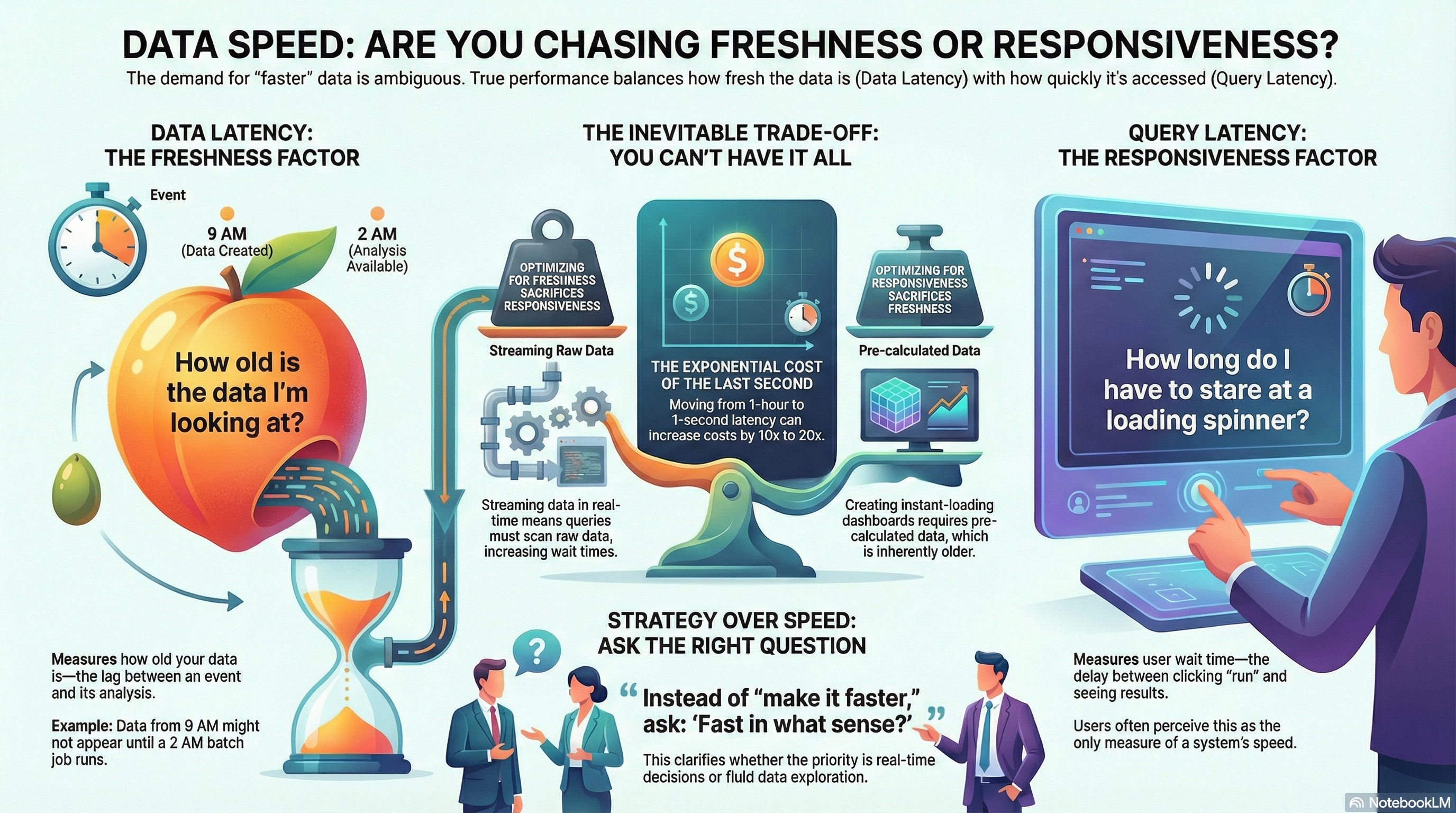
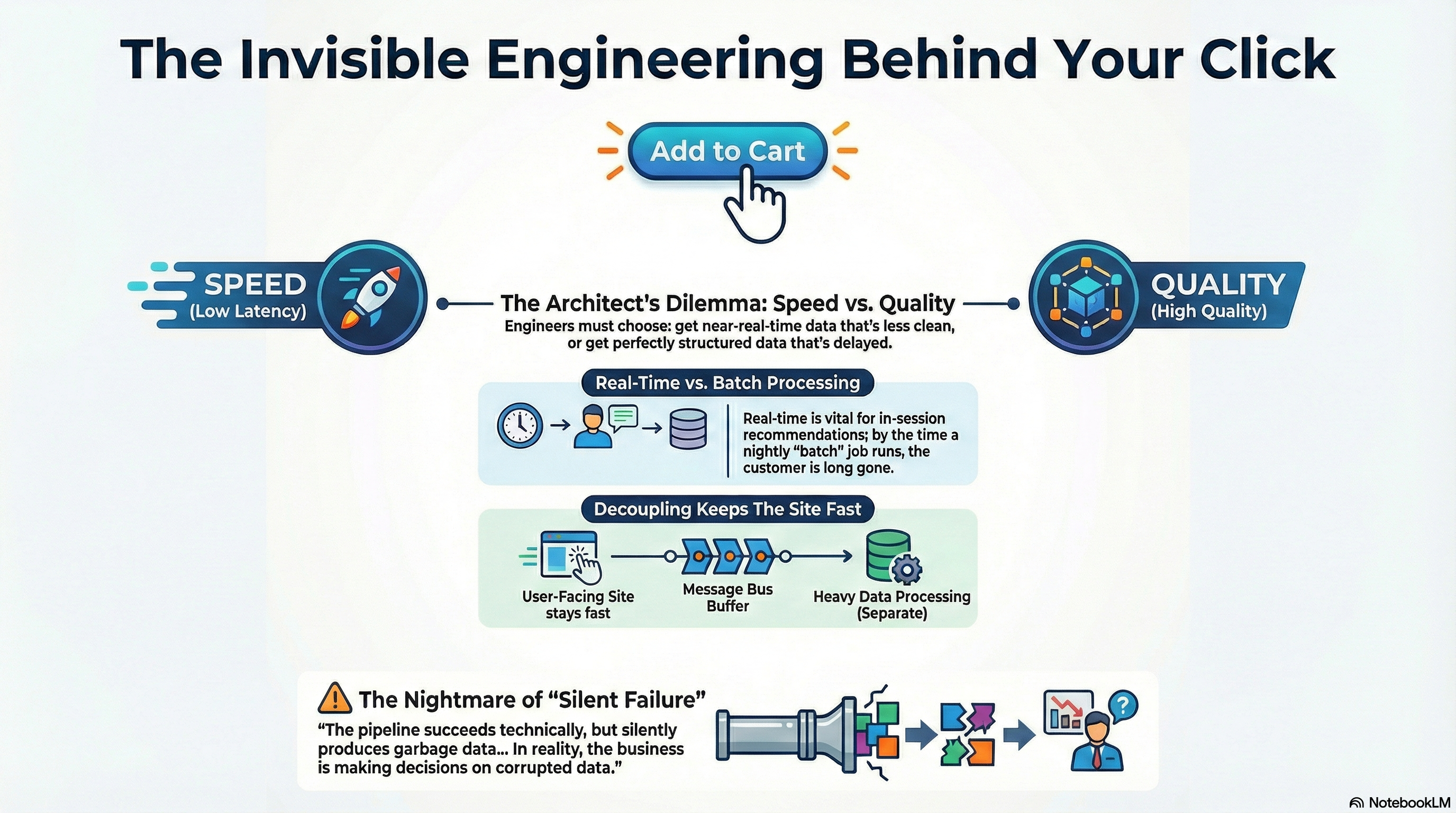
Stop chasing "speed" as a monolith. Data latency and query latency are fundamentally different problems. Optimizing for fresh data often degrades dashboard responsiveness, and vice versa. The real challenge isn't building the fastest system—it's aligning your architecture with actual business needs while managing exponential costs.
The web isnt dying, it’s folding in on itself. From OpenAI’s quiet absorption of innovation to the rise of AI-built clones, developers now live in an era where
Infrastructure providers play a key role in Web3 development. They will be the roads and highways that enable seamless Web3 communication via secure protocols.
Discover how Torram is building a Bitcoin-native, Proof-of-Stake network that brings fast, secure, and decentralized finality to the Bitcoin blockchain.
It took one aquarium thermometer to steal 10GB of data from a Las Vegas casino. The adapter, which lacked basic security policies, was simply not on the security staff’s priority list. It was, however, on the hackers’.
Making good use of a could network first requires firms to consider if they would be meeting their regulatory obligations before ensuring network resilience.
Today, there are more than 900 million Internet users in China -- about three hundred million more than Europe’s total population. It is also more than twice the total U.S. and Canadian populations combined in 2019.
Residual connections changed deep learning fundamentally. The idea is simple: instead of each layer processing information fresh, you add the original input back to the output. So y equals f(x) plus x. This seemingly small change unlocked the ability to train networks with hundreds of layers without everything falling apart during training.
The reason this works comes down to gradient flow. When you train a neural network, you calculate gradients that tell you how to adjust each parameter. In deep networks without residual connections, these gradients either vanish to nothing or explode to infinity as they propagate backward through many layers. The identity mapping created by the residual connection gives gradients a direct highway to travel back through the network unchanged. Early layers still receive meaningful learning signals even in very deep networks.
This property made residual connections so fundamental that every major architecture built in the last decade relies on them, from Transformers to modern language models. What started as an architectural trick became a foundational principle.
WHY WIDER CONNECTIONS SEEMED LIKE AN EASY WIN
Researchers naturally asked: if one residual bypass works well, what if you created multiple bypasses with different paths? This is the idea behind Hyper-Connections, which expand the residual stream width and diversify connectivity patterns. Instead of a single connection between layers, you'd have richer networks of information flowing in parallel. The intuition seemed sound, and early work showed real performance improvements.
But this expansion came with a hidden cost. When you add multiple pathways and widen the connection space, you fundamentally change how the connections work. The function combining those paths no longer preserves the identity mapping property. You've gained architectural complexity but lost the mathematical guarantee that made residual connections stable in the first place.
This loss of the identity mapping created two serious problems. First, training became unstable. Gradients behaved erratically during backpropagation, making it difficult to scale these networks to realistic sizes. Second, moving data through those wider connections consumed substantial memory, creating computational overhead that eroded the practical benefits. The performance gains came at a cost that grew with scale.
This is where the paper reveals its core insight. You don't have to choose between architectural complexity and training stability. Instead, you constrain where that complexity lives.
Think of a sphere. You can move in many directions on its surface, but you're always constrained to the spherical structure itself. You haven't lost freedom, you've shaped it. The paper applies this same logic to neural network connections: allow rich, diverse hyper-connections, but only if they live on a specific manifold, a lower-dimensional mathematical surface embedded in the high-dimensional connection space.
The key is that this manifold constraint preserves the identity mapping property locally. Even though the connections are wider and more complex, the way they combine respects the fundamental principle that makes residual connections work. The hyper-connections get projected onto a manifold that includes the identity function itself. This isn't a compromise that trades away performance. It's a structural constraint that allows you to have both complexity and stability.
The mathematical elegance matters because it resolves the tension completely. You get the stability of the original residual connection design with the performance potential of the wider architecture. Training behaves properly because gradients flow through paths that respect the identity mapping property. The manifold acts as guardrails, keeping you in a learnable zone while still exploring the expanded architectural space.
MAKING IT ACTUALLY EFFICIENT
Mathematics that doesn't run efficiently is rarely useful. The paper doesn't stop at theory, it includes infrastructure optimizations that exploit the manifold structure to reduce memory overhead and computational cost.
Adding mathematical structure to a problem often enables more efficient computation. The manifold constraint provides this structure naturally. Instead of shuffling data through arbitrarily wide connections, the manifold structure allows more efficient implementations. The result is both better performance and better efficiency, which rarely coexist without engineering compromise.
This matters because it separates mHC from purely theoretical contributions. The constraint isn't a beautiful idea that only works on toy problems. It's something you could actually use when training real models with billions of parameters. The optimization work shows that the theoretical insight translates into practical advantage.
TESTING AT REAL SCALE
The paper's claims need evidence. Do the theoretical benefits actually materialize when training realistic models? The experiments test three specific questions: Does mHC maintain the performance improvements of Hyper-Connections while fixing the training instability? Does it actually scale to large models without the memory and computational overhead that plagued standard HC? How does it compare to both baseline residual connections and the wider hyper-connections it improves upon?
The experimental results show that mHC handles the complexity trade-off gracefully. Performance doesn't drop compared to HC, meaning you're not sacrificing the gains that motivated hyper-connections in the first place. Training curves show substantially smoother learning dynamics without the instability that made HC difficult to scale. Scalability improves genuinely, allowing larger models to train with the same computational resources.
These results matter because they validate the entire contribution. If mHC worked only on small networks or toy problems, it would be academically interesting but practically limited. The fact that it works at real scale demonstrates that the theoretical insight translates into something useful for the architectures that power modern AI.
WHAT THIS MEANS FOR BUILDING BETTER MODELS
The paper solves a specific technical problem, but the implications extend further. It reveals something important about how neural network architectures actually work. Residual connections succeeded not because they're the only way to build networks, but because they preserve a specific mathematical property while adding functionality. When you try to extend that design, you risk losing that property unless you're strategic about it.
This points toward a broader principle in topological architecture design, the study of how information flows through network structure. Rather than simply trying new architectures and seeing what works, you can understand the underlying principles that make architectures successful, then innovate within constraints that preserve those principles. It's the difference between trial and error and principled design.
For foundational models, the giant networks that power modern AI systems, this matters deeply. These models are built on architectural principles refined over years of research. If you understand how to innovate responsibly, preserving the properties that make things work while adding new capability, you can guide the evolution of these models more effectively. You move from architecture as empirical craft toward architecture as principled design, where changes are motivated by understanding rather than just intuition.
The paper's real contribution isn't any single technical detail. It's the recognition that you don't need to choose between preserving a foundational principle and innovating beyond it. You can do both when you find the right mathematical structure. That insight will likely shape how future architectures develop.
How ubiquitous are APIs in today’s development processes? Try asking an engineer how many APIs their project integrates. Most teams won’t know the answer. From analytics tools to maps and cloud hosting, modern applications use a hefty collection of internal and public APIs. Developers use these to quickly assemble applications that would otherwise take much more effort to build. However, there’s a forgotten expense not typically calculated early in a project.
This is a Plain English Papers summary of a research paper called Agentic AI and Occupational Displacement: A Multi-Regional Task Exposure Analysis of Emergi...
Each participant stores a tree of pending commands locally, in addition to the state variables viewNumber (starting at 1, stores the highest QC it voted to pre-commit), and prepareQC (starts at nil), lockedQC (starts at nil, stores the highest QC it voted to commit). When a “new-view” or round starts, a public function determines the leader from the current participants.
Explore how decentralized infrastructure networks (DePIN) use blockchain technology to transform industries, enhancing efficiency, security, and democratization
I am currently touring industrial parks outside of Belgrade, Serbia.Here, new manufacturing facilities are rising with minimal leverage, driven by a focus on...
How one test works to analyse millions of Nginx logs from a live website and what to learn from the analysis results while processing it in a timely way.
Discover in this article why Africa is the least area connected to the internet, what challenges users face and opportunities it brings for the digital economy.
In 2017, Codecademy had been struggling to get to $1M MRR. We had set the target multiple times and fallen short repeatedly. In December of that year, Zach (...
It's early on in a products lifecycle that it begins to require a global SRE presence. Once you have gained sufficient customer traction, and if your product warrants it, you need to provide them with around the clock availability support to complete the customer support jigsaw.
The promise of AI agents is immense productivity gains. But putting them into production can be a tale of two extremes: surprisingly fast or painfully slow.
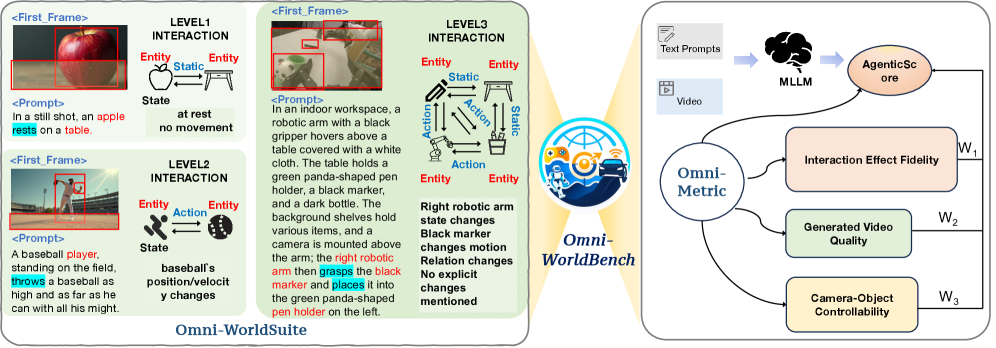
This is a Plain English Papers summary of a research paper called Omni-WorldBench: Towards a Comprehensive Interaction-Centric Evaluation for World Models [h...
Monitor your infrastructure.
First of all, you should know what's happening with your website. If you're experienced with Prometheus/Grafana, you could use them, but if you’re not, it's not a problem; you can use any monitoring service, such as DataDog or any other SaaS service, and set it up really quickly. If it's still hard, use pingdom or site24x7, at least to check that your website is still available.
The core of traditional business project strategy is positioning, which is the consensus of the industry. The traditional theoretical framework for positioning strategy was first proposed by Michael Porter.
This is a Plain English Papers summary of a research paper called CUA-Suite: Massive Human-annotated Video Demonstrations for Computer-Use Agents [https://ww...
Stay ready for traffic surges. DevOps teams use modern observability platforms to handle log spikes with elastic scaling, full ingestion, and clear insights.
Infrastructure as Code (IaC) is the process of managing and configuring an infrastructure using configuration files, rather than manually editing configurations
In the last several years, Google’s Kubernetes project has generated huge buzz. The project has grown and evolved into a titan of the cloud infrastructure world.
While we know the many benefits of going serverless - reduced costs via pay-per-use pricing models, less operational burden/overhead, instant scalability, increased automation - the challenges are often not addressed as comprehensively. The understandable concerns over migrating can stop any architectural decisions and actions being made for fear of getting it wrong and not having the right resources. This article discusses the common concerns around going serverless and our advice to minimise their impact.
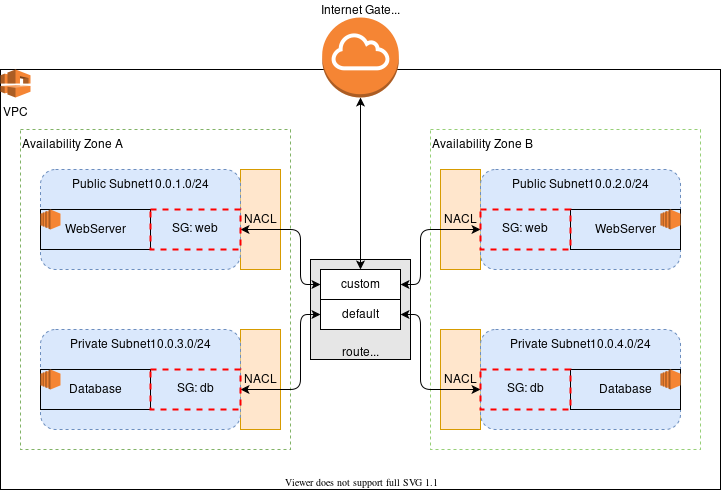
VPC is the topic that flies under the radar of many Software Developers, despite being present in every AWS account (well, maybe not for accounts created before 2009...but that's unlikely). There are a few reasons for this I can think of:
We recently released the first versions of driftctl, a new open-source project for infrastructure developers, DevOps, SRE, and cloud practitioners, with the goal of helping manage all kinds of drifts.
This is a Plain English Papers summary of a research paper called Intern-S1-Pro: Scientific Multimodal Foundation Model at Trillion Scale [https://www.aimode...
This is a Plain English Papers summary of a research paper called WildDet3D: Scaling Promptable 3D Detection in the Wild [https://www.aimodels.fyi/papers/arx...
Investors love usage pricing for net revenue retention. Product teams love it for clear tiers and aligned incentives. Consumer apps should still stick to fees.
For a long time, it’s been widely accepted that startup businesses can gain an edge over larger, establishment rivals, due to their lack of legacy tech baggage. For example, modern challenger banks have – in terms of features and UX at least – ran rings around the traditional stalwarts thanks to their modern IT and data systems.
I would argue that 99% of companies that are really good at developing tech products do these three things: They have clearly defined metrics that they are t...
The Mighty App promises a lot and it might seem like a waste of money but, thanks to some quirks, it can be very useful when it comes to downloading at speed.
This article introduces Structured Data Management (Developer Preview) available in the latest Alluxio 2.1.0 release, a new effort to provide further benefits to SQL and structured data workloads using Alluxio. The original concept was discussed on Alluxio’s engineering blog. This article is part one of the two articles on the Structured Data Management feature my team worked on.
"New Enterprise" is an approach to business that is quickly gaining momentum in many sectors, especially tech: We explore what it is and why it is matters.
The most common business plan that I see for subscription products is: Figure out the product Add a free tier Raise a big round to “scale marketing.” Make a ...
A/B testing can be one of the highest-ROI tools in growth. It's a major unlock in optimizing a business. I have personally launched hundreds of tests. When I...
This is a Plain English Papers summary of a research paper called Unify-Agent: A Unified Multimodal Agent for World-Grounded Image Synthesis [https://www.aim...
In the previous article, I described the concept and design of the Structured Data Service in the Alluxio 2.1.0 release. This article will go through an example to demonstrate how it helps SQL and structured data workloads.