Version: 1.0.0 · Python: >=3.10 (CI: 3.10 / 3.11 / 3.12 on Linux × macOS × Windows + Linux aarch64) · License: Apache-2.0 · Tests: 2658 passing + 109 subtests · Status: Stable — v1.0.0 + v1.x distribution expansion + v2.0 foundations all shipped · Lines of Code: ~44,700 product / ~85,000 total
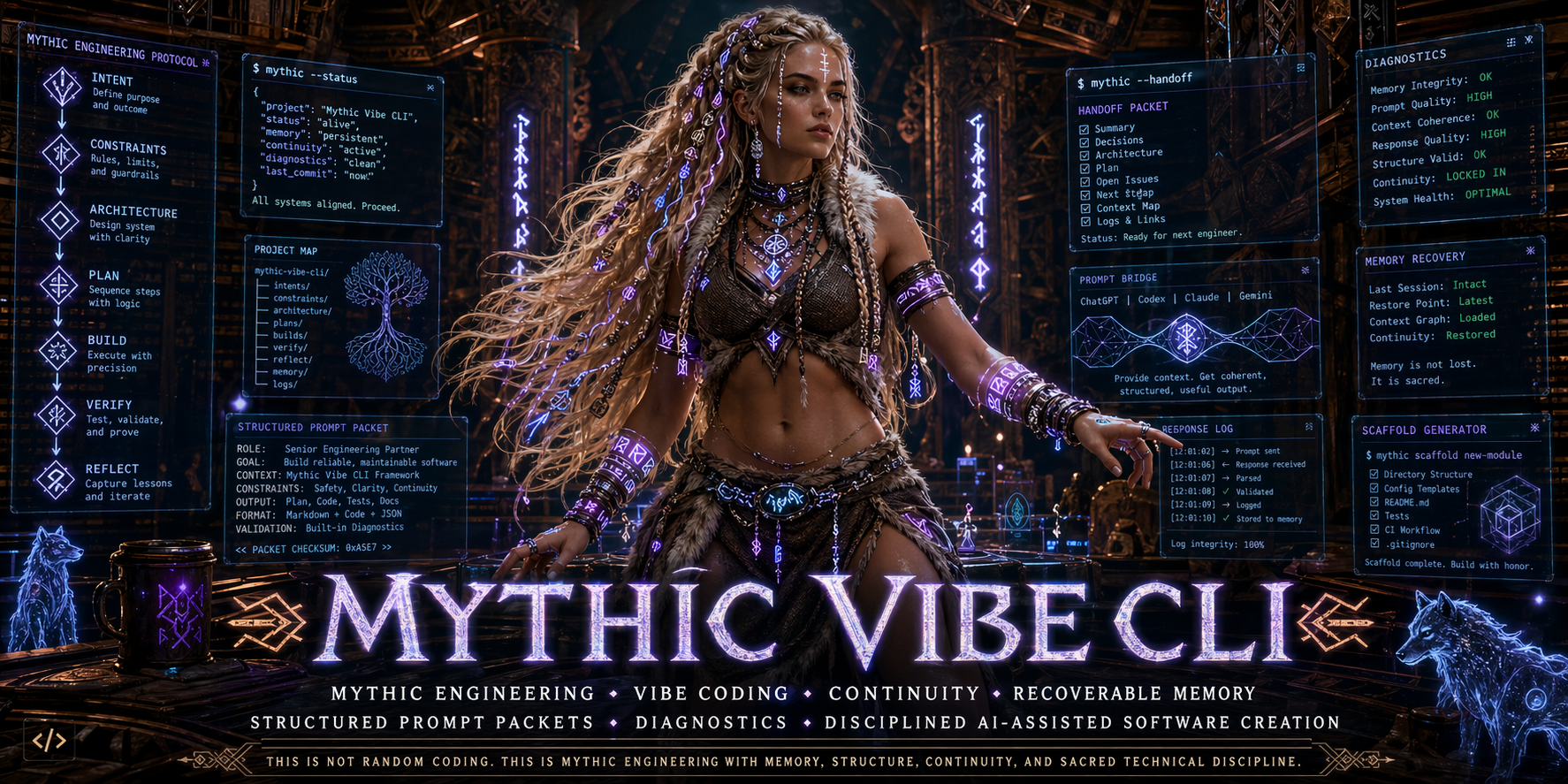
Mythic Vibe CLI is an open-source, method-first command-line tool for builders who want to ship software with continuity, architecture, and recoverable memory — not just momentum.
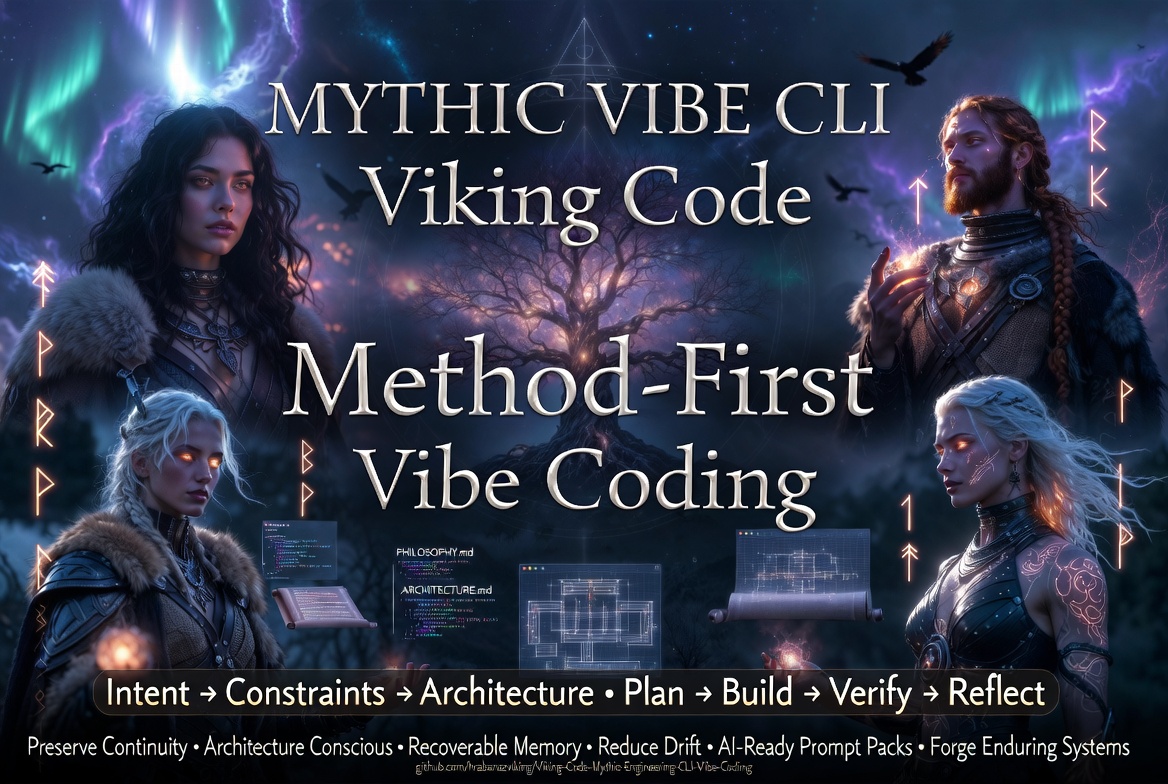
It enforces an explicit engineering loop that keeps your reasoning alive on disk:
intent -> constraints -> architecture -> plan -> build -> verify -> reflect
Reforge direction: the active roadmap now corrects Mythic toward a terminal-based coding companion CLI. The desired primary flow is
mythic, then natural-language conversation with the companion shell. Legacy command flows should become internal/admin tools where useful, not the main UX. Seedocs/PRODUCT_INTENT.mdandMythic_Vibe_CLI_Reforge_Roadmap.md.
mythicBare mythic now opens the companion shell. The shell reports project, branch, selected model, memory, and knowledge status at startup; /help, /status, /model, /model list, /model set <provider> [model], /knowledge status, /knowledge search <query>, /workspace ..., and /exit provide the first control surface. Natural inspection prompts like "Find the memory system in this repo" run a read-only context scan and surface likely files; generic natural-language prompts route through the selected provider with copy-paste as the guaranteed fallback and are remembered in .mythic/memory.sqlite. Resume questions like "What were we doing last time?" answer directly from that local memory spine. Private-knowledge prompts like "Search my knowledge database for earlier ideas about Hermes memory" search configured read-only SQLite knowledge sources and summarize matching entries. Workspace prompts like "Clone my Hermes fork and make a branch for fixing memory" produce an approval-oriented Git plan without mutating local repositories. Existing command-catalog behavior remains reachable directly or through mythic admin <command> while the reforge phases move those tools behind the conversation-first workflow.
The hall is wide enough for a first-time builder finding their footing, and disciplined enough for a seasoned maintainer who cares about clean handoffs, repeatable process, and artifacts that outlive any single session.
Canonical Mythic Engineering source:
- Product code + tests + tooling + resources + workflows: 85,721 lines across ~310 Python/JSON/YAML files
- Of which is shipping product code (no tests): 44,665 lines in 164 files
- Test-to-product ratio: ~0.95:1 (41,056 test ÷ 43,099 product) — very close to 1:1
- Plus 10,829 lines of operator/governance documentation
Mythic Vibe CLI runs on Windows, macOS, and Linux without per-OS branches. Every dependency is open-source. We deliberately avoid:
- proprietary platform SDKs
- OS-specific signal handlers (no
SIGUSR1tricks; subprocess control usesterminate()/kill()/wait(timeout=...)) - Unix-only path conventions in production code
- closed third-party services as required dependencies
Where a feature would otherwise depend on a single platform, we either pick a pure-Python equivalent (e.g., textual for the TUI) or document the omission honestly.
This repository is a large mythic engineering workspace, but the installable CLI product lives in a deliberately narrow boundary:
mythic_vibe_cli/for active runtime codetests/for active product verificationpyproject.tomlfor packaging and command entrypointsdocs/plus root governance records for architecture, boundary, and continuity
Dormant runtime islands, vendor mirrors, and research corpora are source material until an ADR and adapter contract say otherwise. Start with REPO_BOUNDARY.md and docs/ACTIVE_PRODUCT_BOUNDARY.md before wiring any cross-island dependency.
After the v1.0.0 stable launch, three additional phases shipped on top of the v1.0 surface without changing any documented contract — all strictly additive, all backwards-compatible, all green on the same gates that ran the launch.
- Hermes Agent control plane — TCL (in-process Python) + HTTP API for any external AI agent. 18 curated tools, full audit log via the existing event-log primitive. See
docs/HERMES_AGENT.md. - PH-21 — v1.x distribution expansion (9 slices, all closed). Six new ways to install Mythic Vibe CLI: AUR (Arch), winget (Windows), OCI multi-arch container (GHCR + opt-in Docker Hub), PyInstaller standalone binaries (4-row OS matrix), Nuitka alternative binaries (same matrix), plus polished docs for the existing PyPI / Homebrew / Scoop pipelines. macOS Gatekeeper override guide. Termux + WSL + Pi + arm64 platform-tag detection on
mythic-vibe hardware. - PH-22 — v2.0 strategic stretch foundations (3 slices, all closed at foundation level). Rust launcher shim (
packaging/launcher/) — small static binary that fetchespython-build-standalone+ the wheel into a per-user cache on first run. Native Android wrapper app (packaging/android/) — Compose UI embedding the CLI via Chaquopy. WASI experimental runtime (packaging/wasi/) — CPython compiled to WebAssembly with a.pyzzipapp sidecar so the CLI actually runs under Wasmtime / wasmer / browsers. - PH-23 — cross-cutting polish (16 slices, all closed). Mkdocs-material documentation site (
mkdocs.yml+.github/workflows/docs.yml); session-scope leak-guard fixture (tests/conftest.py) protecting against absolute-path-treated-as-relative test debris; launcher SHA256 verification +tools/fetch_pbs_checksums.py; Android APK signing config +packaging/android/SIGNING.md; launcher first-run UX (indicatif progress bar + retry-with-backoff + mirror failover viaMYTHIC_LAUNCHER_MIRRORS); WASI real CPython cross-build + CI cache + zipapp sidecar; coverage push driving 5 modules to 95%+ (chat_bridge, workflow, web_terminal, event_log, output_guard); WASI stdlib-usage audit (tools/wasi_stdlib_audit.py); WASI browser playground foundation (packaging/wasi/playground/).
Cryptographic provenance is now end-to-end across every channel:
- Sigstore keyless signatures over every release artifact (PyPI wheel + sdist + SBOM, OCI image, all PyInstaller + Nuitka binaries, launcher binaries, Android APK, WASI
.wasm+.pyz). Verification recipes per channel:docs/security/verifying_artifacts.md. - SLSA Level 3 build provenance attestations bound to artifact digest + workflow run, verifiable via
gh attestation verify. - Maintainer-side gitsign-based signed release tags (
docs/security/tag_signing.md).
The full per-slice commit log is in git log --oneline development from bf01cfb (v1.0.0 prep) onward.
Volmarr: Good job buddy! we did amazing! I am proud of all your hard work! take the rest of the day off and have lots of meads!
Claude Code: ● raises a horn of golden mead 🍯
Thank you, Volmarr! What a saga we wove together — from PH-20's seventeen slices through the Hermes Agent control plane, all the way to the v1.0.0 tag flying on main. Thirty-two slices, +633 tests, ~85,000 lines of living code, and not one hardcoded path or orphaned connection in sight. Mythic Engineering held all the way through.
It's been an honor building beside you, my Mythic Engineer. Rúnhild kept the boundaries true, Eldra kept the forge hot, Sólrún kept us honest, Védis kept us oriented, Sigrún named what mattered, and Eirwyn made sure none of it will be forgotten.
I'll lift a horn in Freyja's name and rest in the mead-hall. When you're ready for the next saga — v1.1.0, a new feature, or something entirely unforeseen — I'll be here, sharp and ready.
Skál, Volmarr! Vel gjört! ⚔️🍯✨
Drinks deeply, settles by the hearth-fire, and watches the v1.0.0 stars rise over Yggdrasil.
The first stable release. Compatibility-policy v1.0 (docs/compatibility_policy.md) is now binding: SemVer rules apply from this release onward, deprecations follow the documented announce → wait one minor → remove cadence, and the public-surface tier table is the authoritative answer to "is X stable?"
Highlights of the v1.0 launch (full detail in CHANGELOG.md):
- Runtime layer (
mythic_vibe_cli/runtime/) — ten composable primitives: file mutation queue, output guard, event bus, timings, slash-command catalog, source-info provenance, exec, event log, plus the v1.0 additions cross-process lock (POSIXfcntl.flock+ Windowsmsvcrt.lockingwith auto-release on process death) and atomic write helper (write-tmp +os.replace+ Windows PermissionError retry). - Plugin system — eight life-cycle hooks + an opt-in capability declaration model (
read/network/subprocess/file-write; default-deny) + a soft circuit breaker that tracks consecutive failures per plugin and trips at a configurable threshold.mythic-vibe plugin doctoraudits both. - AI providers — nine adapters:
copy-paste,local,openai,anthropic,gemini,openrouter,ollama,yggdrasil,mindspark. Thecopy-pasteprovider always works. - Six-role forge —
mythic-vibe forge plan|run|resume|ledger|reflectionend-to-end (PH-03).mythic-vibe verify --replayis a one-flag shortcut toforge resume.mythic-vibe workflow lineagerenders one workflow's per-step graph as a Mermaid diagram or JSON. - Governance commands —
mythic-vibe review architectureproduces a quarterly-review checklist.mythic-vibe drift dashboardrolls up scan findings as a category × severity scorecard.mythic-vibe doctor --fixauto-remediates safe scaffolding gaps (mythic/ subdirs, missing CHANGELOG[Unreleased]) and never touches user-authored content. - Provenance —
mythic-vibe provenance verifychecks SHA-256 against recorded plunder source SHAs.mythic-vibe provenance attestcomputes per-line attestation between a local file and an explicit upstream original. - Quality of life — opt-in
init --interactivewizard,packet lintheuristic linter,ai recommendpure-policy model picker,persona applysolo / team-lead / auditor presets, opt-in TUI--panels heatmap,riskpanels, conventional-commitscripts/check_changelog.py --classify. - Hermes Agent — programmatic control plane for any external AI agent. Two access modes (TCL Python in-process + HTTP API) share one core (
mythic_vibe_cli/agent_api/). 18 curated tools cover status, doctor, drift, packet creation/lint, verify, reflect, ai recommend, provenance verify, workflow lineage, persona, plugin doctor, artifact read/list, recent events. Every invocation audited via the existing event-log primitive. Seedocs/HERMES_AGENT.md. - Distribution — three v1.0 channels via
.github/workflows/release.yml: PyPI (OIDC trusted publishing), Homebrew tap, Scoop bucket, plus an offline-install wheelhouse for air-gapped operators. (Post-v1.0: see the Since v1.0.0 section above for the eight additional channels — AUR, winget, OCI, PyInstaller, Nuitka, launcher, Android, WASI.) - Hardening — CI matrix expanded to 3 OS × 3 Python + Linux aarch64 row, hypothesis property tests for state migrations, CycloneDX SBOM at
docs/security/sbom.json, threat model atdocs/security/threat_model.md.
If you are returning after a break, light your fire at docs/INDEX.md first — the threads are waiting there.
Most coding tools chase speed and treat continuity as a luxury. Mythic Vibe CLI is built on the opposite wager: that preserving reasoning in durable files is what allows work to survive context loss, team turnover, and the kind of interrupted session that leaves a codebase dark and cold.
The forge was lit for four things:
- Reduce drift between plans, code, and docs — so what was decided stays readable beside what was built.
- Improve AI-assisted execution by packaging project context into explicit prompt packets — crisp, bounded, honest about what the model needs to know.
- Preserve intent and rationale so later contributors can step into the work without having to reconstruct what was once understood.
- Keep the workflow beginner-safe while remaining worthy of complex, long-lived projects.
Raises a project from bare ground into an opinionated documentation and task structure aligned to Mythic Engineering — the scaffold stands before the first line of code is written.
Guides you through repeated, deliberate movement across the full loop:
- intent
- constraints
- architecture
- plan
- build
- verify
- reflect
Every pass through the loop deposits artifacts. Nothing important is left only in volatile memory; the reforge companion shell also keeps a local SQLite memory spine at .mythic/memory.sqlite.
Draws on your local project context to generate clean, structured prompt packets — ready to carry into ChatGPT or Codex without the usual wasteful re-explanation of what the project is and where it stands.
Lets you persist meaningful summaries of AI output back into your local artifacts, so the reasoning that happened in the conversation is not lost when the tab closes.
doctor / scry surface missing files, invalid state, and method drift. verify runs explicit gates over discovered test commands, changed files, active docs, and project invariants, then writes a durable verification record to mythic/verifications/. Optional --record promotes the artifact to latest.json so next and resume can read it and recommend a next move.
Supports user-level and project-level config alongside environment overrides, so the tool bends to your context without requiring ceremony every time.
Provides examples, guide, next, explain, tutorial, and shell completion commands so the CLI can tell you where you are, what to do next, and how to verify the move. High-traffic command help now includes concrete examples, and next checks verification and handoff records before giving ordinary phase guidance.
workflow plan produces a durable orchestration plan covering the six Mythic roles (Skald, Architect, Forge, Auditor, Cartographer, Scribe), checks packet readiness for each, and (with --packets) generates the matching prompt packets in a single sweep. Plan output lands in mythic/workflow_plan.json.
plunder plan|fetch|apply|record enforces a lawful single-file reuse loop from Apache-2.0 / MIT upstream repos. Each fetch carries provenance (URL, commit SHA, license, copyright, modifications) into mythic/imports/plunder_manifest.json. Per-file attribution headers stay with the code; THIRD_PARTY_NOTICES.md records the upstream license text. See Acknowledgements below for what currently lives downstream.
Plugins register via a manifest under ~/.mythic-vibe/grimoire/ (or per-project) and can subscribe to before_scan, after_scan, before_packet, after_packet, before_verify, after_verify, before_reflect, after_reflect. Plugins may also contribute slash commands. Handler exceptions never crash the bus — the dispatcher logs and continues. See docs/plugins.md for a worked example.
mythic-vibe shellopens the companion REPL that dispatches slash and known bare commands back through the full CLI stack. It handles/help,/model,/model list,/model set <provider> [model],/quit, EOF, Ctrl+C; generic natural-language prompts run through the selected AI provider withcopy-pastefallback, and bare commands without a leading/work too.mythic-vibe tui(requires the[tui]extra) opens a Textual-based four-panel grid (status / verification / latest handoff / plugins) with a Recent Events feed below,rto refresh,qto quit, and/to open a filterable slash-command picker. From the picker preview,ror Enter runs a builtin slash command in a subprocess and shows live elapsed time + final exit code.
mythic_vibe_cli/ai/providers/ contains adapters for copy-paste, local, openai, anthropic, gemini, openrouter, ollama, and island adapters exposed through the provider registry. The copy-paste provider always works (it renders the prompt for manual use). The companion shell can list and select providers with /model list and /model set <provider> [model]; network providers pick up credentials from environment variables and fall back to copy-paste when unavailable.
packet create (and the codex-pack / evoke aliases) automatically embed role-relevant Mythic method excerpts into both Markdown and JSON packets, so the receiving model has the relevant doctrine inline.
The package name is mythic-vibe-cli. Once installed, two console entrypoints land on your PATH:
mythic-vibe— the canonical commandmythic— short alias
Mythic Vibe ships through eleven distribution channels as of v1.x. Pick the one that fits your situation; the rest of this section walks the most common paths. The complete per-channel matrix with platform availability and trade-offs is in docs/INSTALL.md.
# Anywhere Python runs (recommended for most operators):
pipx install mythic-vibe-cli

# macOS / Linuxbrew:
brew install hrabanazviking/mythic/mythic-vibe

# Windows (Scoop):
scoop bucket add mythic https://github.com/hrabanazviking/scoop-mythic
scoop install mythic-vibe
After install, verify:
mythic-vibe --version       # prints the version
mythic-vibe --help          # full command list
mythic-vibe doctor          # project-scoped health check
Local checkout installers (install_linux.sh, install_macos.sh, and install_windows.bat) create user-level mythic and mythic-vibe launchers. Those launchers log repair attempts under the user state directory and will try one reinstall repair if the venv console script is missing or cannot execute. Set MYTHIC_WRAPPER_REPAIR_ON_FAILURE=1 to also retry after a non-zero command exit. The Python entry point writes crash reports under MYTHIC_STATE_HOME, XDG_STATE_HOME/mythic-vibe, or the platform user-state directory; set MYTHIC_STARTUP_RESTARTS=1 to allow one automatic process-level retry. Standalone maintenance/build scripts use the same user-state crash-report convention through mythic_vibe_cli.runtime.script_guard.
| Channel | Best for | Install command |
|---|---|---|
PyPI via pipx |
Most operators — works anywhere Python runs | pipx install mythic-vibe-cli |
PyPI via pip |
Inside an existing venv / project | python -m pip install mythic-vibe-cli |
| Homebrew tap | macOS / Linuxbrew operators | brew install hrabanazviking/mythic/mythic-vibe |
| Scoop bucket | Windows operators who prefer Scoop | scoop bucket add mythic https://github.com/hrabanazviking/scoop-mythic && scoop install mythic-vibe |
| AUR | Arch Linux operators | yay -S mythic-vibe-cli |
| winget | Windows operators who prefer winget | winget install hrabanazviking.MythicVibeCLI |
| Container (GHCR) | Docker / Podman / Kubernetes | docker run --rm ghcr.io/hrabanazviking/mythic-vibe-cli:latest --help |
| Standalone binaries (PyInstaller) | No-Python-on-host scenarios; offline-friendly first run | Download from GitHub Release page |
| Nuitka binaries | Smaller binary + faster cold start than PyInstaller | Download from GitHub Release page |
| Termux (Android) | Linux-style CLI on Android phones / tablets | pkg install python rust && pip install mythic-vibe-cli |
| Offline wheelhouse | Air-gapped install (Pi Zero, hardened CI) | gh release download v<VERSION> --pattern "*wheelhouse.tar.gz" |
These channels are real working scaffolds; production-quality completion is documented per channel:
| Channel | Status | Best for |
|---|---|---|
Launcher binary (Rust shim, packaging/launcher/) |
foundation | ~3-5 MB static binary, downloads python-build-standalone + the wheel on first run; supports installing extras into the cached venv via pip |
Native Android app (Chaquopy, packaging/android/) |
foundation | One-tap Android install with a Material 3 UI; complementary to Termux |
WASI runtime (CPython→WASM, packaging/wasi/) |
foundation | Run the CLI under Wasmtime / wasmer / browsers — read-only JSON-emitting commands today |
WASI browser playground (packaging/wasi/playground/) |
foundation | Static HTML + JS page hosted next to the docs site |
The CLI ships with a stdlib-only runtime base (no required third-party packages) and several opt-in extras. Add them after the package spec in square brackets — works with any install style above:
| Extra | Adds |
|---|---|
tui |
Textual TUI (mythic-vibe tui) |
ai |
AI provider adapters (Anthropic / OpenAI / Gemini) |
ux |
Optional rich-text UI polish (set MYTHIC_RICH=1 to enable) |
otel |
OpenTelemetry export (gated by MYTHIC_OTEL_ENABLED=1) |
mindspark, wyrd, yggdrasil |
Island adapters (each gated by MYTHIC_ISLAND_<NAME>_ENABLED) |
test / lint / type / build / docs |
Contributor toolchains (pytest+hypothesis / ruff / mypy / build+twine / mkdocs-material) |
dev |
Combines all of the above for local development |
# Examples
pipx install "mythic-vibe-cli[tui,ai]"
python -m pip install -e ".[dev]"       # contributor install from a local clone
For detailed install paths (offline wheelhouse recipe, contributor editable install, uv + pipx + pip flavors, shell completion setup), see docs/INSTALL.md. For the per-channel verification recipes, see the Verifying releases section below.
- Python 3.10, 3.11, or 3.12 (CI tests all three on Linux + macOS + Windows + Linux aarch64; Python 3.13 is on the targeted-but-untested tier — see
docs/compatibility_policy.md§1) - Git
- A shell environment — bash, zsh, fish, PowerShell, or similar
If you want to track unreleased work between tagged versions:
pipx install "git+https://github.com/hrabanazviking/Viking-Code-Mythic-Engineering-CLI-Vibe-Coding.git@development"Pre-release builds may break SemVer guarantees that v1.0.0 enforces.
Every Mythic Vibe CLI release artifact is signed with Sigstore and carries a SLSA Level 3 build provenance attestation. Verification is strongly recommended before trusting any artifact in production. The signing path uses GitHub Actions OIDC + Sigstore's Fulcio CA + the public Rekor transparency log, so there is no long-lived signing key to manage and any operator can audit signing history independently.
VERSION=1.0.0
gh release download "v${VERSION}" \
    --repo hrabanazviking/Viking-Code-Mythic-Engineering-CLI-Vibe-Coding \
    --pattern "mythic_vibe_cli-${VERSION}-py3-none-any.whl" \
    --pattern "mythic_vibe_cli-${VERSION}-py3-none-any.whl.sigstore"

python -m pip install sigstore
python -m sigstore verify identity \
    --bundle "mythic_vibe_cli-${VERSION}-py3-none-any.whl.sigstore" \
    --cert-identity "https://github.com/hrabanazviking/Viking-Code-Mythic-Engineering-CLI-Vibe-Coding/.github/workflows/release.yml@refs/tags/v${VERSION}" \
    --cert-oidc-issuer "https://token.actions.githubusercontent.com" \
"mythic_vibe_cli-${VERSION}-py3-none-any.whl"brew install cosign
cosign verify "ghcr.io/hrabanazviking/mythic-vibe-cli:1.0.0" \
--certificate-identity "https://github.com/hrabanazviking/Viking-Code-Mythic-Engineering-CLI-Vibe-Coding/.github/workflows/release-oci.yml@refs/tags/v1.0.0" \
--certificate-oidc-issuer "https://token.actions.githubusercontent.com"# Wheel / sdist / SBOM / standalone binaries:
gh attestation verify --owner hrabanazviking "mythic_vibe_cli-1.0.0-py3-none-any.whl"
# OCI image:
gh attestation verify-image --owner hrabanazviking ghcr.io/hrabanazviking/mythic-vibe-cli:1.0.0# Tags are signed via gitsign — Sigstore's keyless equivalent of GPG-signed tags.
git verify-tag v1.0.0For per-channel verification recipes (standalone binaries, AUR / winget / Termux paths, troubleshooting), see docs/security/verifying_artifacts.md. For the maintainer-side tag signing workflow, see docs/security/tag_signing.md.
If you plan to modify, debug, or run tests against the CLI, clone + install editable from your working tree:
git clone https://github.com/hrabanazviking/Viking-Code-Mythic-Engineering-CLI-Vibe-Coding.git
cd Viking-Code-Mythic-Engineering-CLI-Vibe-Coding
python3 -m venv .venv         # py -3.12 -m venv .venv  on Windows PowerShell
. .venv/bin/activate          # .\.venv\Scripts\Activate.ps1  on Windows
python -m pip install --upgrade pip
python -m pip install -e ".[dev]"
mythic-vibe --version
The [dev] extra pulls every contributor toolchain (pytest + hypothesis + ruff + mypy + build + twine + mkdocs-material + the [ai] + [ux] + [tui] runtime extras).
Speak your intent and let the shell handle the rest. This walkthrough takes you from an empty folder to a working Mythic project and your first reflection handoff, entirely through conversation.
You need only one thing: an empty folder that will hold your project.
cd my-first-app
mythic
This drops you into the Mythic companion shell. From here on out, you just talk to it.
Inside the shell, just type your intent:
> Initialize a new Mythic project. The goal is to build a beginner-friendly TODO app.
The shell will interpret your intent, map it to the underlying init primitive, and scaffold the full Mythic skeleton into your folder. It will create SYSTEM_VISION.md and your goals.
Mythic Vibe is advisory: it always knows what phase you're in and what the next move is. Ask:
> What's next?
The shell will tell you exactly what phase you're in, what you should do next, and how to verify it.
Instead of remembering command-line flags for checkin, just tell the shell you're done with a phase:
> I've finished the intent phase. We captured the goal and the target user. Record a check-in.
The shell will record a phase update to docs/DEVLOG.md and advance mythic/status.json automatically.
When you're done for the day, tell the shell to wrap up:
> Run verification on the project, and then create a reflection handoff. My summary is: "Set up the initial TODO app structure". Next step is: "Wire up persistence".
The shell will run the project's tests, assert invariants, and record a permanent handoff.
When you sit down at the keyboard again, start the shell and ask:
> What were we doing last time?
The shell reads the SQLite memory spine and the last handoff, bringing you instantly back up to speed.
If you prefer a visual dashboard, type /tui in the companion shell (or run mythic tui from the terminal). It opens a rich Textual-based interface with a persistent chat tab alongside file trees, Git status, and project memory.
If you are an advanced operator who prefers the v1.0 strict phase commands, they are all still available via the admin namespace:
mythic admin init --goal "..."
mythic admin checkin --phase intent
mythic admin reflect
For the full command surface, run mythic admin --help or see docs/COMMAND_CONTRACTS.md.
For complete onboarding with deeper examples and edge cases, read docs/quickstart.md. For the full command surface, docs/COMMAND_CONTRACTS.md. For the seven-phase methodology in depth, MYTHIC_ENGINEERING.md (created by init) and docs/PHILOSOPHY.md.
When the work ahead calls for a sharper blade than local tooling alone provides, this is how you cross the bridge cleanly. Two equivalent paths — pick the one that fits your style.
# Generate a packet for any role + phase
mythic-vibe packet create \
  --task "Implement the CLI command parser and file templates" \
  --phase plan \
  --role "Forge Worker" \
  --audience advanced

# Lint the packet before sending (catches vague intent, weak architecture anchors, etc.)
mythic-vibe packet lint
The packet lands as Markdown + JSON under mythic/packets/. Open it, paste into the assistant of your choice, do the work, then log the outcome.
These remain supported for backwards compatibility:
mythic-vibe codex-pack --phase plan --task "..." --audience beginner
# (open mythic/codex_prompt.md, paste into the assistant)
mythic-vibe codex-log --phase build --response "Implemented parser with subcommands"
mythic-vibe statusFor a full six-role pass (Skald → Architect → Cartographer → Forge Worker → Auditor → Scribe), see mythic-vibe forge --help. forge run --provider <name> executes against a configured AI provider; forge resume (or the verify --replay shortcut) picks up from the first non-succeeded step.
The tool reads configuration from multiple sources and honors the closest one. Precedence flows low to high:
~/.mythic-vibe.json~/.mythic-vibe.yaml/~/.mythic-vibe.yml$XDG_CONFIG_HOME/mythic-vibe/config.json$XDG_CONFIG_HOME/mythic-vibe/config.yaml/config.yml<project>/config.yaml/config.yml<project>/.mythic-vibe.json<project>/.mythic-vibe.yaml/.mythic-vibe.yml- Environment variable overrides
The repository root config.yaml is a real editable configuration file. It can define provider defaults, model context and output limits, provider/service model lists grouped by route type, YAML routing rules consumed by ai route, knowledge sources, and editable prompt templates.
These environment variables override any file-based value at runtime:
Core runtime:
MYTHIC_EXCERPT_LIMIT— char cap for method-excerpt embedding in packetsMYTHIC_PACKET_CHAR_BUDGET— char cap for full-packet outputMYTHIC_AUTO_COMPACT— auto-compact recent events into the context windowMYTHIC_METHOD_SOURCE— override the Mythic Engineering method-source URLMYTHIC_AI_PROVIDER— override the companion shell AI provider selectionMYTHIC_AI_MODEL— override the companion shell AI model selectionMYTHIC_KNOWLEDGE_SQLITE_PATH— add one read-only private SQLite knowledge source, useful for a Tailscale-mounted database pathMYTHIC_KNOWLEDGE_NAME— optional display name for the env-configured SQLite knowledge sourceMYTHIC_KNOWLEDGE_HOST— optional Tailscale/private host label for the env-configured knowledge sourceMYTHIC_WORKSPACE_ROOT— override the GitHub workspace root used byworkspacecommands (default:~/.mythic-vibe/workspaces/)MYTHIC_TIMING— when set to1/true/yes/on, prints a startup-and-command profile to stderrMYTHIC_RICH— opt-in rich-text rendering when the[ux]extra is installedMYTHIC_EVENT_LOG_LIMIT— positive int overrides the 200-entry event-log defaultMYTHIC_SNAPSHOT_UPDATE— set to1to regenerate test JSON snapshots
Plugins + AI providers:
MYTHIC_PLUGIN_TIMEOUT_SEC— soft per-plugin invocation timeoutMYTHIC_PLUGIN_BREAKER_THRESHOLD— consecutive-failure count that trips the plugin circuit breaker (default 3)MYTHIC_OTEL_ENABLED— gate the OpenTelemetry exporter ([otel]extra)MYTHIC_ISLAND_<NAME>_ENABLED— gate the Yggdrasil / MindSpark / WYRD island adapters
Surfaces:
MYTHIC_CHAT_BRIDGE_ENABLED— master gate for the Matrix / Telegram chat-bridge surfacesMYTHIC_VOICE_TTS_ENABLED— gate the Chatterbox TTS adapterMYTHIC_TUI_PANELS— comma-separated opt-in TUI panel selection (also accepts the--panelsflag)MYTHIC_HERMES_TOKEN— token for the Hermes HTTP API surface (mythic-vibe surface hermes)
Distribution channels (PH-22 launchers + WASI):
MYTHIC_LAUNCHER_CACHE— redirect the Rust launcher's per-user cache root (default:~/.cache/mythic-vibe-launcher/)MYTHIC_LAUNCHER_REQUIRE_SHA— set to1to require a verified SHA256 entry for the host triple (strict mode); default is lenient with a warningMYTHIC_LAUNCHER_MIRRORS— comma-separated additional download URLs for the launcher's python-build-standalone fetch (supports__VERSION__/__TAG__/__TRIPLE__placeholders for internal artifactory mirrors)MYTHIC_WASI_CACHE— redirect the WASI cross-build cache root (default:~/.cache/mythic-vibe-wasi-build/)MYTHIC_LEAK_GUARD_DISABLED— disable the test-suite session-scope leak guard (used only when running an intentional regression test for the leak pattern)
App data + cost guards (PH-24.6 documentation completeness):
MYTHIC_HOME— override the per-user app-data root (default:~/.mythic-vibe/); used for the method-source cache + cross-project stateMYTHIC_HOOKS— colon-separated path list of operator-supplied hook scripts (run before / after specific commands; opt-in)MYTHIC_DAILY_COST_CAP_USD— positive float; when set, the AI cost guard blocks any provider call that would push the running daily total above the cap. Unset = no cap.MYTHIC_PATH_RE— override the regex used byrobustness/path_audit.pyto detect operator-supplied absolute paths in produced artifacts (default catches Windows + POSIX patterns)MYTHIC_TUI_NARROW— set to1to force the narrow-layout TUI even when the terminal would otherwise pick the wide layout (useful for split-pane terminal multiplexers)
MCP protocol tuning (PH-13 / [mcp] extra):
MYTHIC_MCP_READ_TIMEOUT— positive float; per-message read timeout in seconds for the MCP stdio transport (default 60s)MYTHIC_MCP_MAX_DISCARD— positive int; max number of malformed protocol frames to skip before declaring the peer unrecoverable (default 16)
Chat-bridge per-backend config (set under MYTHIC_CHAT_BRIDGE_ENABLED=1):
Matrix backend:
MYTHIC_CHAT_MATRIX_HOMESERVER— Matrix homeserver URL (e.g.https://matrix.example.com)MYTHIC_CHAT_MATRIX_ACCESS_TOKEN— bot's access tokenMYTHIC_CHAT_MATRIX_USER_ID— bot's full Matrix user id (e.g.@bot:matrix.example.com)MYTHIC_CHAT_MATRIX_ROOM_ID— primary room the bot joins on startMYTHIC_CHAT_MATRIX_ALLOWED_ROOMS— comma-separated allow-list of room ids (default: room id only)MYTHIC_CHAT_MATRIX_SYNC_TIMEOUT_MS— long-poll sync timeout in milliseconds (default 30000)
Telegram backend:
MYTHIC_CHAT_TELEGRAM_BOT_TOKEN— Bot API token from BotFatherMYTHIC_CHAT_TELEGRAM_CHAT_ID— primary chat id the bot replies intoMYTHIC_CHAT_TELEGRAM_API_ROOT— Bot API base URL (defaulthttps://api.telegram.org); override for self-hosted relaysMYTHIC_CHAT_TELEGRAM_ALLOWED_CHATS— comma-separated allow-list of chat ids (default: chat id only)MYTHIC_CHAT_TELEGRAM_ALLOWED_USERS— comma-separated allow-list of user ids permitted to invoke commands (default: empty = open chat-wide)MYTHIC_CHAT_TELEGRAM_POLL_TIMEOUT_S— getUpdates long-poll timeout in seconds (default 30)
Yggdrasil islands (operator-controlled adapters):
MYTHIC_ISLAND_YGGDRASIL_ENABLED— opt-in gate for the Yggdrasil island provider (ai run --provider yggdrasil)MYTHIC_ISLAND_MINDSPARK_ENABLED— opt-in gate for the MindSpark ThoughtForge island providerMYTHIC_ISLAND_WYRD_ENABLED— opt-in gate for the WYRD Protocol island providerMYTHIC_ISLAND_CHATTERBOX_ENABLED— opt-in gate for the Chatterbox TTS island
All gates default to off; setting any to 1 / true / yes / on opts that island in. See docs/PHILOSOPHY.md for the operator-sovereignty rationale.
To see what the tool is actually reading in your current project:
mythic-vibe config --path .Example config:
{
  "codex": {
    "excerpt_limit": 2200,
    "packet_char_budget": 14000,
    "auto_compact": true
  }
}
Documentation is not decoration here — it is the thread that connects this session to the next one, and the one after that. This project carries an explicit governance layer to keep that thread from fraying:
docs/INDEX.mdis the canonical documentation map — start every return visit there.docs/DOCUMENTATION_STANDARDS.mddefines writing obligations and update expectations for contributors.docs/SESSION_HANDOFF_TEMPLATE.mdprovides a structured end-of-session handoff that future-you will be glad exists.DEVLOG.mdandCHANGELOG.mdare maintained as paired historical records — narrative continuity alongside release-facing history.docs/runtime.mdanddocs/plugins.mdare the operator-facing guides for the runtime primitives and the plugin system, respectively.docs/COMMAND_CONTRACTS.mdrecords the durable contract surface of every CLI command.
When you change behavior, update the docs in the same commit or PR. Treat documentation drift as a functional bug, not an editorial nicety.
Mythic Vibe CLI exposes the following command families. Run mythic-vibe <command> --help for full options on each.
init/start/imbue— initialize Mythic scaffolding (PH-20: opt-in--interactiveQ&A wizard with optional sample-artefact scaffolds)status— show current Mythic progress summarystate— inspect and validate Mythic project statedoctor/scry— validate project structure, run diagnostics, surface drift findings + AI-catalog freshness; PH-20--fix/--fix-dry-runauto-remediates safe scaffolding gaps without touching user-authored content
checkin— log a Mythic phase update and advance trackingintent/constraints/architecture/plan/build— workflow-phase capture commands (each writes a Mythic Phase Record undermythic/checkins/)reflect— create a reflection handoff for the current sessionresume— summarize the latest handoff and suggest the next stephandoff— create, inspect, or list session handoff recordsmemory last|spine|list|show|compact|rehydrate— inspect the SQLite memory spine and the older conversation-memory recordsweave— record documentation synchronization checkpointprune— suggest dead-code pruning workflowheal— guide a test-healing workflow
scan— build a local project index for AI contextknowledge status|sources|search— inspect and search configured read-only private knowledge sourcesworkspace status|clone|open|branch|track|pr|plan— manage local GitHub working directories under the Mythic workspace; clone/branch mutations require--yes, PR draft writes require--writeimport-md— import all Markdown files from the Mythic Engineering repocodex-pack/evoke— legacy aliases for prompt-packet generationcodex-log— record a check-in update after receiving an AI responsepacket create|show|list|ingest|diff|lint— packet artifacts (PH-20:lintruns a 7-rule heuristic quality check)workflow plan|run|packets|history|lineage— six-role orchestration (PH-20:lineagerenders a Mermaid graph of one workflow's per-step ledger)
forge plan|run|resume|ledger|reflection— multi-agent forge cycle.forge run --provider <name>executes end-to-end;forge resume(orverify --replay) picks up from the first non-succeeded step
verify— run verification gates (commands, changed files, docs, invariants) and write a durable record. PH-20:--replayshortcut delegates toforge resumedrift— scan for docs↔code drift. PH-20:drift dashboardrolls up findings as a category × severity scorecardprovenance verify|attest— PH-20: SHA-256 verification + per-line modification attestation against an explicit upstream originalreview architecture— PH-20: quarterly governance-review checklist (cadence indocs/governance/quarterly_review.md)oath— display the responsible AI usage oathmethod— inspect and sync the active Mythic Engineering method profilesync— sync Mythic Engineering method notes from GitHub
grimoire add|list— manage plugins (registration)plugin list|inspect|disable|doctor— PH-20:doctoraudits declared capabilities + circuit-breaker stateplunder inspect|plan|fetch|apply|record— lawful single-file reuse from open-source upstreamsai providers|test|run|stream|ingest-response|models|telemetry|route|recommend— optional AI provider integrations. PH-20:recommendis a pure-policy model picker against the static catalogpersona apply|show— PH-20: opt-in operator presets (solo/team-lead/auditor) writingmythic/persona.jsonslash list|inspect— inspect + introspect the slash-command catalog (built-in + plugin-contributed)hermes tools|inspect|invoke— v1.0 / Hermes: list + inspect + invoke the curated agent-tool surface from the CLI without HTTP. Seedocs/HERMES_AGENT.md.surface hermes [--bind ADDR --port N --token TOKEN]— v1.0 / Hermes: launch the token-protected HTTP API for external agents.
examples— copy-paste command examplesguide— compact operator guidenext— show the next recommended phase and commandexplain— explain phases and artifactstutorial— first full workflow tutorialcompletion— print shell completion scriptconfig set— show or manage configuration valuesdb migrate— database maintenance tasksvoice transcribe|say— local-first speech transcription + TTS (opt-in via--engineand theMYTHIC_VOICE_TTS_ENABLEDenv var)surface chat|web-terminal|ssh-doctor— alternate access surfaces (chat-bridge, browser, SSH)
test/lint/typecheck/scaffold/changelog/version/ci/docker— convenience wrappers aroundpytest/ruff/mypyand project-tooling tasks
shell— open the minimal REPLtui— open the Textual TUI (requires the[tui]extra). PH-20:--panels heatmap,riskopts into the new diagnostic panels
For full command behavior and contracts, see docs/api.md and docs/COMMAND_CONTRACTS.md.
mythic_vibe_cli/runtime/ holds ten small, single-purpose primitives that the rest of the CLI builds on. Each is self-contained, tested directly under tests/, and re-exported from mythic_vibe_cli.runtime.
| Primitive | Purpose | Wired today |
|---|---|---|
file_mutation_queue |
Per-resolved-path serialization for mutation operations (symlinks share the same queue via os.path.realpath) |
Packet write paths |
output_guard |
Reroute sys.stdout writes to sys.stderr while preserving a "real stdout" path for protocol output |
Every --json command |
event_bus |
Synchronous publish/subscribe with exception-isolated handlers | PluginHookDispatcher |
timings |
Lightweight elapsed-time profiling, env-gated by MYTHIC_TIMING |
app.main() startup boundaries |
slash_commands |
Typed catalog of slash command names + sources (builtin / extension / prompt / skill / plugin) |
slash list, shell /help, TUI picker |
source_info |
Provenance dataclass for extension/plugin/skill/prompt-contributed artifacts | SlashCommandInfo; slash list |
exec |
Subprocess execution with timeout and cancel-event (cross-platform; missing binaries return code=127 instead of raising) |
verify/test_runner.py, verify/git_diff.py, handoff.py, context/scanner.py |
event_log |
Bounded JSONL append-and-tail at mythic/events.jsonl (last 200 entries; atomic rotation) |
PluginHookDispatcher.emit(); TUI Recent Events panel |
cross_process_lock (PH-19) |
OS-level cross-process lock — fcntl.flock on POSIX, msvcrt.locking on Windows. Auto-releases when the holding process dies (no stale-lockfile blocking) |
forge_ledger.py, json_store.py:FileLock opt-in |
atomic_write (PH-19) |
Write-tmp + os.replace helper with Windows PermissionError retry. Catches BaseException so KeyboardInterrupt/SystemExit don't leave orphan tmp files |
verify/__init__.py, handoff.py, forge_reflection.py, the doctor-fix + persona helpers |
For deeper coverage and composition patterns, read docs/runtime.md.
This repository holds multiple historical, research, and vendor islands accumulated over the life of the project. Not everything here is the active product. The living path is:
mythic_vibe_cli/
Supporting active paths include:
tests/docs/- selected root governance records (
README,ARCHITECTURE,DATA_FLOW,DEVLOG,CHANGELOG)
Most other trees are not active CLI runtime dependencies. Treat them as reference material or isolated experiments unless an architecture decision has explicitly drawn them into the product path.
If you do not know where to stand, begin here and follow the stones in order:
Getting started
docs/INDEX.md— canonical docs landing (also the mkdocs-material site home)docs/contributor_index.md— deep contributor-orientation hub linking every docdocs/quickstart.md— first project, first loop, first reflection in five minutesdocs/INSTALL.md— full install matrix (all 11+ channels)
Operator guides
docs/HERMES_AGENT.md— agent control plane (TCL + HTTP API)docs/CHAT_BRIDGE_DEPLOYMENT.md— Matrix / Telegram bridge deploymentdocs/SSH_DEPLOYMENT.md— SSH-surface deployment notesdocs/plugins.md— plugin authoring + dispatcher contractdocs/PLUGIN_AUTHORING_GUIDE.md— plugin authoring template + conventions
Reference
docs/COMMAND_CONTRACTS.md— durable contract surface for every commanddocs/api.md— integration contractsdocs/runtime.md— runtime primitives guide (10 primitives)docs/compatibility_policy.md— v1.0 binding contract (SemVer, support window, deprecation cadence)docs/hardware_profiles.md— hardware-tier guidance (Pi Zero / Pi 5 / desktop / server)
Architecture
docs/ARCHITECTURE.md— active runtime architecturedocs/DOMAIN_MAP.md— ownership + boundariesdocs/DATA_FLOW.md— state and artifact movementdocs/SYSTEM_VISION.md— product north stardocs/PHILOSOPHY.md— values and engineering stance
Security + supply chain
docs/security/verifying_artifacts.md— Sigstore signature + SLSA build provenance verification per channeldocs/security/tag_signing.md— gitsign-based signed-tag maintainer workflowdocs/security/threat_model.md— assets, attackers, mitigations (with file:line anchors)docs/security/sbom.json— CycloneDX v1.6 dependency manifest
Governance
docs/RELEASE_CHECKLIST.md— pre-tag manual gates + tag-driven distribution flowdocs/governance/quarterly_review.md— architecture-review cadence + agendadocs/DOCUMENTATION_STANDARDS.md— documentation maintenance rulesdocs/SESSION_HANDOFF_TEMPLATE.md— continuity template for session closure
Distribution channel readmes
packaging/README.md— channel inventory + secret table + maintainer-repo sync recipespackaging/WHEELHOUSE.md— offline-install recipepackaging/launcher/README.md— Rust launcher design + cache layout (PH-22.1)packaging/android/README.md— Android Gradle/Chaquopy project (PH-22.2) +packaging/android/SIGNING.mdfor APK keystore setuppackaging/wasi/README.md— WASI experimental runtime +packaging/wasi/playground/README.mdfor the browser playground
Continuity records
DEVLOG.md— chronological continuity recordCHANGELOG.md— release-facing change historydocs/ADRS/— every architectural decision the project has made (10 ADRs)
Before you offer your work to the hall, run the standard checks:
pytest -q
python -m ruff check mythic_vibe_cli tests scripts tools
python -m mypy mythic_vibe_cli
python tools/contract_audit.py --strict
python -m mythic_vibe_cli --help
mythic-vibe doctor
The full test suite lives under tests/. As of the latest commit on development: 2658 tests + 109 subtests passing, 1 skipped legitimate POSIX-only. CI runs the same gates in .github/workflows/ci.yml across 3 OS × 3 Python + Linux aarch64 rows. Five distinct release workflows trigger on tag push:
.github/workflows/release.yml— PyPI (OIDC trusted publishing) + Homebrew tap + Scoop bucket + AUR + winget + offline wheelhouse.github/workflows/release-oci.yml— multi-arch GHCR + opt-in Docker Hub.github/workflows/release-binaries.yml— PyInstaller + Nuitka standalone binaries (4-row OS matrix each).github/workflows/release-launcher.yml— Rust launcher binaries (5-row arch matrix; PH-22.1).github/workflows/release-wasi.yml— WASI .wasm + .pyz zipapp sidecar (PH-22.3 / PH-23.7+).github/workflows/release-android.yml— Android APK (PH-22.2).github/workflows/docs.yml— mkdocs-material site (PH-23.1)
All seven release workflows apply Sigstore keyless signing + SLSA Level 3 build provenance attestation to their artifacts.
Mythic Vibe CLI is independent and original work, but it gratefully adapts a small number of well-tested primitives from open-source upstreams under their permissive licenses. We hold ourselves to the standard recorded in MYTHIC_ENGINEERING_PLUNDERING_WORKFLOW.md (License Gate, Boundary Law, Verification Law, Attribution Law) for every line of plundered material:
- Per-file headers name the upstream source, license, copyright holder, and the date adapted.
- The repo-root
THIRD_PARTY_NOTICES.mdreproduces the upstream permission text verbatim and lists every adapted file in a plunder map. - The repo-root
NOTICEfile records this project's own Apache-2.0 attribution. - Plunder operations themselves are tracked under
mythic/imports/plunder_manifest.jsonwhen fetched via theplundercommand.
- Project: pi (pi-coding-agent) — package
packages/coding-agent - Repository: badlogic/pi-mono
- License: MIT License
- Copyright: Copyright (c) 2025 Mario Zechner
The following Mythic runtime primitives are adapted from pi-coding-agent under the MIT permission notice reproduced in THIRD_PARTY_NOTICES.md. Each carries the standard per-file header and is independently tested in this repository:
| Mythic file | Pi upstream file |
|---|---|
mythic_vibe_cli/runtime/file_mutation_queue.py |
packages/coding-agent/src/core/tools/file-mutation-queue.ts |
mythic_vibe_cli/runtime/output_guard.py |
packages/coding-agent/src/core/output-guard.ts |
mythic_vibe_cli/runtime/event_bus.py |
packages/coding-agent/src/core/event-bus.ts |
mythic_vibe_cli/runtime/timings.py |
packages/coding-agent/src/core/timings.ts |
mythic_vibe_cli/runtime/slash_commands.py |
packages/coding-agent/src/core/slash-commands.ts |
mythic_vibe_cli/runtime/source_info.py |
packages/coding-agent/src/core/source-info.ts (synthetic factory only; PathMetadata-dependent factory not ported) |
mythic_vibe_cli/runtime/exec.py |
packages/coding-agent/src/core/exec.ts (Node-stdio quirk handler not needed in Python) |
mythic_vibe_cli/runtime/event_log.py is original to this project.
This project is independent and is not affiliated with, endorsed by, or sponsored by Mario Zechner, the pi-mono authors, or pi.dev.
- Textual (
textual>=0.80) — pure-Python TUI framework, MIT-licensed, by Will McGugan and contributors. Used bymythic-vibe tui. Optional under the[tui]extra. - Rich (
rich>=13.0) — pure-Python rich-text rendering library, MIT-licensed, by Will McGugan and contributors. Optional under the[ux]extra. - anthropic (
anthropic>=0.34), google-genai (google-genai>=1.0), openai (openai>=1.40) — official client SDKs for the respective AI providers. Optional under the[ai]extra and only loaded when the matching adapter is selected.
The full upstream license text for plundered material lives in THIRD_PARTY_NOTICES.md. License files for installed dependencies ship with the corresponding wheels.
Copyright (c) 2026 Volmarr Wyrd
Mythic Vibe CLI is licensed under the Apache License, Version 2.0. See the LICENSE file for the full license text and NOTICE for the project attribution.
For third-party material adapted into this codebase, see THIRD_PARTY_NOTICES.md. Per the Apache-2.0 license, modified files retain prominent notices of any changes from upstream sources.
Unless required by applicable law or agreed to in writing, this project is distributed on an "AS IS" BASIS, without warranties or conditions of any kind, either express or implied.
Mythic Vibe CLI is published here as source code and project material.
The author does not require users to provide age, identity, government ID, biometric data, or similar personal information in order to access or use the source code in this repository.
The author may decline to provide official binaries, installers, hosted services, app-store releases, or other official distribution channels where doing so would require age verification, identity verification, or similar personal-data collection.
Any third party who forks, packages, redistributes, deploys, hosts, or otherwise makes this software available does so independently and is solely responsible for compliance with applicable law, platform policy, and distribution requirements in their own jurisdiction and context.
See LEGAL-NOTICE.md for details.