-
Notifications
You must be signed in to change notification settings - Fork 2.3k
Expand file tree
/
Copy pathfail-fast.md
More file actions
337 lines (241 loc) · 12.7 KB
/
fail-fast.md
File metadata and controls
337 lines (241 loc) · 12.7 KB
1
2
3
4
5
6
7
8
9
10
11
12
13
14
15
16
17
18
19
20
21
22
23
24
25
26
27
28
29
30
31
32
33
34
35
36
37
38
39
40
41
42
43
44
45
46
47
48
49
50
51
52
53
54
55
56
57
58
59
60
61
62
63
64
65
66
67
68
69
70
71
72
73
74
75
76
77
78
79
80
81
82
83
84
85
86
87
88
89
90
91
92
93
94
95
96
97
98
99
100
101
102
103
104
105
106
107
108
109
110
111
112
113
114
115
116
117
118
119
120
121
122
123
124
125
126
127
128
129
130
131
132
133
134
135
136
137
138
139
140
141
142
143
144
145
146
147
148
149
150
151
152
153
154
155
156
157
158
159
160
161
162
163
164
165
166
167
168
169
170
171
172
173
174
175
176
177
178
179
180
181
182
183
184
185
186
187
188
189
190
191
192
193
194
195
196
197
198
199
200
201
202
203
204
205
206
207
208
209
210
211
212
213
214
215
216
217
218
219
220
221
222
223
224
225
226
227
228
229
230
231
232
233
234
235
236
237
238
239
240
241
242
243
244
245
246
247
248
249
250
251
252
253
254
255
256
257
258
259
260
261
262
263
264
265
266
267
268
269
270
271
272
273
274
275
276
277
278
279
280
281
282
283
284
285
286
287
288
289
290
291
292
293
294
295
296
297
298
299
300
301
302
303
304
305
306
307
308
309
310
311
312
313
314
315
316
317
318
319
320
321
322
323
324
325
326
327
328
329
330
331
332
333
334
335
336
337
---
title: 阿里面试官:为什么Java开发手册强制不要在 foreach 里进行元素删除?
shortTitle: Java foreach 循环陷阱
category:
- Java核心
tag:
- 集合框架(容器)
description: 本文解释了为什么在 Java foreach 循环中执行删除操作会导致问题,以及在遍历过程中如何正确地进行元素删除。阅读本文,您将避免在使用 foreach 循环时遇到的常见错误,提高编程安全性与效率。还不是因为fail-fast
head:
- - meta
- name: keywords
content: Java,fail-fast,java foreach 删除元素,foreach 循环, 删除操作, 并发修改异常
---
>这篇文章同样采用小二去面试的形式,给大家换个胃口。
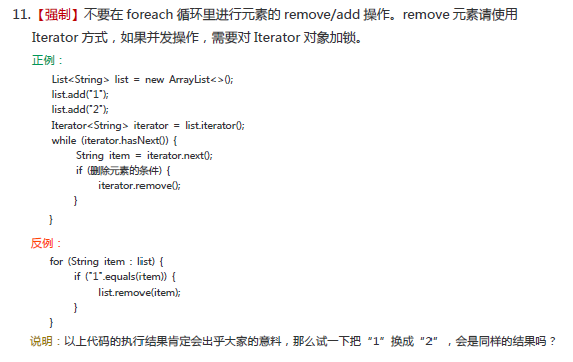
那天,小二去阿里面试,面试官老王一上来就甩给了他一道面试题:为什么阿里的 Java 开发手册里会强制不要在 foreach 里进行元素的删除操作?
小二听完这句话就乐了。为什么呢?因为一天前他刚在《[二哥的Java进阶之路](https://github.com/itwanger/toBeBetterJavaer)》上看到过这道题的答案。
以下是整篇文章的内容。
### 关于fail-fast
为了镇楼,先搬一段英文来解释一下 fail-fast。
>In systems design, a fail-fast system is one which immediately reports at its interface any condition that is likely to indicate a failure. Fail-fast systems are usually designed to stop normal operation rather than attempt to continue a possibly flawed process. Such designs often check the system's state at several points in an operation, so any failures can be detected early. The responsibility of a fail-fast module is detecting errors, then letting the next-highest level of the system handle them.
这段话的大致意思就是,fail-fast 是一种通用的系统设计思想,一旦检测到可能会发生错误,就立马抛出异常,程序将不再往下执行。
```java
public void test(Wanger wanger) {
if (wanger == null) {
throw new RuntimeException("wanger 不能为空");
}
System.out.println(wanger.toString());
}
```
一旦检测到 wanger 为 null,就立马抛出异常,让调用者来决定这种情况下该怎么处理,下一步 `wanger.toString()` 就不会执行了——避免更严重的错误出现。
很多时候,我们会把 fail-fast 归类为 Java 集合框架的一种错误检测机制,但其实 fail-fast 并不是 Java 集合框架特有的机制。
### for-each 删除元素报错
之所以我们把 fail-fast 放在集合框架篇里介绍,是因为问题比较容易再现。
```java
List<String> list = new ArrayList<>();
list.add("沉默王二");
list.add("沉默王三");
list.add("一个文章真特么有趣的程序员");
for (String str : list) {
if ("沉默王二".equals(str)) {
list.remove(str);
}
}
System.out.println(list);
```
这段代码看起来没有任何问题,但运行起来就报错了。

根据错误的堆栈信息,我们可以定位到 ArrayList 的第 901 行代码。
```java
final void checkForComodification() {
if (modCount != expectedModCount)
throw new ConcurrentModificationException();
}
```
也就是说,remove 的时候触发执行了 `checkForComodification` 方法,该方法对 modCount 和 expectedModCount 进行了比较,发现两者不等,就抛出了 `ConcurrentModificationException` 异常。
为什么会执行 `checkForComodification` 方法呢?
是因为 for-each 本质上是个语法糖,底层是通过[迭代器 Iterator](https://javabetter.cn/collection/iterator-iterable.html) 配合 while 循环实现的,来看一下反编译后的字节码。
```java
List<String> list = new ArrayList();
list.add("沉默王二");
list.add("沉默王三");
list.add("一个文章真特么有趣的程序员");
Iterator var2 = list.iterator();
while(var2.hasNext()) {
String str = (String)var2.next();
if ("沉默王二".equals(str)) {
list.remove(str);
}
}
System.out.println(list);
```
来看一下 ArrayList 的 iterator 方法吧:
```java
public Iterator<E> iterator() {
return new Itr();
}
```
内部类 Itr 实现了 Iterator 接口,这是 Itr 的源码。
```java
private class Itr implements Iterator<E> {
int cursor; // 下一个元素的索引
int lastRet = -1; // 上一个返回元素的索引;如果没有则为 -1
int expectedModCount = modCount; // ArrayList 的修改次数
Itr() { } // 构造函数
public boolean hasNext() { // 判断是否还有下一个元素
return cursor != size;
}
@SuppressWarnings("unchecked")
public E next() { // 返回下一个元素
checkForComodification(); // 检查 ArrayList 是否被修改过
int i = cursor; // 当前索引
Object[] elementData = ArrayList.this.elementData; // ArrayList 中的元素数组
if (i >= elementData.length) // 超出数组范围
throw new ConcurrentModificationException(); // 抛出异常
cursor = i + 1; // 更新下一个元素的索引
return (E) elementData[lastRet = i]; // 返回下一个元素
}
}
```
也就是说 `new Itr()` 的时候 expectedModCount 被赋值为 modCount,而 modCount 是 ArrayList 中的一个计数器,用于记录 ArrayList 对象被修改的次数。ArrayList 的修改操作包括添加、删除、设置元素值等。每次对 ArrayList 进行修改操作时,modCount 的值会自增 1。
在迭代 ArrayList 时,如果迭代过程中发现 modCount 的值与迭代器的 expectedModCount 不一致,则说明 ArrayList 已被修改过,此时会抛出 ConcurrentModificationException 异常。这种机制可以保证迭代器在遍历 ArrayList 时,不会遗漏或重复元素,同时也可以在多线程环境下检测到并发修改问题。
```java
protected transient int modCount = 0;
```
### 分析代码执行的逻辑
我们来继续定位之前报错的错误堆栈。这是之前的代码。
```java
List<String> list = new ArrayList<>();
list.add("沉默王二");
list.add("沉默王三");
list.add("一个文章真特么有趣的程序员");
for (String str : list) {
if ("沉默王二".equals(str)) {
list.remove(str);
}
}
System.out.println(list);
```
由于 list 此前执行了 3 次 add 方法。
- add 方法调用 ensureCapacityInternal 方法
- ensureCapacityInternal 方法调用 ensureExplicitCapacity 方法
- ensureExplicitCapacity 方法中会执行 `modCount++`
```java
private void ensureExplicitCapacity(int minCapacity) {
modCount++;
}
```
所以 modCount 的值在经过三次 add 后为 3,于是 `new Itr()` 后 expectedModCount 的值也为 3(回到前面去看一下 Itr 的源码)。
接着来执行 for-each 的循环遍历。
执行第一次循环时,发现“沉默王二”等于 str,于是执行 `list.remove(str)`。
- remove 方法调用 fastRemove 方法
- fastRemove 方法中会执行 `modCount++`
```java
private void fastRemove(int index) {
modCount++;
}
```
modCount 的值变成了 4。
第二次遍历时,会执行 Itr 的 next 方法(`String str = (String) var3.next();`),next 方法就会调用 `checkForComodification` 方法。
```java
final void checkForComodification() {
if (modCount != expectedModCount)
throw new ConcurrentModificationException();
}
```
此时 expectedModCount 为 3,modCount 为 4,就只好抛出 ConcurrentModificationException 异常了。
那其实在阿里巴巴的 Java 开发手册里也提到了,不要在 for-each 循环里进行元素的 remove/add 操作。remove 元素请使用 Iterator 方式。
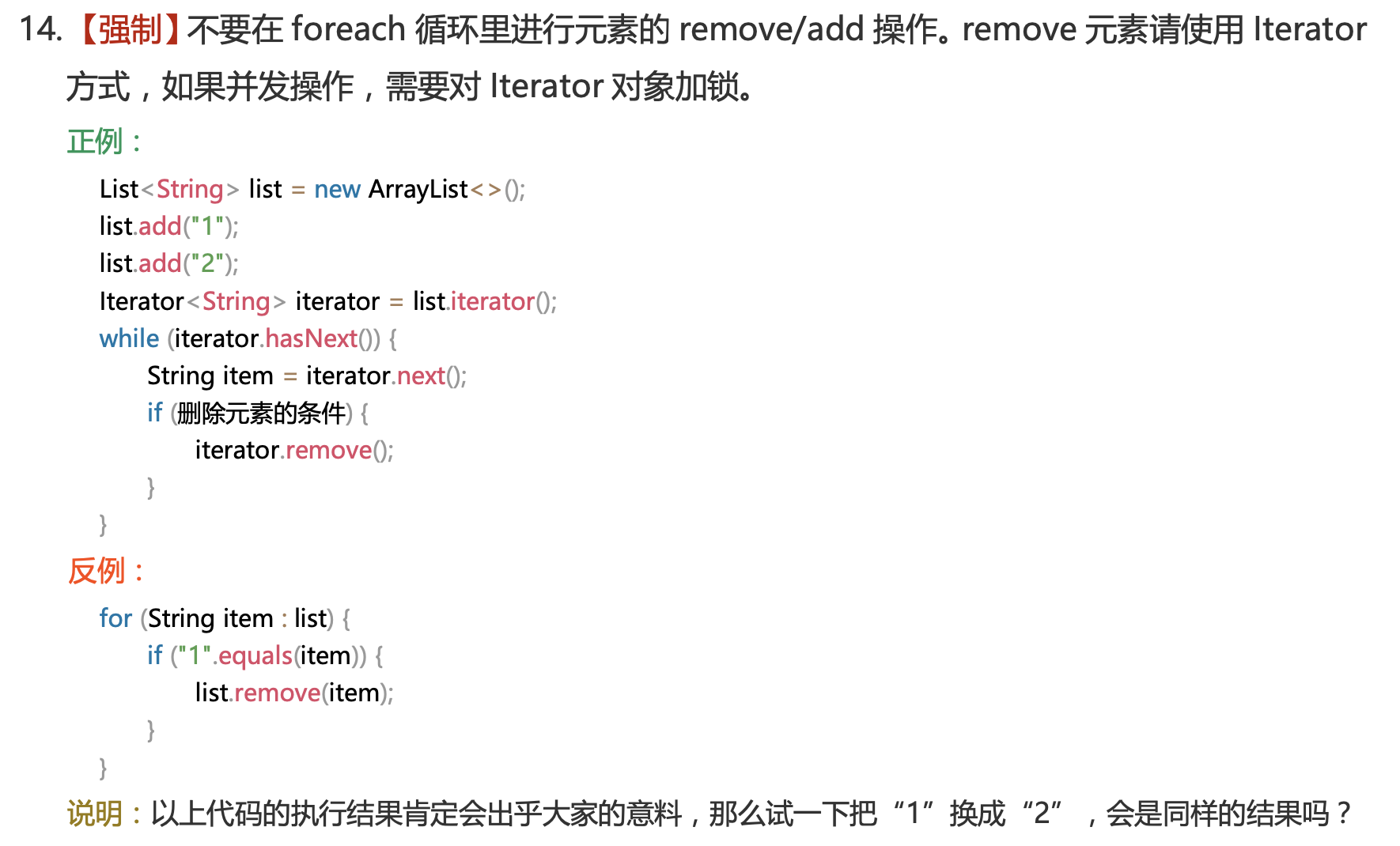
那原因其实就是我们上面分析的这些,出于 fail-fast 保护机制。
### 那该如何正确地删除元素呢?
#### **1)remove 后 break**
```java
List<String> list = new ArrayList<>();
list.add("沉默王二");
list.add("沉默王三");
list.add("一个文章真特么有趣的程序员");
for (String str : list) {
if ("沉默王二".equals(str)) {
list.remove(str);
break;
}
}
```
break 后循环就不再遍历了,意味着 Iterator 的 next 方法不再执行了,也就意味着 `checkForComodification` 方法不再执行了,所以异常也就不会抛出了。
但是呢,当 List 中有重复元素要删除的时候,break 就不合适了。
#### **2)for 循环**
```java
List<String> list = new ArrayList<>();
list.add("沉默王二");
list.add("沉默王三");
list.add("一个文章真特么有趣的程序员");
for (int i = 0; i < list.size(); i++) {
String str = list.get(i);
if ("沉默王二".equals(str)) {
list.remove(str);
}
}
```
for 循环虽然可以避开 fail-fast 保护机制,也就说 remove 元素后不再抛出异常;但是呢,这段程序在原则上是有问题的。为什么呢?
第一次循环的时候,i 为 0,`list.size()` 为 3,当执行完 remove 方法后,i 为 1,`list.size()` 却变成了 2,因为 list 的大小在 remove 后发生了变化,也就意味着“沉默王三”这个元素被跳过了。能明白吗?
remove 之前 `list.get(1)` 为“沉默王三”;但 remove 之后 `list.get(1)` 变成了“一个文章真特么有趣的程序员”,而 `list.get(0)` 变成了“沉默王三”。
#### **3)使用 Iterator**
```java
List<String> list = new ArrayList<>();
list.add("沉默王二");
list.add("沉默王三");
list.add("一个文章真特么有趣的程序员");
Iterator<String> itr = list.iterator();
while (itr.hasNext()) {
String str = itr.next();
if ("沉默王二".equals(str)) {
itr.remove();
}
}
```
为什么使用 Iterator 的 remove 方法就可以避开 fail-fast 保护机制呢?看一下 remove 的源码就明白了。
```java
public void remove() {
if (lastRet < 0) // 如果没有上一个返回元素的索引,则抛出异常
throw new IllegalStateException();
checkForComodification(); // 检查 ArrayList 是否被修改过
try {
ArrayList.this.remove(lastRet); // 删除上一个返回元素
cursor = lastRet; // 更新下一个元素的索引
lastRet = -1; // 清空上一个返回元素的索引
expectedModCount = modCount; // 更新 ArrayList 的修改次数
} catch (IndexOutOfBoundsException ex) {
throw new ConcurrentModificationException(); // 抛出异常
}
}
```
删除完会执行 `expectedModCount = modCount`,保证了 expectedModCount 与 modCount 的同步。
### 小结
为什么不能在foreach里执行删除操作?
因为 foreach 循环是基于迭代器实现的,而迭代器在遍历集合时会维护一个 expectedModCount 属性来记录集合被修改的次数。如果在 foreach 循环中执行删除操作会导致 expectedModCount 属性值与实际的 modCount 属性值不一致,从而导致迭代器的 hasNext() 和 next() 方法抛出 ConcurrentModificationException 异常。
为了避免这种情况,应该使用迭代器的 remove() 方法来删除元素,该方法会在删除元素后更新迭代器状态,确保循环的正确性。如果需要在循环中删除元素,应该使用迭代器的 remove() 方法,而不是集合自身的 remove() 方法。
就像这样。
```java
List<String> list = new ArrayList<>();
list.add("沉默王二");
list.add("沉默王三");
list.add("一个文章真特么有趣的程序员");
Iterator<String> itr = list.iterator();
while (itr.hasNext()) {
String str = itr.next();
if ("沉默王二".equals(str)) {
itr.remove();
}
}
```
除此之外,我们还可以采用 [Stream 流](https://javabetter.cn/java8/stream.html)的filter() 方法来过滤集合中的元素,然后再通过 collect() 方法将过滤后的元素收集到一个新的集合中。
```java
List<String> list = new ArrayList<>(Arrays.asList("沉默", "王二", "陈清扬"));
list = list.stream().filter(s -> !s.equals("陈清扬")).collect(Collectors.toList());
```
好了,关于这个问题,就聊到这里吧,希望能帮助到你。
----
GitHub 上标星 10000+ 的开源知识库《[二哥的 Java 进阶之路](https://github.com/itwanger/toBeBetterJavaer)》第一版 PDF 终于来了!包括Java基础语法、数组&字符串、OOP、集合框架、Java IO、异常处理、Java 新特性、网络编程、NIO、并发编程、JVM等等,共计 32 万余字,500+张手绘图,可以说是通俗易懂、风趣幽默……详情戳:[太赞了,GitHub 上标星 10000+ 的 Java 教程](https://javabetter.cn/overview/)
微信搜 **沉默王二** 或扫描下方二维码关注二哥的原创公众号沉默王二,回复 **222** 即可免费领取。
