-
Notifications
You must be signed in to change notification settings - Fork 2.3k
Expand file tree
/
Copy pathsynchronized-1.md
More file actions
336 lines (258 loc) · 16.7 KB
/
synchronized-1.md
File metadata and controls
336 lines (258 loc) · 16.7 KB
1
2
3
4
5
6
7
8
9
10
11
12
13
14
15
16
17
18
19
20
21
22
23
24
25
26
27
28
29
30
31
32
33
34
35
36
37
38
39
40
41
42
43
44
45
46
47
48
49
50
51
52
53
54
55
56
57
58
59
60
61
62
63
64
65
66
67
68
69
70
71
72
73
74
75
76
77
78
79
80
81
82
83
84
85
86
87
88
89
90
91
92
93
94
95
96
97
98
99
100
101
102
103
104
105
106
107
108
109
110
111
112
113
114
115
116
117
118
119
120
121
122
123
124
125
126
127
128
129
130
131
132
133
134
135
136
137
138
139
140
141
142
143
144
145
146
147
148
149
150
151
152
153
154
155
156
157
158
159
160
161
162
163
164
165
166
167
168
169
170
171
172
173
174
175
176
177
178
179
180
181
182
183
184
185
186
187
188
189
190
191
192
193
194
195
196
197
198
199
200
201
202
203
204
205
206
207
208
209
210
211
212
213
214
215
216
217
218
219
220
221
222
223
224
225
226
227
228
229
230
231
232
233
234
235
236
237
238
239
240
241
242
243
244
245
246
247
248
249
250
251
252
253
254
255
256
257
258
259
260
261
262
263
264
265
266
267
268
269
270
271
272
273
274
275
276
277
278
279
280
281
282
283
284
285
286
287
288
289
290
291
292
293
294
295
296
297
298
299
300
301
302
303
304
305
306
307
308
309
310
311
312
313
314
315
316
317
318
319
320
321
322
323
324
325
326
327
328
329
330
331
332
333
334
335
336
---
title: 面了一个25岁的学妹,把synchronized关键字讲的那叫一个透彻
shortTitle: synchronized关键字
description: 在 Java 中,synchronized 是一个关键字,用于控制多线程环境下的同步访问,它可以防止多个线程同时访问同一代码块或同一对象,从而保证数据的完整性和一致性。
category:
- Java核心
tag:
- Java并发编程
head:
- - meta
- name: keywords
content: Java,并发编程,多线程,Thread,synchronized
---
“三妹,今天我们来学习 synchronized 关键字吧。”我瞅了一眼坐在沙发上的三妹说,她正在王者荣耀呢。
三妹(颜值在线,气质也在线)喝了一口冰可乐接着说:“好的,二哥。马上,打完这把,看我三杀。”
在 Java 中,关键字 synchronized 可以保证在同一个时刻,只有一个线程可以执行某个方法或者某个代码块(主要是对方法或者代码块中存在共享数据的操作),同时我们还应该注意到 synchronized 的另外一个重要的作用,synchronized 可保证一个线程的变化(主要是共享数据的变化)被其他线程所看到(保证可见性,完全可以替代 [volatile](https://javabetter.cn/thread/volatile.html) 功能)。
synchronized 关键字最主要有以下 3 种应用方式:
- 同步方法,为当前对象([this](https://javabetter.cn/oo/this-super.html))加锁,进入同步代码前要获得当前对象的锁;
- 同步静态方法,为当前类加锁(锁的是 [Class 对象](https://javabetter.cn/basic-extra-meal/fanshe.html)),进入同步代码前要获得当前类的锁;
- 同步代码块,指定加锁对象,对给定对象加锁,进入同步代码库前要获得给定对象的锁。
## synchronized同步方法
通过在方法声明中加入 synchronized 关键字,可以保证在任意时刻,只有一个线程能执行该方法。
来看代码:
```java
public class AccountingSync implements Runnable {
//共享资源(临界资源)
static int i = 0;
// synchronized 同步方法
public synchronized void increase() {
i ++;
}
@Override
public void run() {
for(int j=0;j<1000000;j++){
increase();
}
}
public static void main(String args[]) throws InterruptedException {
AccountingSync instance = new AccountingSync();
Thread t1 = new Thread(instance);
Thread t2 = new Thread(instance);
t1.start();
t2.start();
t1.join();
t2.join();
System.out.println("static, i output:" + i);
}
}
```
输出结果:
```
/**
* 输出结果:
* static, i output:2000000
*/
```
如果在方法 `increase()` 前不加 synchronized,因为 i++ 不具备原子性,所以最终结果会小于 2000000,具体分析可以参考《[volatile](https://javabetter.cn/thread/volatile.html)》的内容。
>注意:一个对象只有一把锁,当一个线程获取了该对象的锁之后,其他线程无法获取该对象的锁,所以无法访问该对象的其他 synchronized 方法,但是其他线程还是可以访问该对象的其他非 synchronized 方法。
但是,如果一个线程 A 需要访问对象 obj1 的 synchronized 方法 f1(当前对象锁是 obj1),另一个线程 B 需要访问对象 obj2 的 synchronized 方法 f2(当前对象锁是 obj2),这样是允许的:
```java
public class AccountingSyncBad implements Runnable {
//共享资源(临界资源)
static int i = 0;
// synchronized 同步方法
public synchronized void increase() {
i ++;
}
@Override
public void run() {
for(int j=0;j<1000000;j++){
increase();
}
}
public static void main(String args[]) throws InterruptedException {
// new 两个AccountingSync新实例
Thread t1 = new Thread(new AccountingSyncBad());
Thread t2 = new Thread(new AccountingSyncBad());
t1.start();
t2.start();
t1.join();
t2.join();
System.out.println("static, i output:" + i);
}
}
```
输出结果:
```
/**
* 输出结果:
* static, i output:1224617
*/
```
上述代码与前面不同的是,我们创建了两个对象 AccountingSyncBad,然后启动两个不同的线程对共享变量 i 进行操作,但很遗憾,操作结果是 1224617 而不是期望的结果 2000000。
因为上述代码犯了严重的错误,虽然使用了 synchronized 同步 increase 方法,但却 new 了两个不同的对象,这也就意味着存在着两个不同的对象锁,因此 t1 和 t2 都会进入各自的对象锁,也就是说 t1 和 t2 线程使用的是不同的锁,因此线程安全是无法保证的。
> 每个对象都有一个对象锁,不同的对象,他们的锁不会互相影响。
解决这种问题的的方式是将 synchronized 作用于静态的 increase 方法,这样的话,对象锁就锁的是当前的类,由于无论创建多少个对象,类永远只有一个,所有在这样的情况下对象锁就是唯一的。
参考:[对象和类](https://javabetter.cn/oo/object-class.html)
## synchronized同步静态方法
当 synchronized 同步[静态方法](https://javabetter.cn/oo/static.html)时,锁的是当前类的 Class 对象,不属于某个对象。当前类的 Class 对象锁被获取,不影响实例对象锁的获取,两者互不影响,本质上是 this 和 Class 的不同。
由于静态成员变量不专属于任何一个对象,因此通过 Class 锁可以控制静态成员变量的并发操作。
需要注意的是如果线程 A 调用了一个对象的非静态 synchronized 方法,线程 B 需要调用这个对象所属类的静态 synchronized 方法,是不会发生互斥的,因为访问静态 synchronized 方法占用的锁是当前类的 [Class 对象](https://javabetter.cn/basic-extra-meal/fanshe.html),而访问非静态 synchronized 方法占用的锁是当前对象(this)的锁,看如下代码:
```java
public class AccountingSyncClass implements Runnable {
static int i = 0;
/**
* 同步静态方法,锁是当前class对象,也就是
* AccountingSyncClass类对应的class对象
*/
public static synchronized void increase() {
i++;
}
// 非静态,访问时锁不一样不会发生互斥
public synchronized void increase4Obj() {
i++;
}
@Override
public void run() {
for(int j=0;j<1000000;j++){
increase();
}
}
public static void main(String[] args) throws InterruptedException {
//new新实例
Thread t1=new Thread(new AccountingSyncClass());
//new新实例
Thread t2=new Thread(new AccountingSyncClass());
//启动线程
t1.start();t2.start();
t1.join();t2.join();
System.out.println(i);
}
}
/**
* 输出结果:
* 2000000
*/
```
由于 synchronized 关键字同步的是静态的 increase 方法,与同步实例方法不同的是,其锁对象是当前类的 Class 对象。
注意代码中的 increase4Obj 方法是实例方法,其对象锁是当前实例对象(this),如果别的线程调用该方法,将不会产生互斥现象,毕竟锁的对象不同,这种情况下可能会发生[线程安全问题](https://javabetter.cn/thread/thread-bring-some-problem.html)(操作了共享静态变量 i)。
## synchronized同步代码块
某些情况下,我们编写的方法代码量比较多,存在一些比较耗时的操作,而需要同步的代码块只有一小部分,如果直接对整个方法进行同步,可能会得不偿失,此时我们可以使用同步代码块的方式对需要同步的代码进行包裹。
示例如下:
```java
public class AccountingSync2 implements Runnable {
static AccountingSync2 instance = new AccountingSync2(); // 饿汉单例模式
static int i=0;
@Override
public void run() {
//省略其他耗时操作....
//使用同步代码块对变量i进行同步操作,锁对象为instance
synchronized(instance){
for(int j=0;j<1000000;j++){
i++;
}
}
}
public static void main(String[] args) throws InterruptedException {
Thread t1=new Thread(instance);
Thread t2=new Thread(instance);
t1.start();t2.start();
t1.join();t2.join();
System.out.println(i);
}
}
```
输出结果:
```
/**
* 输出结果:
* 2000000
*/
```
我们将 synchronized 作用于一个给定的实例对象 instance,即当前实例对象就是锁的对象,当线程进入 synchronized 包裹的代码块时就会要求当前线程持有 instance 实例对象的锁,如果当前有其他线程正持有该对象锁,那么新的线程就必须等待,这样就保证了每次只有一个线程执行 `i++` 操作。
当然除了用 instance 作为对象外,我们还可以使用 this 对象(代表当前实例)或者当前类的 Class 对象作为锁,如下代码:
```java
//this,当前实例对象锁
synchronized(this){
for(int j=0;j<1000000;j++){
i++;
}
}
//Class对象锁
synchronized(AccountingSync.class){
for(int j=0;j<1000000;j++){
i++;
}
}
```
## synchronized与happens before
指令重排我们前面讲 [JMM](https://javabetter.cn/thread/jmm.html) 的时候讲过, 这里我们再结合 synchronized 关键字来讲一下。
看下面这段代码:
```java
class MonitorExample {
int a = 0;
public synchronized void writer() { //1
a++; //2
} //3
public synchronized void reader() { //4
int i = a; //5
//……
} //6
}
```
假设线程 A 执行 `writer()` 方法,随后线程 B 执行 `reader()` 方法。根据 happens before 规则,这个过程包含的 happens before 关系可以分为:
- 根据程序次序规则,1 happens before 2, 2 happens before 3; 4 happens before 5, 5 happens before 6。
- 根据监视器锁规则,3 happens before 4。
- 根据 happens before 的传递性,2 happens before 5。
>在 Java 内存模型中,监视器锁规则是一种 happens-before 规则,它规定了对一个监视器锁(monitor lock)或者叫做互斥锁的解锁操作 happens-before 于随后对这个锁的加锁操作。简单来说,这意味着在一个线程释放某个锁之后,另一个线程获得同一把锁的时候,前一个线程在释放锁时所做的所有修改对后一个线程都是可见的。
上述 happens before 关系的图形化表现形式如下:
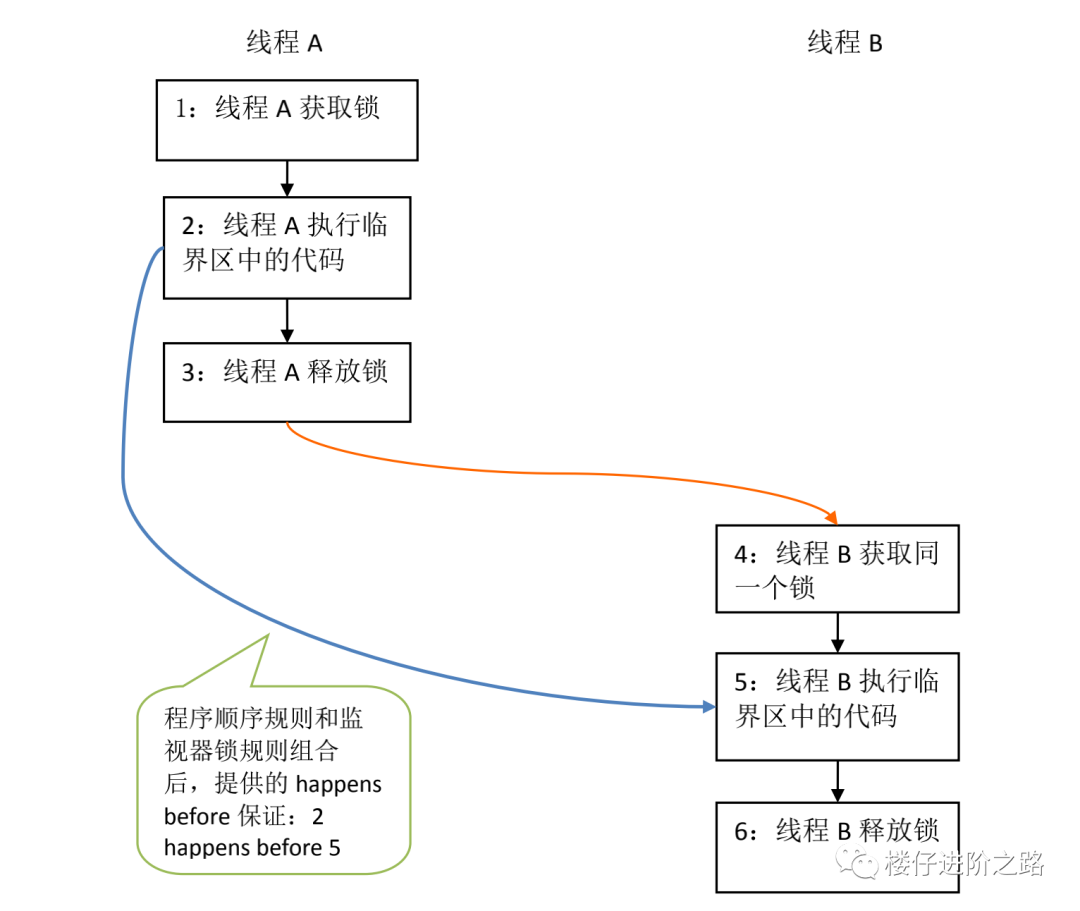
在上图中,每一个箭头链接的两个节点,代表了一个 happens before 关系。黑色箭头表示程序顺序规则;橙色箭头表示监视器锁规则;蓝色箭头表示组合这些规则后提供的 happens before 保证。
上图表示在线程 A 释放了锁之后,随后线程 B 获取同一个锁。在上图中,2 happens before 5。因此,线程 A 在释放锁之前所有可见的共享变量,在线程 B 获取同一个锁之后,将立刻变得对 B 线程可见。
也就是说,synchronized 会防止临界区内的代码与外部代码发生重排序,`writer()` 方法中 a++ 的执行和 `reader()` 方法中 a 的读取之间存在 happens-before 关系,保证了执行顺序和内存可见性。
## synchronized属于可重入锁
从互斥锁的设计上来说,当一个线程试图操作一个由其他线程持有的对象锁的临界资源时,将会处于阻塞状态,但当一个线程再次请求自己持有对象锁的临界资源时,这种情况属于重入锁,请求将会成功。
synchronized 就是可重入锁,因此一个线程调用 synchronized 方法的同时,在其方法体内部调用该对象另一个 synchronized 方法是允许的,如下:
```java
public class AccountingSync implements Runnable{
static AccountingSync instance=new AccountingSync();
static int i=0;
static int j=0;
@Override
public void run() {
for(int j=0;j<1000000;j++){
//this,当前实例对象锁
synchronized(this){
i++;
increase();//synchronized的可重入性
}
}
}
public synchronized void increase(){
j++;
}
public static void main(String[] args) throws InterruptedException {
Thread t1=new Thread(instance);
Thread t2=new Thread(instance);
t1.start();t2.start();
t1.join();t2.join();
System.out.println(i);
}
}
```
1、AccountingSync 类中定义了一个静态的 AccountingSync 实例 instance 和两个静态的整数 i 和 j,静态变量被所有的对象所共享。
2、在 run 方法中,使用了 `synchronized(this)` 来加锁。这里的锁对象是 this,即当前的 AccountingSync 实例。在锁定的代码块中,对静态变量 i 进行增加,并调用了 increase 方法。
3、increase 方法是一个同步方法,它会对 j 进行增加。由于 increase 方法也是同步的,所以它能在已经获取到锁的情况下被 run 方法调用,这就是 synchronized 关键字的可重入性。
4、在 main 方法中,创建了两个线程 t1 和 t2,它们共享同一个 Runnable 对象,也就是共享同一个 AccountingSync 实例。然后启动这两个线程,并使用 join 方法等待它们都执行完成后,打印 i 的值。
此程序中的 `synchronized(this)` 和 synchronized 方法都使用了同一个锁对象(当前的 AccountingSync 实例),并且对静态变量 i 和 j 进行了增加操作,因此,在多线程环境下,也能保证 i 和 j 的操作是线程安全的。
## 小节
“好了,三妹,今天就学到这吧。”好不容易讲完了,我长吁一口气,扶了扶眼镜对三妹说。
记住 synchronized 的三种应用方式,指令重排情况分析,以及 synchronized 的可重入性,通过今天的学习,你基本可以掌握 synchronized 的使用姿势了。
同步会带来一定的性能开销,因此需要合理使用。不应将整个方法或者更大范围的代码块做同步,而应尽可能地缩小同步范围。
在 JVM 的早期版本中,synchronized 是重量级的,因为线程阻塞和唤醒需要操作系统的介入。但在 JVM 的后续版本中,对 synchronized 进行了大量优化,如偏向锁、轻量级锁和适应性自旋等,所以现在的 synchronized 并不一定是重量级的,其性能在许多情况下都很好,可以大胆地用。
>编辑:沉默王二,编辑前的内容主要来自于二哥的[技术派](https://paicoding.com/)团队成员楼仔,原文链接戳:[volatile](https://paicoding.com/column/4/3)。
----
GitHub 上标星 10000+ 的开源知识库《[二哥的 Java 进阶之路](https://github.com/itwanger/toBeBetterJavaer)》第二份 PDF 《[并发编程小册](https://javabetter.cn/thread/)》终于来了!包括线程的基本概念和使用方法、Java的内存模型、sychronized、volatile、CAS、AQS、ReentrantLock、线程池、并发容器、ThreadLocal、生产者消费者模型等面试和开发必须掌握的内容,共计 15 万余字,200+张手绘图,可以说是通俗易懂、风趣幽默……详情戳:[太赞了,二哥的并发编程进阶之路.pdf](https://javabetter.cn/thread/)
[加入二哥的编程星球](https://javabetter.cn/thread/),在星球的第二个置顶帖「[知识图谱](https://javabetter.cn/thread/)」里就可以获取 PDF 版本。