Build project only with Java 21 and 25 - #484
Quality Monitor

🚀 Integration Tests: 100% successful (12 passed)
⛔ Architecture Tests: 100% successful (15 passed)
〰️ Line Coverage: 39% (332 missed lines)
➰ Branch Coverage: 47% (85 missed branches)
 CheckStyle: No warnings
 PMD: No warnings
☕ Java Compiler: No warnings
 SpotBugs: No bugs
🐛 Error Prone: No bugs
🚫 Revapi: 3 warnings (low: 3)
🛡️ OWASP Dependency Check: 18 vulnerabilities (high: 8, normal: 8, low: 2)
🌀 Cyclomatic Complexity: 275 (total)
💭 Cognitive Complexity: 103 (total)
➿ N-Path Complexity: 265 (total)
📏 Lines of Code: 2666 (total)
📝 Non Commenting Source Statements: 825 (total)
🔗 Class Cohesion: 100.00% (maximum)
⚖️ Weight of Class: 100.00% (maximum)
🚦 Quality Gates
Overall Status: ✅ SUCCESS
✅ Passed Gates
- ✅ Tests Success Rate: 100.00 >= 100.00
- ✅ Potential Bugs: 0.00 <= 0.00
- ✅ Style Violations: 0.00 <= 0.00
Created by Quality Monitor v3.5.0 (#e4cc310)
Details
☀️ Quality Monitor
 Tests
Tests
| Icon | Name | Reports | Passed | Skipped | Failed | Tests |
|---|---|---|---|---|---|---|
|
Unit Tests | 11 | 71 | 0 | 0 | 71 |
| 🚀 | Integration Tests | 1 | 12 | 0 | 0 | 12 |
| ⛔ | Architecture Tests | 2 | 15 | 0 | 0 | 15 |
| Total | ➖ | 14 | 98 | 0 | 0 | 98 |
⚠️ Style
| Icon | Name | Reports | Errors | High | Normal | Low | Total |
|---|---|---|---|---|---|---|---|
|
CheckStyle | 2 | 0 | 0 | 0 | 0 | 0 |
|
PMD | 3 | 0 | 0 | 0 | 0 | 0 |
| ☕ | Java Compiler | 1 | 0 | 0 | 0 | 0 | 0 |
| ➕ | Total | 6 | 0 | 0 | 0 | 0 | 0 |
🐛 Bugs
| Icon | Name | Reports | Errors | High | Normal | Low | Total |
|---|---|---|---|---|---|---|---|
|
SpotBugs | 1 | 0 | 0 | 0 | 0 | 0 |
| 🐛 | Error Prone | 1 | 0 | 0 | 0 | 0 | 0 |
| ➕ | Total | 2 | 0 | 0 | 0 | 0 | 0 |
🚫 API Problems
| Icon | Name | Reports | Errors | High | Normal | Low | Total |
|---|---|---|---|---|---|---|---|
| 🚫 | Revapi | 1 | 0 | 0 | 0 | 3 | 3 |
🛡️ Vulnerabilities
| Icon | Name | Reports | Errors | High | Normal | Low | Total |
|---|---|---|---|---|---|---|---|
| 🛡️ | OWASP Dependency Check | 1 | 0 | 8 | 8 | 2 | 18 |
👣 Code Coverage
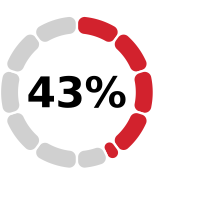
| Icon | Name | Covered % | Missed % |
|---|---|---|---|
| 〰️ | Line Coverage | 39 | 61 |
| ➰ | Branch Coverage | 47 | 53 |
| ➕ | Total Ø | 43 | 57 |
📐 Software Metrics
| Icon | Name | Total | Min | Max | Mean | Median |
|---|---|---|---|---|---|---|
| 🌀 | Cyclomatic Complexity | 275 | 1 | 6 | 1.44 | 1 |
| 💭 | Cognitive Complexity | 103 | 0 | 14 | 0.54 | 0 |
| ➿ | N-Path Complexity | 265 | 1 | 6 | 1.39 | 1 |
| 📏 | Lines of Code | 2666 | 1 | 37 | 9.19 | 1 |
| 📝 | Non Commenting Source Statements | 825 | 1 | 20 | 3.14 | 1 |
| 🔗 | Class Cohesion | 100.00% | 0.00% | 100.00% | 20.11% | 0.00% |
| ⚖️ | Weight of Class | 100.00% | 0.00% | 100.00% | 84.71% | 0.00% |
🚦 Quality Gates
Overall Status: ✅ SUCCESS
✅ Passed Gates
- ✅ Tests Success Rate: 100.00 >= 100.00
- ✅ Potential Bugs: 0.00 <= 0.00
- ✅ Style Violations: 0.00 <= 0.00
Annotations
Check warning on line 1 in edu/hm/hafner/util/LineRangeList.java
 github-actions / Quality Monitor
Revapi: java.method.noLongerFinal
Method is no longer final.
Check warning on line 1 in edu/hm/hafner/util/LineRangeList.java
github-actions / Quality Monitor
Revapi: java.method.movedToSuperClass
The method used to be declared in class 'edu.hm.hafner.util.LineRangeList' but is now declared in superclass 'java.util.AbstractCollection<E>'.
Check warning on line 1 in io/jenkins/plugins/util/QualityGate.java
github-actions / Quality Monitor
Revapi: java.class.nowImplementsInterface
Class now implements interface 'hudson.model.Describable<io.jenkins.plugins.util.QualityGate>'.
Check warning on line 1 in cli-2.516.3.jar (shaded: net.i2p.crypto:eddsa:0.3.0)
github-actions / Quality Monitor
OWASP Dependency Check: CVE-2020-36843
The implementation of EdDSA in EdDSA-Java (aka ed25519-java) through 0.3.0 exhibits signature malleability and does not satisfy the SUF-CMA (Strong Existential Unforgeability under Chosen Message Attacks) property. This allows attackers to create new valid signatures different from previous signatures for a known message.
Check warning on line 1 in commons-jelly-tags-fmt-1.1-jenkins-20250616.jar
github-actions / Quality Monitor
OWASP Dependency Check: CVE-2018-1000052
fmtlib version prior to version 4.1.0 (before commit 0555cea5fc0bf890afe0071a558e44625a34ba85) contains a Memory corruption (SIGSEGV), CWE-134 vulnerability in fmt::print() library function that can result in Denial of Service. This attack appear to be exploitable via Specifying an invalid format specifier in the fmt::print() function results in a SIGSEGV (memory corruption, invalid write). This vulnerability appears to have been fixed in after commit 8cf30aa2be256eba07bb1cefb998c52326e846e7.
Check warning on line 1 in commons-lang-2.6.jar
github-actions / Quality Monitor
OWASP Dependency Check: CVE-2025-48924
Uncontrolled Recursion vulnerability in Apache Commons Lang.

This issue affects Apache Commons Lang: Starting with commons-lang:commons-lang 2.0 to 2.6, and, from org.apache.commons:commons-lang3 3.0 before 3.18.0.

The methods ClassUtils.getClass(...) can throw StackOverflowError on very long inputs. Because an Error is usually not handled by applications and libraries, a
StackOverflowError could cause an application to stop.

Users are recommended to upgrade to version 3.18.0, which fixes the issue.

Sonatype's research suggests that this CVE's details differ from those defined at NVD. See https://ossindex.sonatype.org/vulnerability/CVE-2025-48924 for details
Check warning on line 1 in jfreechart-1.0.19.jar
github-actions / Quality Monitor
OWASP Dependency Check: CVE-2023-52070
JFreeChart v1.5.4 was discovered to be vulnerable to ArrayIndexOutOfBounds via the 'setSeriesNeedle(int index, int type)' method. NOTE: this is disputed by multiple third parties who believe there was not reasonable evidence to determine the existence of a vulnerability. The submission may have been based on a tool that is not sufficiently robust for vulnerability identification.
Check warning on line 1 in jline-2.14.6.jar
github-actions / Quality Monitor
OWASP Dependency Check: CVE-2023-50572
An issue in the component GroovyEngine.execute of jline-groovy v3.24.1 allows attackers to cause an OOM (OutofMemory) error.
github-actions / Quality Monitor
OWASP Dependency Check: CVE-2015-1809
XML external entity (XXE) vulnerability in CloudBees Jenkins before 1.600 and LTS before 1.596.1 allows remote attackers to read arbitrary XML files via an XPath query.
github-actions / Quality Monitor
OWASP Dependency Check: CVE-2015-1811
XML external entity (XXE) vulnerability in CloudBees Jenkins before 1.600 and LTS before 1.596.1 allows remote attackers to read arbitrary XML files via a crafted XML document.
github-actions / Quality Monitor
OWASP Dependency Check: CVE-2013-2034
Multiple cross-site request forgery (CSRF) vulnerabilities in Jenkins before 1.514, LTS before 1.509.1, and Enterprise 1.466.x before 1.466.14.1 and 1.480.x before 1.480.4.1 allow remote attackers to hijack the authentication of administrators for requests that (1) execute arbitrary code or (2) initiate deployment of binaries to a Maven repository via unspecified vectors.
github-actions / Quality Monitor
OWASP Dependency Check: CVE-2012-6073
Open redirect vulnerability in Jenkins before 1.491, Jenkins LTS before 1.480.1, and Jenkins Enterprise 1.424.x before 1.424.6.13, 1.447.x before 1.447.4.1, and 1.466.x before 1.466.10.1 allows remote attackers to redirect users to arbitrary web sites and conduct phishing attacks via unspecified vectors.
github-actions / Quality Monitor
OWASP Dependency Check: CVE-2012-0324
Cross-site scripting (XSS) vulnerability in Jenkins before 1.454, Jenkins LTS before 1.424.5, and Jenkins Enterprise 1.400.x before 1.400.0.13 and 1.424.x before 1.424.5.1 allows remote attackers to inject arbitrary web script or HTML via unspecified vectors, a different vulnerability than CVE-2012-0325.
github-actions / Quality Monitor
OWASP Dependency Check: CVE-2012-0325
Cross-site scripting (XSS) vulnerability in Jenkins before 1.454, Jenkins LTS before 1.424.5, and Jenkins Enterprise 1.400.x before 1.400.0.13 and 1.424.x before 1.424.5.1 allows remote attackers to inject arbitrary web script or HTML via unspecified vectors, a different vulnerability than CVE-2012-0324.
github-actions / Quality Monitor
OWASP Dependency Check: CVE-2012-6072
CRLF injection vulnerability in Jenkins before 1.491, Jenkins LTS before 1.480.1, and Jenkins Enterprise 1.424.x before 1.424.6.13, 1.447.x before 1.447.4.1, and 1.466.x before 1.466.10.1 allows remote attackers to inject arbitrary HTTP headers and conduct HTTP response splitting attacks via unspecified vectors.
github-actions / Quality Monitor
OWASP Dependency Check: CVE-2012-6074
Cross-site scripting (XSS) vulnerability in Jenkins before 1.491, Jenkins LTS before 1.480.1, and Jenkins Enterprise 1.424.x before 1.424.6.13, 1.447.x before 1.447.4.1, and 1.466.x before 1.466.10.1 allows remote authenticated users with write access to inject arbitrary web script or HTML via unspecified vectors.
github-actions / Quality Monitor
OWASP Dependency Check: CVE-2013-0158
Unspecified vulnerability in Jenkins before 1.498, Jenkins LTS before 1.480.2, and Jenkins Enterprise 1.447.x before 1.447.6.1 and 1.466.x before 1.466.12.1, when a slave is attached and anonymous read access is enabled, allows remote attackers to obtain the master cryptographic key via unknown vectors.
Check warning on line 1 in spring-core-6.2.8.jar
github-actions / Quality Monitor
OWASP Dependency Check: CVE-2025-41249
The Spring Framework annotation detection mechanism may not correctly resolve annotations on methods within type hierarchies with a parameterized super type with unbounded generics. This can be an issue if such annotations are used for authorization decisions.

Your application may be affected by this if you are using Spring Security's @EnableMethodSecurity feature.

You are not affected by this if you are not using @EnableMethodSecurity or if you do not use security annotations on methods in generic superclasses or generic interfaces.

This CVE is published in conjunction with  CVE-2025-41248 https://spring.io/security/cve-2025-41248 .

Sonatype's research suggests that this CVE's details differ from those defined at NVD. See https://ossindex.sonatype.org/vulnerability/CVE-2025-41249 for details
Check warning on line 1 in spring-core-6.2.8.jar
github-actions / Quality Monitor
OWASP Dependency Check: CVE-2025-41242
Spring Framework MVC applications can be vulnerable to a “Path Traversal Vulnerability” when deployed on a non-compliant Servlet container.

An application can be vulnerable when all the following are true:

  *  the application is deployed as a WAR or with an embedded Servlet container
  *  the Servlet container  does not reject suspicious sequences https://jakarta.ee/specifications/servlet/6.1/jakarta-servlet-spec-6.1.html#uri-path-canonicalization
  *  the application  serves static resources https://docs.spring.io/spring-framework/reference/web/webmvc/mvc-config/static-resources.html#page-title  with Spring resource handling


We have verified that applications deployed on Apache Tomcat or Eclipse Jetty are not vulnerable, as long as default security features are not disabled in the configuration. Because we cannot check exploits against all Servlet containers and configuration variants, we strongly recommend upgrading your application.

Sonatype's research suggests that this CVE's details differ from those defined at NVD. See https://ossindex.sonatype.org/vulnerability/CVE-2025-41242 for details
Check warning on line 1 in spring-security-core-6.5.1.jar
github-actions / Quality Monitor
OWASP Dependency Check: CVE-2025-41248
The Spring Security annotation detection mechanism may not correctly resolve annotations on methods within type hierarchies with a parameterized super type with unbounded generics. This can be an issue when using @PreAuthorize and other method security annotations, resulting in an authorization bypass.

Your application may be affected by this if you are using Spring Security's @EnableMethodSecurity feature.

You are not affected by this if you are not using @EnableMethodSecurity or if you do not use security annotations on methods in generic superclasses or generic interfaces.

This CVE is published in conjunction with  CVE-2025-41249 https://spring.io/security/cve-2025-41249 .

Sonatype's research suggests that this CVE's details differ from those defined at NVD. See https://ossindex.sonatype.org/vulnerability/CVE-2025-41248 for details
Check warning on line 1 in stapler-adjunct-codemirror-1.3.jar
github-actions / Quality Monitor
OWASP Dependency Check: CVE-2020-7760
This affects the package codemirror before 5.58.2; the package org.apache.marmotta.webjars:codemirror before 5.58.2. The vulnerable regular expression is located in https://github.com/codemirror/CodeMirror/blob/cdb228ac736369c685865b122b736cd0d397836c/mode/javascript/javascript.jsL129. The ReDOS vulnerability of the regex is mainly due to the sub-pattern (s|/*.*?*/)*
Check warning on line 190 in io/jenkins/plugins/util/QualityGate.java
github-actions / Quality Monitor
Not covered lines
Lines 34-190 are not covered by tests
Check warning on line 66 in io/jenkins/plugins/util/QualityGateResult.java
github-actions / Quality Monitor
Not covered lines
Lines 57-66 are not covered by tests
Check warning on line 80 in io/jenkins/plugins/util/QualityGateResult.java
github-actions / Quality Monitor
Not covered line
Line 80 is not covered by tests
Check warning on line 92 in io/jenkins/plugins/util/QualityGateResult.java
github-actions / Quality Monitor
Not covered lines
Lines 88-92 are not covered by tests