






Automatic interface renaming when modules are installed into NetBox device bays.
When a module (transceiver, line card, converter) is installed into a module bay,
NetBox creates interfaces using position-based naming from the module type template.
This often produces incorrect names — e.g., Interface 1 instead of et-0/0/4.
This plugin hooks into Django's post_save signal on the Module model to
automatically apply renaming rules based on configurable templates.
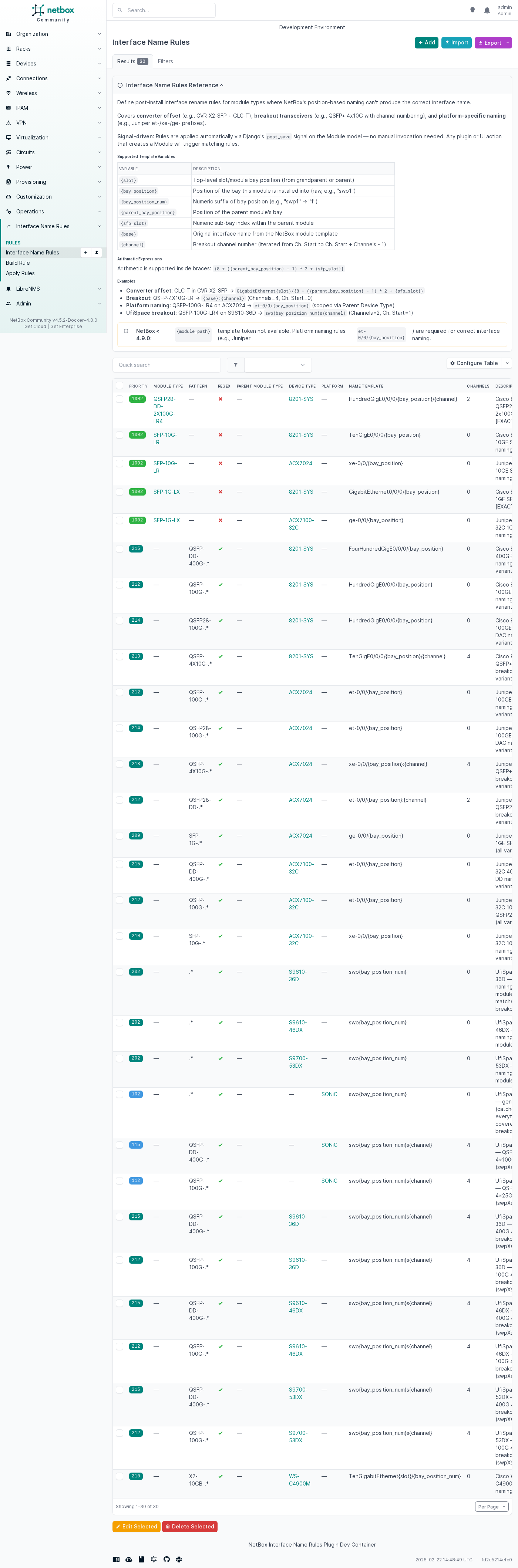
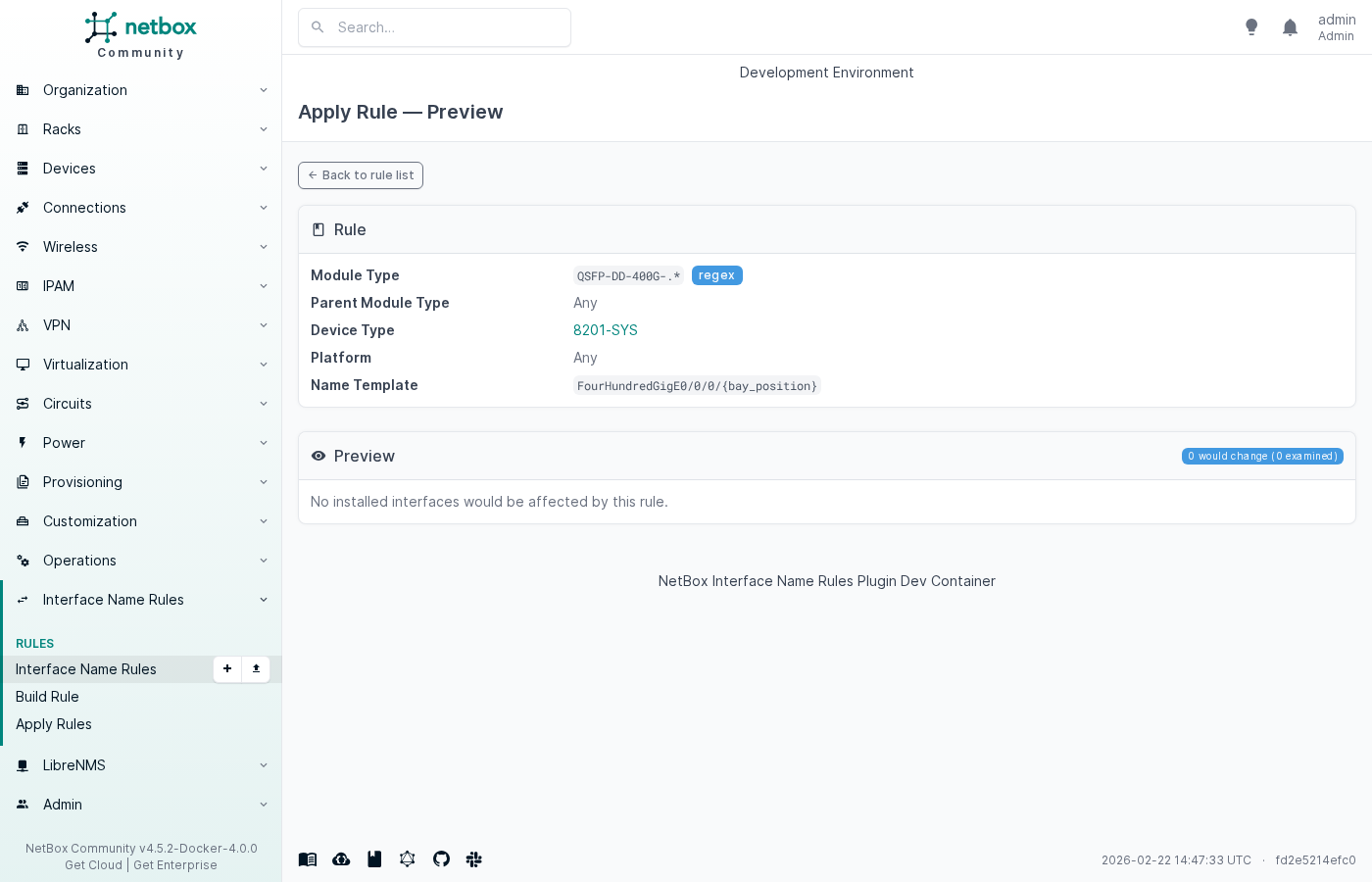
- Signal-driven — rules fire automatically on module install, no manual step needed
- Template variables —
{slot},{bay_position},{bay_position_num},{base},{channel}, etc. - Arithmetic expressions —
{8 + ({parent_bay_position} - 1) * 2 + {sfp_slot}} - Breakout support — create multiple channel interfaces from a single port (e.g., QSFP+ 4x10G)
- Scoping — rules can be scoped to specific device types, parent module types, or be universal
- Bulk import/export — YAML-based rule management via the UI or API
| Scenario | Example |
|---|---|
| Converter offset | GLC-T in CVR-X2-SFP → GigabitEthernet3/10 |
| Breakout channels | QSFP-4X10G-LR → et-0/0/4:0 through et-0/0/4:3 |
| Platform naming | QSFP-100G-LR4 on ACX7024 → et-0/0/{bay_position} |
| UfiSpace breakout | QSFP-100G on S9610 → swp{bay_position_num}s{channel} |
pip install netbox-interface-name-rulesAdd to configuration.py:
PLUGINS = ['netbox_interface_name_rules']Rules are managed through the NetBox UI under Plugins → Interface Name Rules, or via the REST API at /api/plugins/interface-name-rules/rules/.
See the full configuration guide for all rule fields, priority scoring, and template variable reference.

- NetBox ≥ 4.3.0 (CI tests 4.3, 4.5, 4.6)
- Python ≥ 3.12
Apache 2.0
- Full documentation — installation, configuration, examples
- DeepWiki — AI-generated codebase overview
See CONTRIBUTING.md for how to submit code or interface name rules.
Community-contributed rules for various vendors are in the contrib/ directory.
Inside the devcontainer:
netbox-test                 # run this plugin's tests (shared test_netbox DB)
netbox-test-isolated <app> [flags]   # run on a per-session ISOLATED test DB
netbox-test-isolated is concurrency-safe: Django otherwise names the test
database test_<DB_NAME> (test_netbox), so two manage.py test runs in the
same devcontainer collide on one DB and corrupt each other's migrations (a
crashed run can even leave an idle in transaction connection holding locks that
wedges every later run). The helper points the test DB at a unique name —
derived from the first app argument, or TEST_DB_NAME=... — via the
isolated_test_settings shim
(--settings=isolated_test_settings with .devcontainer/config on PYTHONPATH).
Plain netbox-test keeps using the shared default (test_netbox);
netbox-test-isolated instead derives a per-app DB name by default — test_<app>
from the first app argument (this plugin when none is given) — unless you set
TEST_DB_NAME explicitly. Example — test a sibling plugin without disturbing a
parallel run:
netbox-test-isolated netbox_nso_plugin --keepdb