

A complete little shmup: move with the d-pad, fire with B. Clear the staggered invader formation; don't let one reach your row. The same game the GBA and Genesis SDKs ship, rebuilt for the NES's tighter hardware.
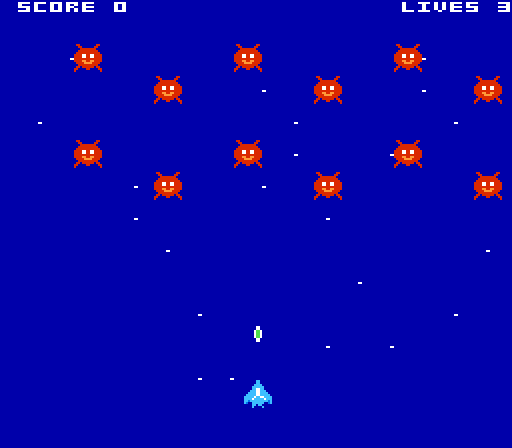
neslua run examples/starfall/main.lua --sheet examples/starfall/shmup_sheet.chr--sheet uploads a CHR sprite sheet to the pattern table at boot (a .chr
blob, or a .png that the build quantizes per tile). Regenerate the art with:
node examples/starfall/build_sheet.mjs # writes shmup_sheet.png + shmup_sheet.chrThe GBA and Genesis versions lean on a framebuffer-ish tile plane and fat 16x16 sprites. The NES is stricter, and the port is an honest lesson in its limits:
- 8x8 sprite tiles, composed as 2x2 blocks. Every actor (ship, invader,
shot's big form, burst) is
spr(n, x, y, 2, 2)- four hardware sprites. The sheet is 128px wide so the runtime'sn, n+1 / n+16, n+17tile stride lines up the top and bottom halves. - 64 sprites, 8 per scanline. Twelve invaders is 48 sprite tiles on its own. The formation is staggered: odd columns drop a full 16px, so no scanline ever holds both an even and an odd column - at most 3 invaders (6 tiles) cross any line, leaving headroom for shots so nothing vanishes.
- Shots are single tiles. A 2x2 bullet would be 24 tiles for six shots; a 1-tile green bolt keeps the budget clear.
- Four sprite sub-palettes via
nes.spal(0..3). Each 8x8 tile is 3 colors + transparent.nes.spalpicks the sub-palette asprcall uses, so the ship is cyan, invaders red, shots green and the burst yellow - all at once. - The starfield is BACKGROUND, not sprites. It is painted into the
nametable once (a couple of
"."glyphs per frame through the VRAM queue), which keeps all 64 sprites free for the actors. - The HUD is drawn once.
score/liveslabels are laid down on the first frame; only the digits repaint, and only when they change - the VRAM queue drains ~16 tiles/vblank and can't take a full repaint every frame.