I see several mentions in the forum of people asking if they can customise the fields available in the User Settings page:
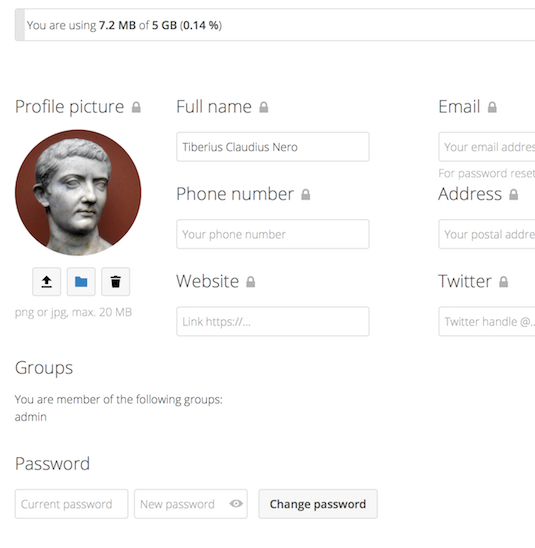
So far there doesn't seem to be a general solution, although the workaround would be to use the contacts app.
Related to #21986 - except:
- I'd like the fields to be visible in the user settings page - not just in the user table in the admin page (not sure if this was what that issue meant, but that's what it implied to me).
- I'd like to extend beyond e-mail addresses for arbitrary extra fields.
In case it's not clear, something like this crude mockup:

Motivation: I'd like to use the in-built information linked to someone's account, rather than maintain e.g. a separate spreadsheet/similar for keeping track of everyone in the organisation, performing regular tasks and scripting. I can use this information for setting up email accounts and generating a signature for example, when someone new is onboarded. I've probably included toy examples in the mockup above, but it did make me think what sort of broad range of user information might be important in different organisations. Academic institutions might need to maintain the school/department within a university, a student's programme or PhD funding provider; allergies, relevant health conditions, disabilities that might impact first aid or mobility could be important for anyone in a physical office; A vet's might want to keep track of people's personal pets in order to display a little biopic on their website; a company producing multimedia might want to keep track of youtube, spotify, accounts, or companies may want to manage their LinkedIn presence by having the user's individual account on the system. Github/etc. usernames would be very useful to have linked to an account. Maybe some of these perhaps a bit beyond scope, but, it's food for thought, and also, as nextcloud is about keeping all your data in one place, I like the idea of managing personal info within the system rather than tacking it on somewhere.
Implementation:
- Presumably the logical way would be to add extra fields in the users database table - or probably link to a separate table listing these (I'm not really a DB guy so I'm probably picturing a simplified setup of how it actually works)
- The types of data would therefore probably need to be worked out, mapped to sensible UI components, validated, and constrained
- And there might be quite a few of these - email addresses, phone numbers, dates for birthdays, I'd like to have a file selection dialogue so that users can pick an image from a folder on our instance
- Would combo-boxes need to be supported, for selecting items from a list?
- It's possible that some RAD UI design kind of applications might offer some inspiration here. I wouldn't mind editing a page in the admin settings that sort of mocked up the page, handled mapping into the backend, and then I drag-and-drop items onto a form or something. Flexible and potentially less manual labour, but probably more time-consuming to implement.
- I expect all this might have some corner cases or be more complicated than it sounds
- As a quick fix, personally, I wouldn't mind at all if this info were stored in JSON, or just strings, or something similar, and I could handle the rest myself. Don't expect this option to be that popular, but just mentioning it. Tagging some JSON with embedded PNGs or whatever onto a user or limiting the extra fields to a list of strings would be perfectly acceptable for what I need to do for it.
- Would this information also be shown in the adminstrators' view of users? It makes sense that it might be, but conversely, the table would get very large. Perhaps a flag could be added to each field to indicate if admins need to be able to see and edit it or not. Currently, the basic information like name, password, quota is visible in the administrators' view; things like Twitter handles are not shown
As a side note, I don't know if the information in the user settings currently maps into a contact for use in the contacts app, under a group for registered users. The installation I run is several versions behind the current stable release, so things may have changed since what we are on. I think adding fields in the user settings is a more common-sense and nicer way to manage UX/UI, but I understand that contacts integration could limit options (AFAIK it tries to retain compatibility with VCARDs etc., so adding extra fields that are only sensible in Nextcloud is a problem), or conversely that it could be the more straightforward way to implement something like this.
Thanks!
How to use GitHub
- Please use the 👍 reaction to show that you are interested into the same feature.
- Please don't comment if you have no relevant information to add. It's just extra noise for everyone subscribed to this issue.
- Subscribe to receive notifications on status change and new comments.
Is your feature request related to a problem? Please describe.
A clear and concise description of what the problem is. Ex. I'm always frustrated when [...]
Describe the solution you'd like
A clear and concise description of what you want to happen.
Describe alternatives you've considered
A clear and concise description of any alternative solutions or features you've considered.
Additional context
Add any other context or screenshots about the feature request here.

I see several mentions in the forum of people asking if they can customise the fields available in the User Settings page:

So far there doesn't seem to be a general solution, although the workaround would be to use the contacts app.
Related to #21986 - except:
In case it's not clear, something like this crude mockup:
Motivation: I'd like to use the in-built information linked to someone's account, rather than maintain e.g. a separate spreadsheet/similar for keeping track of everyone in the organisation, performing regular tasks and scripting. I can use this information for setting up email accounts and generating a signature for example, when someone new is onboarded. I've probably included toy examples in the mockup above, but it did make me think what sort of broad range of user information might be important in different organisations. Academic institutions might need to maintain the school/department within a university, a student's programme or PhD funding provider; allergies, relevant health conditions, disabilities that might impact first aid or mobility could be important for anyone in a physical office; A vet's might want to keep track of people's personal pets in order to display a little biopic on their website; a company producing multimedia might want to keep track of youtube, spotify, accounts, or companies may want to manage their LinkedIn presence by having the user's individual account on the system. Github/etc. usernames would be very useful to have linked to an account. Maybe some of these perhaps a bit beyond scope, but, it's food for thought, and also, as nextcloud is about keeping all your data in one place, I like the idea of managing personal info within the system rather than tacking it on somewhere.
Implementation:
As a side note, I don't know if the information in the user settings currently maps into a contact for use in the contacts app, under a group for registered users. The installation I run is several versions behind the current stable release, so things may have changed since what we are on. I think adding fields in the user settings is a more common-sense and nicer way to manage UX/UI, but I understand that contacts integration could limit options (AFAIK it tries to retain compatibility with VCARDs etc., so adding extra fields that are only sensible in Nextcloud is a problem), or conversely that it could be the more straightforward way to implement something like this.
Thanks!
How to use GitHub
Is your feature request related to a problem? Please describe.
A clear and concise description of what the problem is. Ex. I'm always frustrated when [...]
Describe the solution you'd like
A clear and concise description of what you want to happen.
Describe alternatives you've considered
A clear and concise description of any alternative solutions or features you've considered.
Additional context
Add any other context or screenshots about the feature request here.