In this project, a multi-agent for tennis player control is trained using Deep Deterministic Policy Gradient (DDPG). Through learning by self-playing, the agent obtained good performance in the evaluation test.
- Network Architecture
The architecture of the Actor and Critic networks are summarized using the project pytorch-summary as follows:
- Actor Network
---------------------------------------------------------------- Layer (type) Output Shape Param # ================================================================ Linear-1 [-1, 1, 64] 1,600 Linear-2 [-1, 1, 128] 8,320 Linear-3 [-1, 1, 2] 258 ================================================================ Total params: 10,178 Trainable params: 10,178 Non-trainable params: 0 ---------------------------------------------------------------- Input size (MB): 0.00 Forward/backward pass size (MB): 0.00 Params size (MB): 0.04 Estimated Total Size (MB): 0.04 ----------------------------------------------------------------- Critic Network
---------------------------------------------------------------- Layer (type) Output Shape Param # ================================================================ Linear-1 [-1, 64] 1,600 Linear-2 [-1, 128] 8,576 Linear-3 [-1, 64] 8,256 Linear-4 [-1, 1] 65 ================================================================ Total params: 18,497 Trainable params: 18,497 Non-trainable params: 0 ---------------------------------------------------------------- Input size (MB): 0.00 Forward/backward pass size (MB): 0.00 Params size (MB): 0.07 Estimated Total Size (MB): 0.07 ---------------------------------------------------------------- - Hyper-parameters
- learning rate for actor network: 1e-5
- learning rate for the critic network: 1e-4
- learning rate decay rate: 0.995
- replay buffer size: 1e6
- long term reward discount rate: 0.95
- soft update tau: 0.001
- Training Strategy
- Adam is used as the optimizer
- An
early-stopscheme is applied to stop training if the 100-episode-average score continues decreasing over20consecutive episodes. - Each time the model gets worse regarding avg scores, the model recovers from the last best model and the learning rate of Adam is decreased:
new learning rate = old learning rate * learning rate decay rate
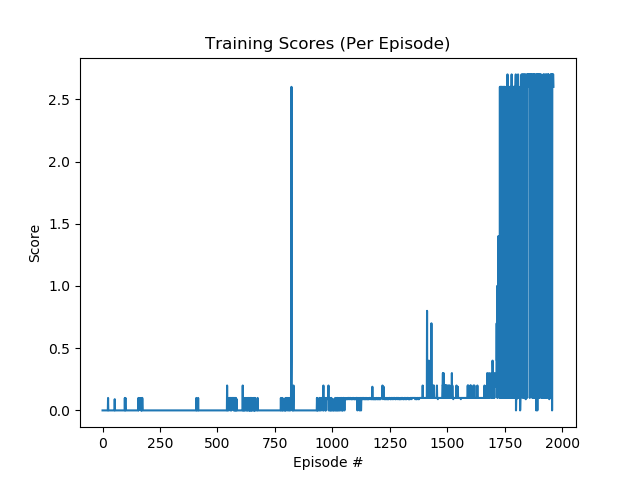
During training, the performance jumped to the best level and stabalized there after about 1700 episodes. Before that, the first time the performance surpassed 0.5 occurred at around episode 800. The episodic and average (over 100 latest episodes) scores are plotted as following:
- Reward per-episode during training
- Average reward over latest 100 episodes during training
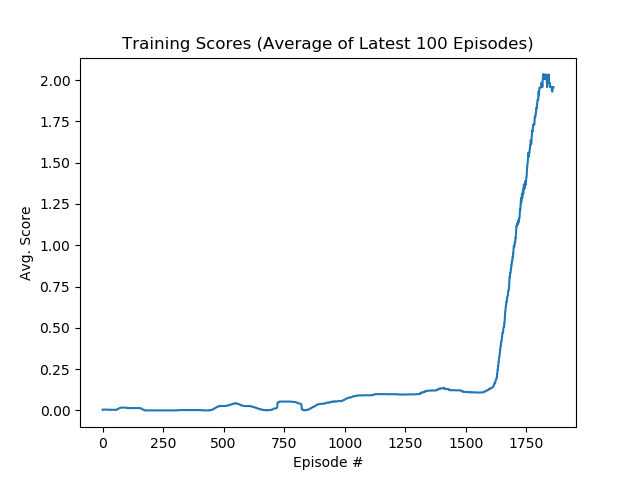
As can be seen from the plot, the average score gradually passed 0.5 and reached 2.0 during training, before the early-stopping scheme terminates the training process.
The scores of 100 testing episodes are visualized as follows:
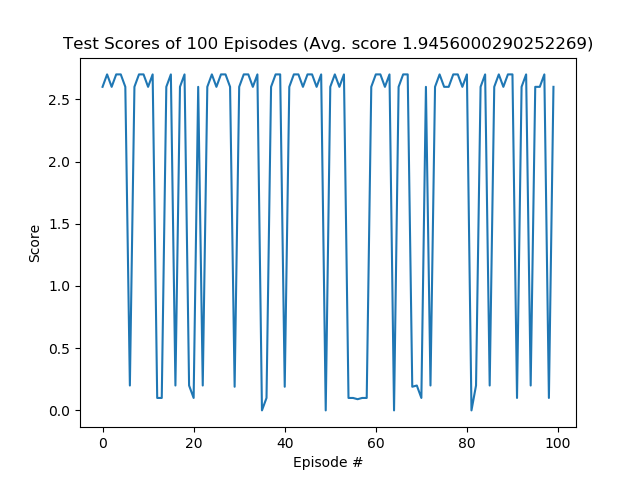
The model obtained an average score of +1.95 during testing, which is over +0.5.
The trained model has successfully solved the tennis play task. The performance:
- an average score of
+1.95over100consecutive episodes - the best model was trained using around
1700episodes
has fulfilled the passing threshold of solving the problem: obtain an average score of higher than +0.5 over 100 consecutive episodes.
- Use prioritized replay buffer, or Rainbow to improve the Critic network
- Use methods like GAE or PPO in the calculation of policy loss, to improve the training performance of the Actor network.
- See if A2C and other algorithms could perform better.