C99, portable, zero-allocation, MIT. From 8-bit MCUs to 64-bit hosts.





midi2 is a small piece of infrastructure for boards that already have too much to do. Sound chips, displays, USB stacks, sensors, network. MIDI 2.0 arrives at the transport layer as 32-bit words; midi2 turns those words into structured events and stays out of the way the rest of the time.
The library implements 100% of the UMP format (M2-104-UM v1.1.2) and 100% of MIDI-CI (M2-101-UM v1.2). The application owns memory and decides which modules to link. The transport (USB, BLE, network, serial) lives somewhere else, by design.
midi2 is the C99 core. Higher-level wrappers depend on it and add language-specific ergonomics for each platform target.
The first published wrapper is midi2cpp: a C++17 Arduino-friendly wrapper with m2device, m2host, m2bridge and m2ci classes, distributed through the Arduino Library Manager, the PlatformIO Registry and the ESP Component Registry. It ships 20 platform recipes under midi2cpp/examples/, one per role (device, host, bridge), covering RP2040, RP2350, ESP32-S3, ESP32-P4, ESP32-C6, nRF52840 and SAMD21 boards via Pico SDK / TinyUSB native CMake / ESP-IDF / PlatformIO build paths.
- midi2
| Spec | Document | Coverage |
|---|---|---|
| M2-104-UM v1.1.2 | UMP Format and MIDI 2.0 Protocol | 100% (all message types MT 0x0 through 0xF) |
| M2-101-UM v1.2 | MIDI-CI | 100% (all 31 messages, 4 categories, Appendix E responder) |
| M2-115-U v1.0.2 | Bit Scaling and Resolution | 100% (round-trip safe 7/14/16/32 bit) |
| M2-116-U v1.0 | MIDI Clip File | Partial (Delta Clockstamp, Start/End of Clip) |
#include "midi2.h"

uint32_t w[2];
midi2_msg_note_on(w, /*group*/ 0, /*channel*/ 0,
                  /*note*/ 60, /*velocity*/ 0xC000,
                  /*attr_type*/ 0, /*attr_data*/ 0);

uint8_t  note = midi2_msg_get_note(w);
uint16_t vel  = midi2_msg_get_velocity(w);

uint16_t vel16 = midi2_msg_scale_up_7to16(127);
With typed dispatch:
#include "midi2.h"

void on_note_on(uint8_t group, uint8_t channel, uint8_t note,
                uint16_t velocity, uint8_t attr_type,
                uint16_t attr_data, void *ctx) {
    /* application logic */
}

midi2_dispatch dp;
midi2_dispatch_init(&dp);
dp.on_note_on = on_note_on;
midi2_dispatch_feed(w, 2, &dp);The amalgam (dist/midi2.h + dist/midi2.c) is the recommended path. For finer control, modules can be picked individually:
| Module | Files | State | Purpose |
|---|---|---|---|
midi2_msg |
.h |
Stateless | UMP construction, parsing, value scaling. All MTs. MT 0x2 / MT 0x4 protocol translation. USB MIDI 1.0 cable event to UMP. |
midi2_dispatch |
.h .c |
Caller-allocated | Typed UMP dispatch (49 callbacks). Optional MT 0x2 to MT 0x4 upscale. |
midi2_proc |
.h .c |
Caller-allocated | Group filtering and remap, SysEx7/8 reassembly, UMP Stream and SysEx8 fragmenting senders. |
midi2_conv |
.h .c |
Caller-allocated | MIDI 1.0 byte stream to UMP (Running Status, streaming SysEx, MT 0x2 to MT 0x4 translation). |
midi2_ci_msg |
.h |
Stateless | MIDI-CI message construction and parsing. All 32 messages. |
midi2_ci_dispatch |
.h .c |
Caller-allocated | Typed CI dispatch (33 callbacks). |
midi2_ci |
.h .c |
Caller-allocated | Convenience CI responder: Discovery, Profiles, PE (Subscribe/Notify), Process Inquiry, MUID collision detection, optional NAK-on-unknown. Appendix E complete. |
midi2_msg alone is a header include with zero overhead.
Memory belongs to the application. midi2 does not call malloc, does not keep a hidden heap, and does not bake buffer sizes into headers. A 16 KB board declares small buffers. A desktop tool declares large ones. Same source, same API.
uint8_t sysex_buf[256];
midi2_proc_state proc;
midi2_proc_init(&proc, sysex_buf, sizeof(sysex_buf), NULL, 0);

uint8_t profiles[4][5];
midi2_ci_property props[2];
midi2_ci_state ci;
midi2_ci_init(&ci, seed, profiles, 4, props, 2);Functions that can fail return error codes. There is no global errno, no asserts that fire in release builds, no silent truncation.
int rc = midi2_ci_add_profile(&ci, profile_id);
if (rc == MIDI2_CI_ERR_FULL) {
    /* the application decides what to do */
}328 assertions across 8 suites compile clean with -Wall -Wextra -Wpedantic. CI runs 11 jobs on every push:
| Target | Type |
|---|---|
| gcc Linux x64 | Compile and run |
| clang Linux x64 | Compile and run |
| Apple clang macOS | Compile and run |
| MSVC Windows | Compile and run |
| gcc 32-bit Linux x86 | Compile and run |
| gcc + ASan + UBSan | Compile and run |
| ARM Cortex-M4 | Cross-compile |
| AArch64 Cortex-A | Cross-compile |
| RISC-V 64 | Cross-compile |
| ESP32 (ESP-IDF component) | Cross-compile |
| AVR ATmega328P | Cross-compile (header-only) |
make test
make CC=clang testmidi2 ships in four shapes. Pick the one that matches your build flow.
Install via Library Manager (search midi2, click Install) or manually drop the repo into ~/Arduino/libraries/midi2/. The library.properties declares the library; Arduino IDE compiles the modular src/*.c files automatically. Sketches use the umbrella header:
#include <midi2.h>Two example sketches under examples/ (BasicUsage, CIDiscovery) appear in the IDE's File > Examples menu after install. Validated on Arduino UNO (AVR) and Teensy 4.1.
platformio.ini:
lib_deps = sauloverissimo/midi2 @ ^0.4.0Library Manager pulls the same src/ modular layout via library.json (srcDir = src).
Published on the ESP Component Registry. Add to your project's main/idf_component.yml:
dependencies:
  idf: ">=5.0"
  sauloverissimo/midi2: ">=0.4.0"
idf.py reconfigure drops the component into managed_components/midi2/. The if(ESP_PLATFORM) gate in CMakeLists.txt routes ESP-IDF builds to idf_component_register with the modular src/midi2_*.c set, so the same source serves IDF, Arduino, PlatformIO, and native CMake without forks.
Drop dist/midi2.h only. In exactly one .c file:
#define MIDI2_IMPLEMENTATION
#include "midi2.h"Download dist/midi2.h and dist/midi2.c from the release page. Drop both into the tree. Compile midi2.c alongside the project.
#include "midi2.h"Works with Arduino, PlatformIO, ESP-IDF, CMake, Make, plain gcc.
For finer control, copy individual files from src/:
midi2_msg.h          Always needed. Header-only.
  +- midi2_dispatch  Typed UMP callbacks.
  +- midi2_proc      SysEx reassembly, group filtering.
  +- midi2_conv      MIDI 1.0 byte stream to UMP.
  +- midi2_ci_msg    MIDI-CI message construction and parsing.
       +- midi2_ci_dispatch  Typed CI callbacks.
       +- midi2_ci           Convenience CI responder.
midi2: infrastructure layer 2 of a 4-layer MIDI 2.0 stack:
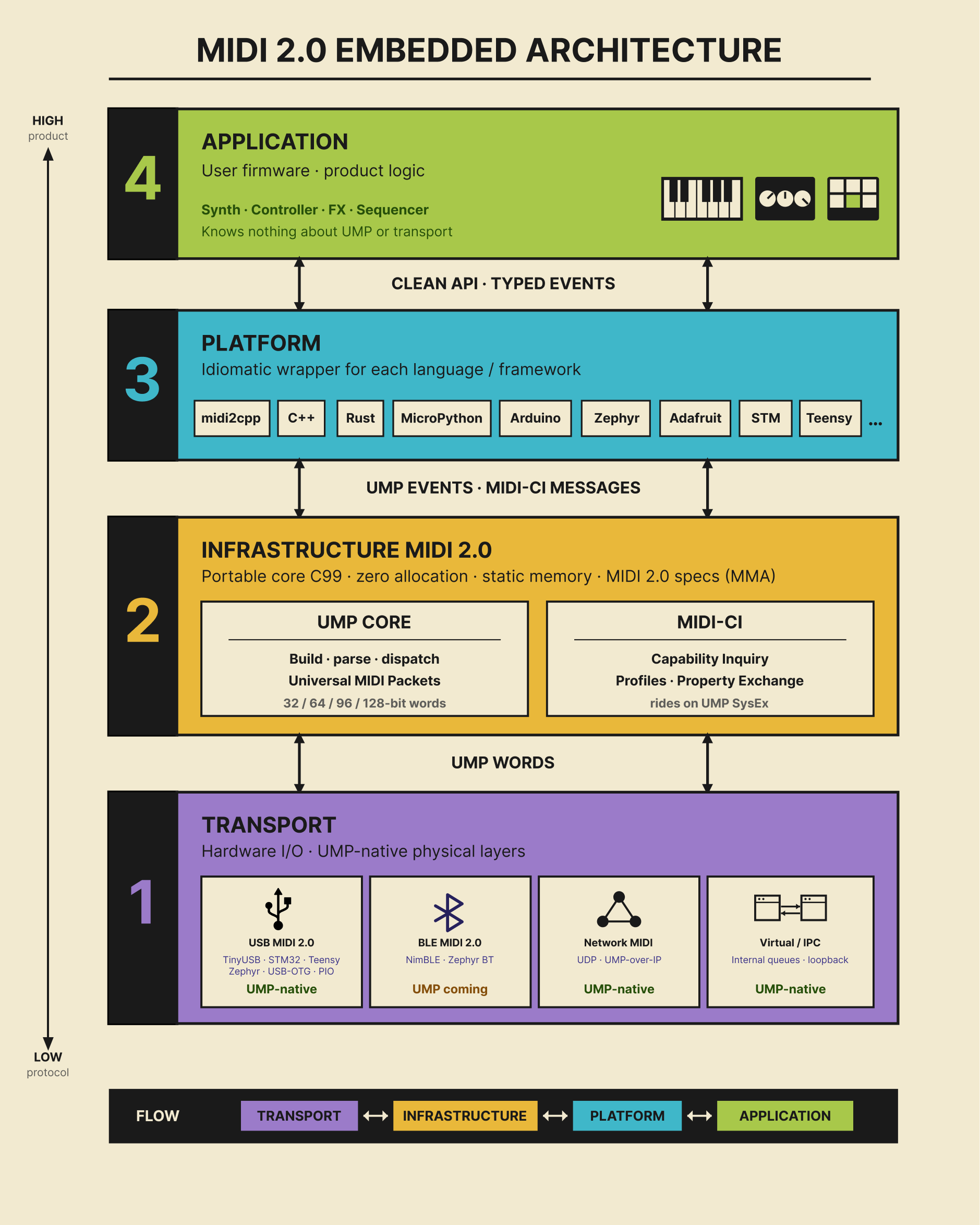
What each layer owns:
| Concern | Layer |
|---|---|
| USB descriptors, endpoints, DMA | Transport |
| UMP construction, parsing, scaling | midi2 |
| Typed dispatch (49 UMP + 33 CI callbacks) | midi2 |
| SysEx reassembly, group filtering | midi2 |
| CI construction and parsing | midi2 |
| MIDI 1.0 byte stream conversion | midi2 |
| CI convenience responder (optional) | midi2 |
Arduino-style callbacks (onNoteOn) |
Platform |
| Profile behavior (GM2, MPE) | Platform or App |
| PE JSON schema interpretation | Platform or App |
| FreeRTOS tasks, event queues | Platform |
| Musical application logic | App |
- Embedded first. The same source compiles for AVR ATmega328P, Cortex-M0, RISC-V 64, ESP32 Xtensa, and 64-bit desktops. The smallest target dictates the design.
- Zero allocation. No
malloc, no hidden heap, no per-call buffers. The application sizes everything at init. - Stateless where possible.
midi2_msgkeeps no state; the same word array round-trips through any number of helpers without coupling. - Three system headers.
<stdint.h>,<stdbool.h>,<string.h>. That is the dependency list. - Errors are codes, not exceptions. Functions report what happened; the application decides.
- Spec-complete on its own scope. 100% of UMP. 100% of MIDI-CI. Anything outside those documents lives elsewhere.
The boundary is drawn so the core stays portable. A few things deliberately do not belong here.
- Not a transport. USB-MIDI 2.0, BLE MIDI, Network MIDI 2.0, Serial DIN: each has its own driver. midi2 reads and writes UMP words; the wire is somebody else's responsibility.
- Not a JSON parser. Property Exchange headers are JSON, but parsing JSON in a zero-allocation embedded library is a poor fit. The application chooses a JSON parser at the platform layer.
- Not a Profile implementation. GM2, MPE, and the M2-118 through M2-125 profiles describe device behavior. midi2 carries the negotiation messages; the behavior lives in the application.
- Not the fastest UMP library. Speed was not a primary goal. Correctness, portability, and predictable memory were. On a Cortex-M4 at 168 MHz, midi2 dispatches faster than any USB transport can deliver words anyway.
You can sponsor midi2 at GitHub Sponsors. Sponsorship funds spec access, hardware for cross-platform validation, and continued maintenance.
midi2 is created and maintained by Saulo Veríssimo.
The MIDI 2.0 specifications referenced here are copyright of the MIDI Association and available at https://midi.org/midi-2-0.
"MIDI" is a registered trademark of the MIDI Manufacturers Association (now MIDI Association). "MIDI 2.0", "MIDI-CI", and "UMP" are terms defined by the MIDI Association in the public specifications.
MIT. Free for commercial and open-source use.