
2026-05-07 — v3 update: DFlash via llama.cpp PR #22105 added. First public RTX 3090 + DFlash + Q4 datapoint. Result: best DFlash config (
--draft-max=8) is 77.0 tok/s vs 138.9 baseline = NET LOSS −44.6 %. Slightly less bad than Oleg draft-spec (−52 %) but still net negative. The MoE-expert-routing × consumer-Ampere bandwidth hypothesis from v2.x generalises to DFlash too — co-trained spec heads (vLLM MTP, see sister repo) remain the only positive yield path on this hardware. Full results, raw logs, and reproducer inv3_dflash_2026_05_07/.
2026-04-26 — Exp 2 (code/JSON workload, N=3, standalone 3090) added. A reader-suggested hypothesis was that structured / low-entropy prompts (code, JSON config, SQL) might let llama.cpp's
--draft-min/--draft-maxngram speculation win where diverse natural-language prompts lost. Tested with 5 code/JSON prompts × 3 trials × 3 configs = 45 measurements. Result: still NET LOSS — baseline 139.22 ± 0.46 tok/s, Oleg--draft-min 2 --draft-max 3266.57 ± 7.57 tok/s (−52 %), srogmann--draft-min 48 --draft-max 6483.84 ± 1.80 tok/s (−40 %). The workload-shape hypothesis is refuted on llama.cpp + Q4 + RTX 3090; the regression is structural (MoE expert-saturation, see "Why" paragraph). Full data + reproducer inv2_3090_followup/exp2_codejson_n3/.The picture changes for vLLM, however. A clean A/B retest in the sibling repo
thc1006/qwen3.6-vllm-2x3090on the same physical hardware, run with matched flags AND--no-enable-prefix-caching, found vLLMmethod=mtp num_speculative_tokens=1is +27.5 % faster decode rate (decode TPOT 7.620 ± 0.022 ms → 5.976 ± 0.456 ms, holds across all 5 prompts and concurrencies C ∈ {1, 4, 8}). The previously reported vLLM −12 % was a flag confound + an MTP × prefix-cache interaction artifact (vllm #38182 reports MTP drops cache hit rate ~92 % → ~71 %). So: the negative finding in this repo is engine + spec-method specific (llama.cpp draft on consumer Ampere) — not hardware-class-independent as v2.2 stated. The "Cross-engine confirmation" paragraph below has been corrected accordingly.
UPDATE 2026-04-22 — v2 follow-up bench added In response to Oleg-dM's comment on the HF discussion, a second independent bench was run on a fresh single-3090 box, testing
--draft-min 2 --draft-max 32(Oleg's suggestion), the srogmann-style--draft-min 48 --draft-max 64, default--draft-min 5, and a control sweep. All artefacts live inv2_3090_followup/with methodology + full table inv2_3090_followup/SUMMARY.md.Cross-validated on current master (
bcb5eeb64, after PR #22227speculative-simple: add checkpoint support) — identical results to original commit within ±0.3 % noise, so the regression is not a stale-commit artefact. Raw logs inv2_3090_followup/v2_master_cross_check/.Short version of what v2 adds:
- Original "mean 120, bimodal tail 59" is the mixture of two regimes — prompts that keep spec-decode active all the way (collapse to 55–85 tok/s) and prompts that exhaust the draft cache and fall back to normal decode (~140 tok/s).
- v2 uses 5 predictable structured prompts that keep spec-decode active throughout, so the worst-case degradation (−39 % to −60 %) is more visible than the mixture average.
- Oleg's
--draft-min 2 --draft-max 32beats the--draft-min=5defaults (65 vs 55 tok/s) but is still −54 % vs baseline 139.9.- Counter-intuitive finding: aggressive
--draft-min 48 --draft-max 64is the least bad recipe (−39 %) because the large draft window amortises the verify / KV overhead.n_acc_tokens / n_gen_tokens100 % is real (confirmed via source reading ofcommon/speculative.cpp+ a--verboserun emittingdraft acceptance rate = 1.00000 (115 accepted / 115 generated)).Conclusion of the original post stands: no spec-decode configuration on a consumer 3090 is a net win for Qwen3.6-35B-A3B at Q4_K_M.

TL;DR. After llama.cpp PR #19493 (merged 2026-04-19) enabled classic draft speculative decoding for Qwen3.5/3.6 MoE models, I ran a 19-config matrix on a single RTX 3090 with Qwen3.6-35B-A3B-UD-Q4_K_XL via llama-server at commit 9789512.
Finding. No speculative-decode configuration achieves a net speedup over the non-speculative baseline on this hardware. Mean decode drops 3–12 % across ngram-cache, ngram-mod, and classic draft with the vocab-matched Qwen3.5-0.8B (vocab 248320) — and every configuration hits a bimodal tail reaching as low as 59–67 tok/s on reasoning / code prompts, despite 100 % draft acceptance.
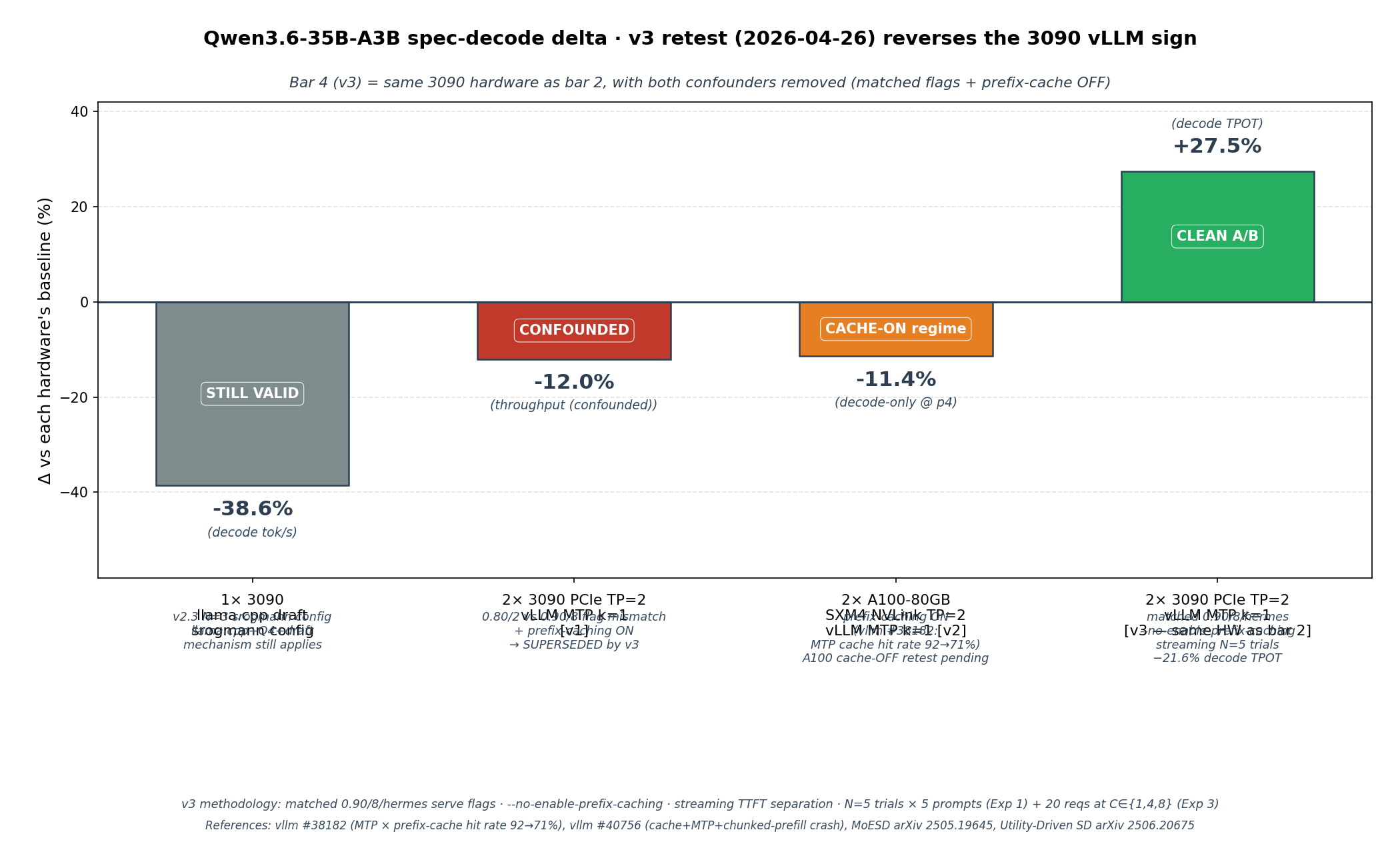
Cross-engine status (corrected 2026-04-26): the negative direction reported here is engine-specific to llama.cpp + Q4 + draft speculation, not engine-independent as v2.2 stated. A v3 clean A/B retest in the sibling repo on 2× RTX 3090 PCIe with vLLM 0.19.1 with matched flags 0.90 / 8 / hermes AND --no-enable-prefix-caching flips MTP k=1 to −21.6 % decode TPOT (≡ +27.5 % faster decode rate) with N=5 trials × 5 prompts. v1/v2 published vLLM −12 % was a flag confound (0.80/2 vs 0.90/8); the previously cited Modal A100 −11.4 % was prefix-cache-ON and is best read as the prefix-cache-ON-regime A100 datapoint, not as evidence MTP is intrinsically negative — vllm #38182 reports MTP drops cache hit rate ~92 % → ~71 %, so cache-ON masks MTP's compute speedup with cache-loss penalty. Full v3 methodology + per-prompt + concurrent C∈{1,4,8} data: thc1006/qwen3.6-vllm-2x3090 (results/mtp_v3_clean_ab_*.json).
This is consistent with the MoE-specific pathology in MoESD (arXiv 2505.19645) and Utility-Driven SD for MoE (arXiv 2506.20675): for a 3B-active MoE like A3B, draft batch K stays below the expert-saturation threshold (~94 tokens for this sparsity), so every extra draft token triggers new expert loading that outweighs the verification savings.

- GPU: 1 × RTX 3090 (
CUDA_VISIBLE_DEVICES=1), SM 8.6, 24 GB, driver 580.126.09, CUDA 12.6 - Host: Ubuntu 24.04, kernel 6.17, i7-11700, 62 GB RAM
- llama.cpp: commit
9789512(post #19493 merge, pre #20075 second-round fix) - Model:
unsloth/Qwen3.6-35B-A3B-GGUF·Qwen3.6-35B-A3B-UD-Q4_K_XL— 21 GB - Draft model (for classic SD):
unsloth/Qwen3.5-0.8B-GGUF·Qwen3.5-0.8B-Q4_K_M— 508 MB, vocab 248320 (matches target) - Server flags (fixed across matrix):
-ngl 999 -c 16384 --jinja -fa on -ctk q8_0 -ctv q8_0 - Sampling: greedy (
temperature=0), 300max_tokensunless noted; 1 warmup turn; 10 prompts (English chat / reasoning / code / multi-turn / 繁中) - Full environment snapshot in
BENCHMARK_ENV.md
| config | mean tok/s | min | max | std | draft accept | notes |
|---|---|---|---|---|---|---|
| baseline | 135.7 | 135.3 | 136.2 | 0.3 | — | reference |
| baseline-rerun | 135.5 | 135.1 | 136.0 | 0.3 | — | reproduction |
| draft-qwen3-0.6b | 135.3 | 135.0 | 135.5 | 0.2 | — (draft failed) | vocab 151936 ≠ 248320, draft never attached — treat as baseline, shown for posterity |
| ngmod-n32 | 133.7 | 133.5 | 133.9 | 0.1 | 0 % | N too large to hit — effectively baseline |
| baseline-1000tok | 133.2 | 132.7 | 134.0 | 0.4 | — | —2 % from long output alone |
| ngram-mod-n24 | 131.1 | 129.6 | 136.1 | 2.6 | 100 % (35/35) | srogmann-recommended params |
| ngmod-n24-1000tok | 131.1 | 124.1 | 138.3 | 3.9 | 100 % | long output same |
| ngmod-n{8,12,16,20} | 129.6–130.0 | 119.8–128.8 | 134 | 2–5 | 100 % | whole ngram-mod family ≈ -4 % |
| ngcache-kv-fp16 | 121.3 | 67.3 | 137.9 | 27.6 | 100 % (88/88) | fp16 KV does not rescue — KV quant is not the cause |
| draft-q35-08b-max8 | 121.1 | 59.2 | 136.2 | 30.9 | 100 % (270/270) | correct-vocab classic SD, still net-negative |
| draft-q35-08b-max16 | 121.0 | 59.6 | 136.1 | 30.3 | 100 % | increasing K does not help |
| draft-q35-08b-max32 | 120.3 | 59.5 | 134.8 | 29.7 | 100 % | |
| draft-q35-08b-1000tok | 120.2 | 64.8 | 133.9 | 28.3 | 100 % | long output same |
| ngram-cache | 119.1 | 65.3 | 136.2 | 27.8 | 100 % (96/96) | |
| ngcache-rerun | 118.8 | 65.6 | 135.7 | 27.5 | 100 % | reproduction |
| ngcache-1000tok | 115.9 | 60.0 | 133.6 | 28.7 | 100 % (317/317) | worst mean |

The regression is entirely bimodal by prompt class: chat prompts (short_greet, multi_turn_*, zh_cn) where ngram cannot find hits stay at ~135 tok/s; structured prompts (reasoning, code_small, long_explain) where drafts do trigger collapse to 59–95 tok/s.

With predicted_per_second as the per-request decode rate reported by llama-server and every tested config returning 100 % acceptance, the classical intuition "high acceptance → high speedup" fails here. This is not a measurement artifact; it is MoE expert-loading overhead on every drafted token.
Qwen3.6-35B-A3B routes 8-of-256 experts per token (sparsity ρ ≈ 0.031). Per MoESD the batch size needed to saturate the expert set is T_thres = log_{1-ρ}(1 - 0.95) ≈ 94. For any K draft tokens below that, each drafted token has high probability of pulling a fresh expert slice into compute, and the verification forward pass ends up loading the union of those per-token expert sets. At single-stream batch=1, K (1–32) ≪ T_thres, so this expert-union overhead is paid in full with no amortization vs autoregressive — exceeding the savings from skipping per-token forward passes, even at 100 % acceptance.
Scope correction (2026-04-26): earlier versions of this paragraph claimed the mechanism is "engine-independent" / "hardware-class-independent" because the same negative direction was seen across 3090 (llama.cpp draft) and A100 NVLink (vLLM MTP, prefix-cache-ON) and Hopper H20-3e (vllm #38182). The v3 vLLM clean A/B retest with prefix-cache OFF on the same 3090 hardware (sibling repo) flipped vLLM MTP k=1 to +27.5 %, so the engine-independence claim was wrong. The expert-saturation argument does still explain why llama.cpp's draft-then-verify path loses on consumer Ampere (the verify pass loads the union of K positions' expert sets at draft K=1–32 ≪ T_thres). What's different about vLLM MTP k=1 is the structurally smaller K (k=1 vs llama.cpp drafts of 5–64) and the lighter-weight verify path that reuses the target's hidden states without a separate draft-model forward pass. So: the mechanism is real and real-world relevant for draft-model spec-decode, but does not generalize to all spec-decode methods. Mixtral measurements in arXiv 2506.20675 match the draft-spec direction.
Counter-example: the same ngram-mod machinery in PR #20075 shows Qwen3.5-122B-A10B (10 B active) gaining roughly +15–45 % on Apple M3 Max (PR author's bench, 0.8 B draft, acceptance 63–89 %), and +31 % to +119 % on AMD Strix Halo gfx1151 with the REAP-pruned variant (@0xSero's comment in the same PR). A10B has a 3.3× larger active footprint and a correspondingly lower T_thres, which is why it gains where A3B loses on consumer GPUs.
For Qwen3.6-35B-A3B on a single RTX 3090 as of 2026-04-21:
- Do not enable
--spec-type ngram-cache,--spec-type ngram-mod, or classic--model-draft— every variant is net-negative. - Do use the baseline llama-server setup above;
135.7 tok/sis the fastest current single-request decode. - If you previously ran Qwen3.6 via Ollama 0.20.x with
Q4_K_Mand saw ~107 tok/s, switching to llama-server with theUD-Q4_K_XLquant is itself a +27 % speedup before any speculation.
Situations where this may not apply: (i) A10B-class and larger MoE variants, where active params cross the expert-saturation threshold; (ii) after the hybrid-SSM/MoE checkpoint situation settles — PR #20075 was open at v1 publication, with a comment on 2026-04-25 suggesting it can be closed because its functionality has been superseded elsewhere; future llama.cpp versions may behave differently; (iii) with a future smaller-bpw draft model distilled specifically for A3B that can sustain very large K; (iv) batched multi-user serving — speculative decoding's verification cost can amortise across concurrent requests, but I have not benched this path for llama.cpp + A3B; this study covers single-stream voice-dialog only. (v) a different inference engine entirely — the v3 vLLM clean A/B retest in the sibling repo (matched flags + --no-enable-prefix-caching) flips MTP k=1 to +27.5 % faster decode rate on the same 3090 hardware, so the negative finding here is engine + spec-method specific to llama.cpp draft-then-verify, not a general property. (vi) other speculative methods — this bench tests ngram-cache, ngram-mod, and classic --model-draft in llama.cpp. EAGLE-3 with CUDA graphs (vLLM Model Runner V2) is not evaluated here and may have different characteristics on A3B.
# 1. Build llama.cpp with CUDA for SM 8.6
git clone --depth 1 https://github.com/ggml-org/llama.cpp ~/benchmarks/llama.cpp
cd ~/benchmarks/llama.cpp
CUDACXX=/usr/local/cuda-12.6/bin/nvcc cmake -B build \
    -DGGML_CUDA=ON -DCMAKE_CUDA_ARCHITECTURES=86 \
    -DLLAMA_CURL=OFF -DBUILD_SHARED_LIBS=OFF
cmake --build build --config Release -j --target llama-server llama-bench

# 2. Pull target + draft GGUFs
hf download unsloth/Qwen3.6-35B-A3B-GGUF Qwen3.6-35B-A3B-UD-Q4_K_XL.gguf \
    --local-dir ~/benchmarks/models/qwen3.6-ud-q4kxl
hf download unsloth/Qwen3.5-0.8B-GGUF --include '*Q4_K_M*' \
    --local-dir ~/benchmarks/models/qwen3.5-0.8b

# 3. Run the matrix (expect ~30 minutes wall-clock on one 3090)
bash run_matrix.sh           # 4 configs: baseline + ngcache + ngmod-n24 + draft-qwen3-0.6b
bash run_p0_matrix.sh        # 13 configs: correct-vocab draft sweep + 1000tok + N sweep + kv-fp16

# 4. Plot + summary
python analysis/plot.py
Raw per-request timings for every run are in results/*.json and results/verify/*.json. Aggregated numbers are in analysis/summary.csv and analysis/summary_by_config.csv.
predicted_per_secondas reported by llama-server ispredicted_n / predicted_ms * 1000. Draft time and verification time are both included in the denominator. This is the user-visible metric.- Warmup of one completion before measurement; server is restarted between configs so KV cache / prefix-cache state never bleeds across configs.
- Prompt set (10 prompts) spans short chat, reasoning, code, multi-turn, and 繁體中文 — deliberately chosen so that ngram-family draft triggers on some prompts and not others, exposing the bimodal behaviour.
- Output capped at 300 tokens (and 1000 tokens in the
-1000tokvariants); all completions reach the cap, sopredicted_nis constant across runs within a config. - Single-GPU single-request (
batch=1) is the use case for an interactive desktop robot; results do not extrapolate to multi-tenant serving where concurrent-batching hides the MoE overhead.
- Single node, single 3090. NVLink or tensor-parallel across two 3090s is not evaluated; previous community benchmarks (himeshp, ure.us) find TP gives < 4 % speedup on A3B due to all-to-all scatter/gather.
- Each config run once (10 prompts, 1 warmup); no formal n=3 replicates. Std columns in the table are over prompts, not over repeats. Observed run-to-run variance between
baselineandbaseline-rerunis 0.2 tok/s, which is well below any effect discussed. - llama.cpp is evolving fast — commit
9789512on 2026-04-21 is what was tested. PR #20075 is open and may change these numbers. - Output was greedy. With
temperature > 0, draft acceptance rates would drop and the regression may be slightly different in shape but not in direction (the bottleneck is expert loading, not draft quality).
Independent observations and academic work that have appeared since the v1 / v2 benches went public, and that broadly support the saturation-threshold framing above. Each row notes scope honestly — none of these are exact replicas of this bench.
| When | Source | Independent evidence |
|---|---|---|
| 2026-02-17 | MoE-Spec (arXiv 2602.16052) | Theoretical naming for the phenomenon: "expert budgeting" — large draft trees activate many unique experts, "the top 32 of 64 experts capture 93 % of aggregate routing probability"; proposes a training-free verification-time budget cap. No public code yet. |
| 2026-02 | Alloc-MoE (arXiv 2604.08133) and XShare (arXiv 2602.07265) | Concurrent papers framing the same expert-saturation pressure under speculative parallelism. |
| 2026-02-26 | vllm-project/vllm#35387 | Adjacent: 4× H100 80 GB FP8 + Qwen3-Next-80B-A3B-Instruct-FP8 with method=qwen3_next_mtp reports −76.5 % latency regression (not the same hardware/quant/arch as this bench, and the suspected root cause is mamba_postprocess CPU sync — different mechanism — but the same negative direction). |
| 2026-03-26 → 2026-04-14 | vllm-project/vllm#38182 | Independent reporter on NVIDIA H20-3e (Hopper) finds Qwen3.5-35B-A3B + MTP drops prefix-cache hit rate from ≈92 % → ≈71 %. @Angazenn pinpoints the cause to vllm/v1/core/single_type_kv_cache_manager.py:L457 (last matched block force-dropped when MTP is on, combined with very large block sizes for Qwen3.5 MoE). @inaniloquentee volunteered a fix; no PR submitted as of 2026-04-25. |
| 2026 | vLLM Qwen3.5/3.6 Recipes — official doc | Now states up-front: "MTP-1 reduces per-token latency but degrades text throughput under high concurrency because speculative tokens consume KV cache capacity, reducing effective batch size." The single-stream / consumer-GPU regime of this bench is consistent with that disclosure. |
| 2026-04-22 | HF discussion #14 on unsloth/Qwen3.6-35B-A3B-GGUF |
Oleg-dM's question on --draft-min aggressiveness motivated the v2 follow-up bench. Same conclusion held across both 9789512 and current master bcb5eeb64 commits. |
Net interpretation (revised 2026-04-26). The Qwen3.x-35B-A3B + spec-decode regression I observed on a single RTX 3090 is robust for llama.cpp's draft-then-verify path — confirmed on different commits (9789512 and master bcb5eeb64), on N=3 standalone-3090 replication, and on a code/JSON workload variant (Exp 2 in v2.3, all configs −40 % to −52 %). The MoE-Spec / Utility-Driven SD theoretical framing applies here because llama.cpp's K=5–64 draft tokens cause the verify pass to load the union of K positions' expert sets at K ≪ T_thres ≈ 94. The narrative should be read as "single-stream llama.cpp draft-spec for 3B-active MoE on consumer Ampere is a net loss across the configs tested", NOT as engine-independent — the v3 vLLM clean A/B retest in the sibling repo (matched flags + --no-enable-prefix-caching) flips MTP k=1 to +27.5 % faster decode rate on the same 3090 hardware, because vLLM MTP k=1 has structurally smaller K (k=1 vs llama.cpp 5–64) and a lighter-weight verify path that reuses target hidden states. Earlier corroborations on Hopper H100/H20-3e + FP8 + vLLM MTP that I cited may also be partly attributable to the vllm #38182 prefix-cache × MTP interaction (cache hit rate drops 92 % → 71 % under MTP) rather than an intrinsic MoE × MTP property; an A100/H100 v3-equivalent retest with prefix-cache OFF is the natural follow-up.
- thc1006/qwen3.6-vllm-2x3090 — sibling repo. Same model, 2× RTX 3090, vLLM 0.19.1 with
--speculative-config method=mtp num_speculative_tokens=1(qwen3.6's built-in MTP heads). v1/v2 published −12 % throughput was a flag confound + prefix-cache interaction; v3 clean A/B retest (2026-04-26) with matched flags +--no-enable-prefix-cachingflips MTP to +27.5 % faster decode rate — see v3.0 release. So the negative finding here is engine-specific to llama.cpp draft-spec on consumer Ampere, not engine-independent as v2.2 of this repo claimed. - llama.cpp PR #19493 — speculative checkpointing (MERGED 2026-04-19)
- llama.cpp PR #20075 — follow-up fix (OPEN)
- llama.cpp Issue #20039 — original feature request
- llama.cpp docs/speculative.md
- MoESD: Unveil Speculative Decoding's Potential for Sparse MoE (arXiv 2505.19645)
- Utility-Driven Speculative Decoding for Mixture-of-Experts (arXiv 2506.20675)
- MoE-SpeQ (arXiv 2511.14102)
- vLLM Issue #38182 — Qwen3.5-35B-A3B MTP + prefix cache regression
- Qwen3.6-35B-A3B model card (vocab 248320)
- Qwen3.5-0.8B model card (vocab 248320)
Hsiu-Chi Tsai · hctsai1006@cs.nctu.edu.tw · GitHub thc1006
MIT — see LICENSE. Results (CSV / JSON) released under CC-0.